Reimagining public investment in health

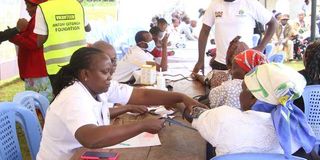
Medics from Mwai Kibaki Hospital examine patients during a free medical camp at Othaya Stadium in Nyeri County last year.

Photo credit: File

The countries that will lead the 21st century will not simply be those whose people live longer. They will be those whose people stay healthier for longer — able to learn, work, innovate, care for their families and participate fully in society. That is why the next frontier of development is not lifespan alone, but healthspan: the number of years people live in good health.

This is no longer a niche public health idea. It is fast becoming a global economic imperative. The World Health Organisation has shown that scaling up primary healthcare interventions in low- and middle-income countries could save 60 million lives and increase average life expectancy by 3.7 years by 2030, while most projected health gains under the Sustainable Development Goals could be achieved through primary healthcare.
The World Bank Group has made the same point in economic terms: investing in a healthy workforce, infrastructure and technology, is central to growth, jobs, and resilience.

For too long, governments have treated health as a social service to be funded after the so-called “productive” sectors have been prioritised. That distinction no longer makes sense.

Health is not separate from growth; it underpins it. A child who is well nourished and vaccinated is more likely to stay in school and become a productive adult. A worker whose diabetes is detected early is more likely to remain economically active...Simply put, no country can build a competitive economy on an unhealthy population.

The Covid-19 pandemic made this reality unmistakable. When health systems failed, economies stalled. Productivity fell, public finances came under strain, and years of development gains were reversed. The lesson: economic growth can't be sustained without healthy populations.

That is why the healthspan agenda cannot sit with ministries of health alone. It belongs just as much to Treasury, Education, and Infrastructure. If governments are serious about inclusive growth, they must stop budgeting and governing in silos while citizens live integrated lives. Healthspan is built across the life course and across sectors: in clinics, yes, but also in classrooms, transport systems, housing, sanitation, food systems, and digital networks.

Treasuries, in particular, should stop viewing health spending as consumption. Well-targeted health investment builds human capital. According to the World Bank Group, every dollar invested in nutrition can yield returns of up to $23 through better health and higher productivity, while in low-income countries, each health sector job can generate roughly 3.4 additional jobs in related industries. In this light, prevention and primary healthcare are not soft options; they are fiscally sound investments. Value for money matters: every dollar invested in health should improve outcomes, strengthen systems, and reinforce the resilience of the wider economy.

Education ministries should see the same logic. Healthspan starts long before old age. It begins in childhood, when nutrition, vaccination, mental health support, eyesight, menstrual health, and access to clean water determine whether children can attend school consistently and learn effectively.

A country that ignores the health of its learners is quietly weakening its future workforce. Human capital is built not only through teaching, but through keeping students healthy enough to benefit from it.

Infrastructure ministries, too, are central to the healthspan conversation. Safe roads reduce trauma. Reliable transport improves access to care. Clean water and sanitation prevent disease before it reaches hospitals. Better housing reduces exposure to respiratory illness and heat stress. Digital infrastructure enables health records, telemedicine, supply-chain visibility, and faster emergency response. Much of what determines whether people live healthy lives is decided long before they enter a hospital ward.

For ministries of health, the implication is clear: the future cannot remain overwhelmingly hospital-centric and curative. This shift is especially urgent for Africa. The continent’s demographic dynamism is rightly seen as an economic opportunity, but it will only become a dividend if governments invest in keeping people healthy and productive throughout their lives.

A youthful population without strong nutrition, primary care, safe urbanisation, and quality education is not an automatic advantage. It is a missed opportunity in waiting.
The real measure of a successful state is not only how many years it adds to life, but how many healthy years it adds to human potential.

In the coming decades, the smartest governments will be those that treat health not as a cost centre at the margins of public policy, but as core economic infrastructure. The shift from lifespan to healthspan is therefore not simply a medical debate. It is one of the most important development, fiscal, and competitiveness questions of our time. As Ralph Waldo Emerson observed, “The first wealth is health.”

Thee promise vs challenge

Kenya’s current health reforms illustrate both the promise and the difficulty of this transition. Efforts to expand financial protection, strengthen primary healthcare, and build more integrated systems matter not only for better health outcomes, but for household stability and long-term economic resilience.

Yet the challenge — and opportunity — extends far beyond any single reform programme or country. Around the world, governments are confronting the same reality: treating disease late is more expensive than preventing it early, and fragmented systems cost more than coordinated ones.

What global health leadership now requires is not less compassion, but more strategic clarity. Leaders must understand medicine, certainly, but also public finance, human capital, infrastructure, technology, and return on investment. The old language of “health spending” is too narrow for the challenges ahead. The better language is productivity, fiscal resilience, and shared prosperity.

As governments prepare medium-term expenditure frameworks and annual budgets, there are concrete opportunities to act. Finance ministries can treat health as a core economic investment across sector budgets, while Cabinet-level coordination can help break silos and align incentives around prevention, productivity, and long-term resilience. Just as importantly, leaders should begin to track and report healthspan, not just lifespan, as a measure of national progress and development performance.

Dr Oluga is Principal Secretary, Medical Services

PAYE Tax Calculator

Note: The results are not exact but very close to the actual.