Kenya now Africa’s second-largest major arms importer

Photo credit: Compiled by John Waweru | Designed by Stanslaus Manthi

Kenya became Africa's second-largest importer of major arms in 2025, reflecting the country's growing investment in national security amid rising regional instability and modernisation of its defence forces.

Kenya imported 117 million Trend-Indicator Value (TIV) worth of major conventional arms in 2025, a more than six-fold increase from 19 million TIV recorded in 2024, according to data from Sweden-based Stockholm International Peace Research Institute (Sipri), an independent global security think tank.
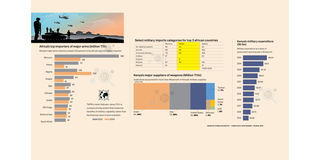
A TIV is a unique unit developed by SIPRI to measure the volume of international transfers of major conventional weapons. Instead of using financial costs, it assigns a common numerical value to weapons based on their size, capability, and technical advancement.

The sharp rise placed Kenya behind only Morocco, which led the continent with 392 million TIV, while overtaking traditional military spenders such as Algeria, Angola and Ethiopia.

Sipri uses a unique pricing system, the trend-indicator value (TIV), to measure the volume of deliveries of major conventional weapons. The Sipri TIV measures transfers of military capability rather than the financial value of arms transfers.

Globally, Kenya is now among the top 50 arms importers, accounting for 0.3 percent of worldwide arms imports, underlining its expanding role in defence procurement.

The surge in imports coincided with a record Sh190 billion military budget in 2025, as the government stepped up investments in equipment, surveillance systems and military hardware to address emerging security threats.

Kenya's defence spending represented 1.07 percent of GDP, remaining below the global average but reflecting a gradual upward trend in military investment over recent years.

The data further shows that between 2020 and 2025 Israel, Italy and the United States supplied about 90 percent of Kenya's military imports, highlighting Nairobi's continued reliance on its traditional strategic partners for defence equipment and technology. In 2025, transfers from Israel included Air-defence systems and missiles worth 45 million TIV and 49 million TIV, respectively.

Security challenges

The increase comes against a backdrop of persistent security challenges, including the fight against terrorism along Kenya's Northeastern border, protection of critical infrastructure, maritime security in the Indian Ocean and participation in regional peacekeeping operations.

Across Africa, Morocco remained the continent's largest arms importer with 392 million TIV, followed by Kenya (117 million), Algeria (108 million), Angola (84 million) and Mali (64 million).

The figures illustrate a broader shift in defence priorities across the continent as governments respond to geopolitical tensions, cross-border conflicts and internal security threats through increased military acquisitions.

For Kenya, however, the rising defence bill presents a delicate fiscal balancing act. While enhanced military capability is considered critical for national security and safeguarding economic assets, the higher expenditure comes at a time when the government is also under pressure to increase funding for healthcare, education and social protection.

PAYE Tax Calculator

Note: The results are not exact but very close to the actual.