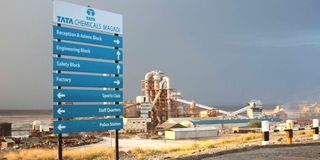
President William Ruto ordered Tata Chemicals, soda ash producer, to cease operations after 114 years of operation. This came a month after the Mining CS suspended its licence.
A new investor will take over, on condition they build the local processing plants Tata supposedly never did. Tata had applied to expand its concession by 127 square kilometres barely a year earlier, which is not the posture of a company that saw this coming.
It's tempting to read this as a Tata problem: a stubborn compliance dispute, a company caught between a county land-rates fight and a government that lost patience. That reading is comfortable but wrong.
Against the backdrop of Kenya's Local Content Bill, currently making its way through Parliament and proposes 80 percent local staffing and fines of up to Sh100 million, as well as mining rules that already require 35 percent local equity, Magadi serves as a striking example of the direction in which policy was already heading.
Kenya is right to want more of the value chain onshore, and wrong to be announcing that ambition via a shutdown order instead of a published, prospective standard that investors could have priced in advance.
Local value addition is a defensible industrial policy goal. Indonesia banned the export of raw nickel ore in stages from 2014, prompting investors to build smelters and make money from the process.
This was possible because the rule was written down before it was enforced. Nigeria's Local Content Act did the same for oil and gas, providing a clear legislative framework and dispute resolution body. Nobody loved it, but everybody could plan for it. But Kenya's version looks more like Zambia's intermittent nationalisation of its copper mines in the 2000s.
To be clear, this is not expropriation in the legal sense. Kenya remains a signatory to MIGA and ICSID, and the Foreign Investment Protection Act still guarantees against seizure of private property. Tata Chemicals hasn't had its asset seized; it's been told to leave, and a successor will be found. But perception doesn't read the fine print of investment treaties.
To a boardroom in Mumbai, London or Beijing, "the government shut down a century-old licence with a month's notice" may become the dominant signal in assessing Kenya’s resource-sector risk.
That's the number that should worry the market. Not Magadi's roughly $100 million in annual forex, but the multiple Kenya just repriced on every future resource investment in the country.
Unfortunately, when regulatory discretion this significant is exercised close to a political moment, investors don't need to know the motive to price the pattern, only that the discretion exists and can be exercised again.
Sovereign risk models are lagging indicators, and this is the leading one. It will show up first in the terms the next investor negotiating with Kenya is offered, whether or not that investor had ever heard of Lake Magadi before.
My argument is for local content as law, written down, phased in, enforced on notice rather than by decree. This would give investors clarity on what Kenya expects, by when and under what rules. It would make the government’s industrial-policy ambition easier to understand, plan for and ultimately support.
Then, businesses would be responding to a clearly communicated direction rather than trying to interpret it after the fact.
Until then, foreign concession-holders in Kenya risk operating under a licence that reads one way on paper and another way in the next political address.
Joyce is a Digital Storytelling Consultant at P&L Consulting Group