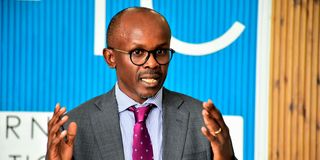
Dr James Mworia takes charge of a fund that cannot borrow, must earn its way, and has ten years to prove that Kenya can finance its future without mortgaging it.
The Board of the National Infrastructure Fund has announced the appointment of Dr James Mworia, MBS, as founding Chief Executive Officer, effective September 7, 2026, following a competitive recruitment process. On the face of it, this is a personnel announcement.
In substance, it is the first real test of whether the country's most consequential piece of economic legislation in years becomes a functioning institution or remains a statute.
The case for NIF was made in the Treasury's own numbers.
According to the Controller of Budget, public debt stood at Sh12.82 trillion at the end of March 2026, a nine per cent rise in nine months. Over the same period, the government spent Sh1.35 trillion servicing debt, roughly 42 per cent of total receipts. The debt-to-GDP ratio reached 69.5 per cent by February 2026, well above the 55 per cent anchor Parliament drafted into law for 2028.
Appearing before the National Assembly's Public Debt and Privatisation Committee in May, Treasury Cabinet Secretary John Mbadi disclosed that debt service would consume about 91 per cent of ordinary revenue in the current financial year. "We have been shifting resources from development in this country to servicing debt," he told the committee.
Those remarks make the case for the National Infrastructure Fund. Kenya has high ambitions, with no room on its balance sheet. The roads, transmission lines, ports and irrigation schemes the economy needs have not changed. What has changed is the borrowing model that funded them for twenty years. That window has effectively closed, creating a need to find another way to pay for the much-needed infrastructure.
A fund built to be different
The National Infrastructure Fund Act, 2026, sponsored by Leader of the Majority Kimani Ichung'wah and assented to by President William Ruto in March, is intended to mobilise close to Sh5 trillion over the next decade for infrastructure in transport and logistics, energy, ICT, water and agriculture. The money is not meant to come from the Treasury.
It is meant to come from domestic pension funds, collective investment schemes, sovereign wealth funds, climate finance institutions and long-term investors who currently park their money in government paper because there is nowhere better to put it.
Three features of the law are what separate NIF from the parastatals Kenyans have learned to be wary of.
The Fund is barred from borrowing or taking credit against its own balance sheet. It cannot become another line in the debt register, which is the single most important safeguard in the entire statute. Its expenditure and commitments in any financial year may not exceed its annual income together with any surplus brought forward, so it must live within what it earns.
And its Investment Policy must be tabled before the National Assembly, considered within ninety days and published in the Kenya Gazette, an oversight architecture strengthened by amendment after members raised concerns during the Bill's passage about excessive executive influence over the Fund.
NIF is designed to recycle capital, not simply spend it. It takes national priorities, turns them into projects investors can back, moves mature assets to long-term owners or the capital markets, and uses the proceeds to fund what comes next.
If it works, as engineers and project developers have begun to show, the same shilling can build three times as much.
The Singapore comparison, honestly considered
Kenyan development rhetoric has invoked Singapore since Vision 2030 was drafted, almost always as aspiration rather than method. NIF is the first Kenyan institution whose architecture actually borrows from Singapore’s approach.
Temasek Holdings was incorporated in June 1974 to take over a vast portfolio of 35 companies from Singapore's Ministry of Finance, then valued at S$354 million. As at 31 March 2026, that portfolio stood at S$518 billion.
The lesson usually drawn is about returns. The more useful lesson is about the decision that made the returns possible: the Singapore government concluded that its rightful role was to manage the economy rather than individual enterprises, and handed commercial decisions to an institution judged on commercial results.
Malaysia followed with Khazanah, India with its National Investment and Infrastructure Fund, Indonesia with the Indonesia Investment Authority. Each is a variation on one idea of state capital deployed with private discipline. It is worth saying plainly that this model has failed as often as it has worked.
For every Temasek, there is a state investment vehicle that has become a parking bay for political favours and a euphemism for off-budget spending. The variable is never the founding legislation, which is always admirable.
The variable is whether the first ten investment decisions are made on merit, and whether the institution is willing to say no to a politically attractive project that does not pay.
Which is precisely why the choice of founding chief executive mattered more than a typical appointment.
Why the Board chose a builder
Dr Mworia has over twenty-five years of experience in investment management, enterprise development and capital allocation, and has operated at the principal-investor level since 2005. The headline from his Centum tenure is that shareholders' funds grew to approximately eleven times their opening value.
The instructive detail is the qualifier: he did it without raising additional shareholder equity at the holding-company level.
It is the closest thing in Kenyan corporate life to a rehearsal for NIF's central constraint. A fund that cannot borrow and cannot rely on repeated Treasury injections has to grow the way Centum did, by originating well, structuring carefully, operating the assets properly and realising value at the right moment to fund the next thing.
Very few executives anywhere in the region have done that over a full cycle.
His record covers the entire investment lifecycle across multiple East African industries: origination and evaluation, structuring and execution, assembling management teams, establishing governance and operating systems, mobilising financing, active portfolio management and preparing enterprises for long-term ownership or exit.
He has raised capital from commercial banks, development finance institutions, debt capital markets, institutional investors and strategic partners, and has sat on the boards of the Nairobi Securities Exchange and the Central Depository and Settlement Corporation, which matters for an institution whose exit route runs through Kenya's capital markets.
He is also, unusually, an advocate of the High Court of Kenya with a law degree from the University of Nairobi, a Certified Public Accountant, a Chartered Global Management Accountant and a CFA charterholder. Sometimes infrastructure transactions fail at the intersection of law, accounting and finance.
It is no bad thing that the person leading them has qualified in all three.
The questions that remain, and should
Sceptics have already noted that Mworia joined the NIF Board as an independent director on 8 July, appointed by the Treasury Cabinet Secretary alongside Fahima Ali Ahmed Zein, Christopher Kibui Maranga, Latoya Ouna, Lawrence Kibet and Mohammed Abdirahman Hassan, and has moved to the executive suite two months later. The Act anticipates exactly this situation.
An independent director ceases to hold that position upon becoming an employee of the Fund, and the Board, not the Cabinet Secretary, appoints and removes the chief executive. The governance point is that the appointment was made by the body Parliament designed to make it.
Analysts have raised fair questions too, among them the Institute of Economic Affairs, which has questioned the opportunity cost of capitalising a new fund while the primary balance remains the binding fiscal constraint. These are the right arguments to have, and NIF will be stronger for answering them in public rather than waiting them out.
None of this is settled by an appointment. The tests that matter are visible and dated. Kenyans should watch for the Investment Policy tabled before the National Assembly and gazetted, because it will reveal whether the Fund intends to invest commercially or politically. They should watch the first three transactions, because pipeline announcements are cheap and financial close is not. And they should watch the first asset NIF actually sells, because until capital has been recycled once, the model is a theory.
Temasek is fifty-two years old. Kenya's fund is six months old. The distance between them is five decades of decisions taken the same disciplined way, in good years and bad, by people who were allowed to take them on the merits.
What Kenyans can reasonably ask of NIF in its first year is a pipeline they can see, an investment policy they can read, and a board that appoints on competence rather than connection. On Monday, it delivered the third. The rest is execution, and Dr Mworia has spent his career being judged on exactly that.
The writer is Managing Director at Rock Investment Bank