Livestock expos are learning platforms

New Content Item (1)

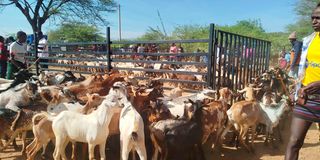
Goats being sold at the Nginyang' livestock market in Tiaty on December 15, 2025.

Photo credit: Florah Koech | Nation Media Group

Kenya's red meat supply is based on pastoralist production systems, with approximately 80-90 percent of production coming from livestock raised by pastoralists in arid and semi-arid lands (ASALs). The supply chains are largely informal, and the country suffers a meat deficit that drives cross-border trade.

The main thrust of current policy interventions is to manage the significant climate risks, improve productivity, traceability and market linkages.
Local consumption is deeply centred around the nyama choma culture. Nairobi and Mombasa are the key markets, accounting for an estimated 75 percent of the country's total meat consumption.

Offals (the fifth quarter), are a key profit driver for slaughterhouses and butcheries. But without the cold-chain, they don’t transport well, spoiling quickly in the heat. As a result, slaughterhouses located far away from the two main markets struggle – even with significant investments those in Maralal and Isiolo are yet to become operational.

Kenya’s meat-deficit is estimated at 300,000 metric tons of red meat. The country relies on significant livestock imports from neighbouring nations including Ethiopia, Somalia, Tanzania, and Uganda. The animals are mainly walked but sometimes trucked, to key livestock markets at Mabera, Bisil, Garissa, and Garsen.

The sector is heavily fragmented, relying on a long chain of middlemen (aggregators) rather than direct producer to processor relationships. However, there is a discernible shift to value addition and feedlots, including by supermarket chains. A few aggregators, borrowing from horticulture, are experimenting with contracted pastoralists models.

Livestock exhibitions and expos have emerged as strong new marketing and learning platforms, joining the annual calendar of agricultural shows that are hosted by the Agricultural Society of Kenya (ASK).

These expos offer organisers an opportunity to focus on a smaller range of subjects or content, allowing deeper treatment. This attracts the specialist or commercial farmer, investor, supplier or industry professional.

This sort of event typically involves master classes, demonstrations, exhibitions and in some cases, livestock auctions. The format is great for processors and feedlot operators, as it provides an opportunity to learn and find better technologies. Auctions are an excellent mechanism for price discovery.

The fourth edition Tri-Nations Livestock Expo featured breeders from Kenya (three), Tanzania (three) and Nambia (six). The Kenyans included Olpajeta, Sosian, and Woragus Boran Stud. Tanzania had Mbogo Ranches, West Kilimajaro, and Bajuta. Namibia had Super Game, Leroux van Wyk Dorpers, Anam Cara, Brandy Bush, Hanekom Meatmasters, and Silversand Savanas.

On auction were Boran, Nguni, Brahman, Simbra, Angus, Jersey, Ayrshire and Tuli cattle. The sheep and goats (shoats) breeds included Red Maasai sheep, White Dorper, Boer Goat, Kalahari Red goat, Meatmaster sheep, Van Rooy sheep, and Savanna goat.

Shoats auction prices were very impressive. A Meatmaster lot, comprising a breeding ram and four ewes sold for Tsh24.5 million equivalent to Sh1.2 million. That was more than the KSh400,000 an in-calf boran heifer fetched. A Van Rooy ram sold for Sh197,000.

Laikipia farmers featured strongly both for their stock and technology. The champion bull, a boran, was from breeder Woragus, while the champion female was from Olpajeta. Ranch Experts, a feedlot operator and tech developer from Rumuruti, was recognized for their management and marketplace app.

The expo attracted participants from the three exhibiting countries but also from Brazil, USA and South Africa. There were dozens of exhibitors, on everything from finance, fencing, tractors, trailers, other farming vehicles, and veterinary inputs.

Both the Kenyan buyers and the breeders from Nambia explained to me in some detail, the difficulties involved in moving livestock across borders. Veterinary authorities of the nation through which you are passing have to inspect the animals. Inspection delays stress the animals, and can cause death. The Zambia border came in for most criticism, with trucks spending 40 hours at the border.

Exhibiting financiers included Equity Bank, NMB and CRDB. NMB Bank announced that livestock owners will now be able to use their livestock assets as collateral to secure financing to invest in productivity-enhancing activities such as commercial livestock fattening.

Ndiritu Muriithi is an economist and partner at Ecocapp Capital.  He is also the chairman of KRA and former governor of Laikipia County. Email: [email protected]


PAYE Tax Calculator

Note: The results are not exact but very close to the actual.