Local shareholders of Tatu City are mounting a last-ditch effort to reverse an alleged dilution of their stakes by their foreign business partners, even as their shares face the auctioneer's hammer following a recent ruling by Mauritius' highest court.
The latest move has seen Kenyan businessman Steve Mwagiru and Belgian investor Etienne Delbar, through BlackKnight Holdings Ltd, seek permission from the Supreme Court of Mauritius to institute arbitration proceedings before the London Court of International Arbitration (LCIA) on behalf of Manhattan Coffee Investment Holdings Ltd (MCIH), a company currently under liquidation.

Under Mauritius' Insolvency Act, legal proceedings on behalf of a company in liquidation cannot start without the court's leave.
BlackKnight Holdings is owned by a group of original investors in the Tatu City project, including Mr Mwagiru, former Central Bank of Kenya Governor Nahashon Nyagah, members of the Shah family and Mr Delbar.
Mr Delbar has separately appointed Mr Mwagiru through a power of attorney to represent him in the proceedings as he seeks to recover what he says is his diluted stake in the offshore investment structure behind Tatu City.
The applicants want the court to allow them to start arbitration in the name of MCIH to challenge what they describe as the unlawful dilution of the company's shareholding in Cedar IV Ltd and Cedarsoc Ltd, the two Mauritian investment vehicles through which ownership interests in Tatu City and Kofinaf are held.
Setback for local shareholders
They argue that a series of transactions undertaken between 2014 and 2016 unlawfully reduced MCIH's stake in favour of entities linked to Russian investor Stephen Jennings, the founder of Rendeavour.
"The applicants seek leave to commence proceedings on behalf of Manhattan Coffee Investment Holdings Ltd, a company in liquidation," the November 2025 filing states.
The plea will be heard next month against a fresh setback for local shareholders after the Privy Council dismissed Mr Mwagiru's attempt to stop the sale of MCIH's shares by court-appointed liquidators.
The five-judge bench ruled that Mr Mwagiru, who filed the case as a director of MCIH, lacked the legal standing under Section 174 of the Insolvency Act 2009 to continue litigation on behalf of MCIH after it entered liquidation.
Only creditors and shareholders, the court said, could file on behalf of a company under liquidation.
"For these reasons, the board considers that the appellant had no standing to apply for an order under Section 174 of the IA 2009 for authority to continue the Plaint on behalf of and in the name of the Company," the Privy Council ruled on May 16, 2026.
The decision marked another setback in a dispute that has stretched for nearly two decades and has been fought in courts and arbitration tribunals in Kenya, Mauritius and London.
The battle traces its roots to the late 2000s, when Mr Mwagiru, his mother Rosemary Wanja Mwagiru, Mr Nyagah, businessman Vimal Shah and Belgian investor Delbar teamed up to acquire more than 5,000 acres of coffee farms off Thika Road, inspired by the Kibaki administration's Vision 2030 infrastructure drive and the construction of the Thika Superhighway.
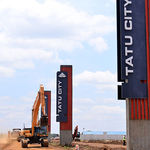
Tatu City signage.
Photo credit: File | Nation Media Group
Ownership of the land was subsequently placed under a web of offshore companies. Cedar IV (Mauritius) Ltd owns 99.9 percent of Tatu City, while Cedar IV itself is owned by SCF Holdings II, controlled by Mr Jennings' Rendeavour, and MCIH, the investment vehicle representing the Kenyan minority investors.
MCIH, in turn, is equally owned by BlackKnight Holdings Ltd and Redline Investments Corporation. Mwagiru and his mother, Delbar and Nyagah, are the shareholders of BlackKnight, while the family of Bidco chair Vimal Shah owns Redline.
However, the relationship between shareholders quickly deteriorated, resulting in multiple court battles over management and ownership of the project.
The applicants argue that MCIH's interests were unlawfully diluted after additional shares were issued in Cedar IV and Cedarsoc under loan conversion arrangements long after the contractual conversion periods had expired.
According to the court filings, the companies also issued shares based on valuations that significantly understated the value of the underlying assets.
"The share issuances were undertaken after the conversion periods had expired and at an undervalue, thereby unlawfully diluting Manhattan Coffee's shareholding," the applicants argue in their supporting documents.
Mr Delbar separately traces his claim to a Subscription and Shareholders' Agreement signed on June 16, 2008, under which he acquired a four percent stake in Cedar IV.
Investment decisions
He says the acquisition was later approved by MCIH's board but that subsequent transactions eroded his interest without lawful authority. The liquidation of MCIH stems from an unrelated arbitration award in London.
In February 2018, the London Court of International Arbitration ruled that MCIH, Mr Shah, Mr Nyagah and Mr Mwagiru had defrauded SCF Holdings II by falsely representing that a $20 million deposit had been paid to vendors of part of the Tatu City land when it had not. The tribunal awarded $15 million (Sh1.94 billion) in damages, together with interest and costs, after finding that the misrepresentation influenced SCF Holdings II's investment decisions.
The minority shareholders neither challenged the award within the statutory 28 days nor settled the debt.
SCF Holdings II subsequently petitioned the Mauritian courts to wind up MCIH, whose principal asset comprised its shares in the Cedar companies.
The company unsuccessfully resisted the liquidation before being wound up in 2023.
Mr Mwagiru has argued that the liquidation opens the door for SCF Holdings II to acquire MCIH's Cedar shares from the liquidators, potentially allowing it to offset part of the purchase price against the outstanding arbitration debt and further consolidate its control over Tatu City.
"The intended proceedings concern the dilution of Manhattan Coffee's interests in Cedar IV and Cedarsoc and are necessary to protect the company's rights," the new application states.