How MPs deleted 5pc mitumba tax in draft Finance Bill

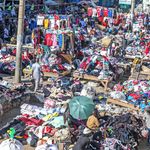
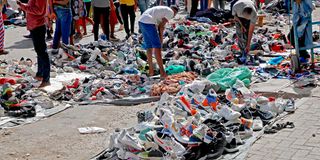
Kenyans pick through second-hand shoes at Gikomba market in Nairobi on February 4, 2024.  

Photo credit: File | Lucy Wanjiru | Nation Media Group

The National Assembly Finance Committee deleted a five percent tax on Mitumba imports from a draft Finance Bill that had the backing of the Treasury and State House amid pressure to reinstate the duty.

The final Finance Bill published by the committee did not have the tax for the second hand shoes and clothed despite the draft from the Treasury containing the five percent duty.
Addressing multiple taxes levied on second-hand clothes, popularly known as mitumba, at the point of entry are among the reasons the National Treasury proposed the introduction of payment of one off payment of taxes in the Finance Bill, 2026.

National Treasury Cabinet Secretary John Mbadi said the move was also informed by a request from representatives of mitumba traders who complained for a complicated payment of taxes anytime their mitumba consignment lands in the country.

Treasury reckons that State House had backed the introduction of the tax.

“It was their request, and as an office, and as a government that listens to Kenyans, we believe that it was the right way to go. That is the proposal we took to the National Assembly, but unfortunately, it has been dropped,” said Mr Mbadi.

The draft from the Treasury is regarded as an informal document, which the Finance committee can make minimal changes before publication of the final Bill, which is subject to public participation.

The National Treasury now wants the proposal reinstated, insisting that it does not harm the country’s thriving mitumba trade that supports over two million jobs.

The current taxation regime sees mitumba traders pay four duties and levies including a 35 percent import duty based on the custom value of imports, charged per kilogram and a 16 percent value added tax (VAT) on imported customs values.

Mitumba importers must also pay levies including the railway development levy (RDL) and the import declaration fee (IDF).

The mitumba traders came up with the proposed harmonized taxation rate for imports as they lamented the current regime which also sees them pay for the duties and levies in US dollars.

“We recommend that all income duty be paid at the port of entry, upon arrival of goods. All levies and duties should be settled at the port of entry to enhance compliance and accountability,” the Mitumba Consortium Association of Kenya (MCAK) told the National Treasury in a memorandum seen by this publication.

The consortium has had several engagements with both the National Treasury and State House over the last seven months.

According to a highly placed source at the National Treasury, President William Ruto enquired why the five percent tax rate was being considered and asked for a meeting with both the exchequer and the mitumba traders to understand the taxation dynamics on second-hand clothing articles.

President Ruto agreed to the proposal afterwards and the provision was carried in the draft Finance Bill, 2026.

The source presented this publication with photos, representing receipts of the months’ long engagement between the exchequer and the mitumba traders including MCAK Chairperson Teresia Njenga.

Tax experts had questioned how the provision would be implemented when a draft of the Finance Bill, 2026 was in circulation, highlighting that the five percent tax rate was tied to deemed profits from the mitumba trade.

“The implementation of this provision is likely to raise questions as to its fairness, since it requires that the traders pay income tax on a deemed profit even before the goods are cleared,” analysts at Bowmans Law said previously.

The mitumba sub-sector is seen as playing a critical role in Kenya’s economy and is estimated to support over two million Kenyans.
MCAK estimates that the sector pays Sh16 billion in taxes on the exchequer annually.

The mitumba market is seen as crucial to not just job creation but also the exchequer with previous estimates from the Institute of Economic Affairs (IEA) placing flows to State coffers at Sh1 billion per month.

“Accumulatively, the importer incurs about Sh1.5 million per container in taxes. If there is a delay which is often the case, the importers incur demurrage charges which could accumulate for weeks,” the IEA said in its State of Second-Hand Clothes and Footwear Trade in Kenya, published in 2021.

“Normally, a 40-foot container carries an average of 24 tonnes. Out of the 185,000 tonnes imported in 2019, it then is averaged to have been transported in 8,000 forty-feet containers. Each importer pays an average of Sh1.5 million per container. This then implies that the government of Kenya received an average of Sh12 billion in import duty from second-hand clothes. The sector contributes to at least Sh1 billion in revenue per month.”

Both the quantities and value of second-hand clothing imports rose in 2025 indicating the continued growth of the mitumba industry in the country, as per data from the Kenya National Bureau of Statistics (KNBS) Economic Survey, 2026.

Volumes of second-hand clothing rose from 230,535 tonnes in 2024 to 250,527 tonnes in 2025.

The value of mitumba imports meanwhile hit Sh30.2 billion from Sh27.8 billion in the same review period.

Second-hand clothing import prices remained stable, registering a slight increase to trade at Sh120,800 per tonne in 2025, rising marginally from Sh120,640 per tonne in 2024.

The National Treasury said the harmonization of taxes on mitumba would not only bring down the effective duties and levies charged on the imports but also reduce run-ins between the traders and the Kenya Revenue Authority (KRA).

“They asked for a simplified tax system where they pay at the point of entry, and no one comes again to demand for any taxes. This becomes a final tax,” said John Mbadi, the National Treasury Cabinet Secretary.

Mbadi says the National Treasury will push for the reinstatement of the tax provision by recommending further amendments to the final Finance Bill, 2026 through the National Assembly.

Mitumba traders say the proposal for a single rate of tax has been driven primarily by compliance challenges where many businesspeople have found themselves at loggerheads with KRA.

“Our issue has always been KRA agents coming after mitumba traders five years later claiming unpaid taxes,” said Martin Gitau, the chief executive officer of MCAK.

Follow our WhatsApp channel for the latest business and markets updates.

PAYE Tax Calculator

Note: The results are not exact but very close to the actual.