Mitumba imports surge further, wear down Ruto’s textile revival strategy

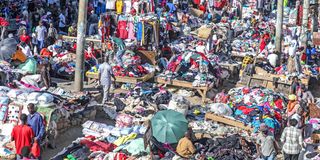
Traders selling second-hand clothes at Gikomba Market in Nairobi on February 23, 2025.

Photo credit: Dennis Onsongo | Nation Media Group

Kenya’s imports of second-hand clothes have continued to rise despite President William Ruto’s ambitious plan to revive the country’s cotton, textiles, and apparel value chains.

Latest official data shows that traders shipped in mitumba worth Sh14 billion between January and June 2025, marking a 3.7 percent jump over a similar period last year and extending a trend of increased imports.
This means that the value of Kenya’s mitumba imports has cumulatively risen by 64.3 percent in three years, up from Sh8.52 billion in the first half of 2022.

The steepest climb came in 2023 when imports soared by 41.02 percent to Sh12.01 billion before slowing to 12.41 percent in 2024 and 3.74 percent this year, an analysis of data collated by the Kenya National Bureau of Statistics shows.

“Mitumba has played a big economic role in Kenya, especially because we are an economy with so many people living below the poverty line,” said Teresia Wairimu, chairperson of the Mitumba Consortium Association of Kenya, in an interview on NTV's Media’s Fixing the Nation show in May.

“With as little as Sh1,000, you can start a mitumba business. Most people have found out that this is actually a job. It’s an opportunity that works for hardworking people,” she said, adding that the business has become the main source of livelihood for unemployed youth who have since stopped looking for jobs.

Growth of second-hand clothes imports highlights the enduring dominance of used wear in Kenya’s fashion industry, underscoring the uphill task facing the Ruto administration, which is banking on textile revival to drive industrialisation, exports, and jobs.

Since taking power in September 2022, Dr Ruto has made revitalising the textiles and apparel sub-sector a key part of his Bottom-Up Economic Transformation Agenda (Beta).

The revival strategy is anchored in a draft National Cotton, Textile and Apparel (CTA) Policy 2024, which seeks to enhance competitiveness and sustainability of Kenya’s cotton-to-clothing value chain while expanding regional and global market access.

As part of the ambitious revival plan aimed at boosting cotton farming, modernising ginneries and expanding value addition, the government states in the 2025 Budget Policy Statement (BPS) that it mobilised cotton farmers into co-operatives and distributed 70 metric tons of certified cotton seeds, including biotech and hybrid varieties, across 24 cotton-growing counties.

The government states that in the coming years it plans to establish value addition centres in Nyando and Kieni, and seven modern cooperative ginneries in Homa Bay, Siaya, Meru, Lamu, Kwale, Kirinyaga, and Bungoma counties.

The plan, according to the BPS, will also see authorities modernise existing ginneries, equip tailoring hubs at County Industrial Development Centres (CIDCs), construct industrial warehouses and industrial sheds, and develop railway siding infrastructure at the Athi River Export Processing Zone (EPZ).

The government also plans to run “Made in Kenya” global campaigns, train commercial attachés to promote textile exports, and link local tailors and MSMEs with schools, colleges, and larger entrepreneurs.

However, Ms Wairimu argues that Kenya’s textile industry is heavily import-dependent, with a small fraction of materials sourced locally.

“Local means everything is local. But in Kenya’s textile industry, everything is imported — from cotton to almost all materials used to make clothes,” she said.

“We need to ask about the percentage of local materials we have because all materials in the EPZ and local manufacturers are imported.”

Kenya largely sources its second-hand clothes from the United States, the United Kingdom, China, the European Union, Oman, and Lithuania.

Kenya, about five months ago, renewed its push to ban the importation of second-hand clothes after the US imposed tariffs on Kenyan exports.

In a new policy on the cotton, textile, and apparel sector, the Ministry of Trade and Investment has blamed the high importation of Mitumba on the deterioration of the local textile sector, arguing that the time had come to take action on the dumping of second-hand clothes in the country.

The US has been at the forefront of the push against any ban on its imports into Kenya.

A 35 percent tariff on second-hand clothes or mitumba, graft, and a series of temporary tax waivers to curb rises in domestic food prices are among key trade barriers flagged by the US, prompting President Donald Trump to hit Kenya with a 10 percent reciprocal tariff.

“Among the imports that are impacted by the 35 percent fourth tariff band are US exports of secondhand clothing and environmentally cleaner cooking products. Many textiles and agricultural products are classified as “sensitive items” under the EAC and, as a result, are subject to ad valorem tariff rates above 35 percent,” US Trade Representative Jamieson Greer said.

PAYE Tax Calculator

Note: The results are not exact but very close to the actual.