Time flies with great content! Renew in to keep enjoying all our premium content.
Health partnerships must boost preparedness
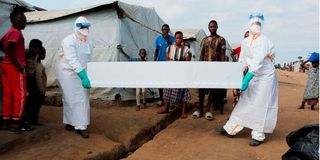
Health workers wearing personal protective equipment (PPE) carry the coffin of a person who died of Ebola for burial at the Kigonze displaced persons camp, one month after an Ebola outbreak was declared, in Bunia, eastern Democratic Republic of Congo on June 18, 2026.
The recent Ebola outbreaks in Uganda and the Democratic Republic of Congo (DRC) have once again underscored the persistent threat that emerging infectious diseases pose to East Africa.
As of 29 May 2026, the World Health Organization (WHO) had reported more than 900 suspected Ebola cases and over 220 unconfirmed deaths in the DRC, alongside nine confirmed cases and one death in neighbouring Uganda linked to cross-border transmission.
The disease is caused by the Bundibugyo strain of Ebola, for which no licensed vaccine currently exists, and the outbreak has triggered heightened surveillance and preparedness measures across the region.
Against this backdrop, reports that the United States is supporting construction of a state-of-the-art infectious disease isolation facility in Kenya have been welcomed with mixed feelings.
Although the facility is widely viewed as an important investment in Kenya's ability to prevent and respond to infectious disease outbreaks, its development also prompts a broader debate about national sovereignty, the politics of global health security, and the extent to which donor-funded preparedness infrastructure contributes to sustainable health systems strengthening.
As Kenya seeks to enhance its readiness for future outbreaks, it must carefully consider how such investments can advance national health priorities while safeguarding local ownership, long-term resilience, and strategic autonomy.
At first glance, the investment appears both timely and necessary. Kenya is a regional transport and commercial hub, connecting East and Central Africa through extensive air, sea, and land networks. A specialised isolation facility could significantly enhance the country’s capacity to detect, isolate, and manage highly infectious diseases such as Ebola, Marburg, and future pandemic threats.
The public health case is indeed compelling, but from a policy and social framing point of view, the timing is very wrong. The WHO has repeatedly warned that outbreaks of Ebola and other emerging infectious diseases are becoming more frequent due to environmental change, population growth, urbanisation, and increased global mobility.
For Kenya, preparedness and responsive systems are not optional.
The country has experienced repeated public health emergencies, including Covid-19, cholera outbreaks, Rift Valley Fever, and recurring threats of cross-border disease transmission.
Investments in advanced treatment and isolation infrastructure can, therefore, enhance national readiness and potentially position the country as a regional centre of excellence for outbreak response. However, preparedness infrastructure alone cannot be viewed in isolation from broader questions of governance and sovereignty.
Historically, global health security investments have often reflected the interests of both donor and recipient countries. Following the anthrax attacks, SARS, Ebola, and Covid-19, high-income countries increasingly recognised that disease threats emerging elsewhere could rapidly become domestic security concerns.
Consequently, investments in surveillance systems, laboratories, and outbreak response mechanisms must always be prioritised.
There is nothing inherently wrong about mutually beneficial partnerships. Indeed, Kenya has benefited significantly from international cooperation in HIV/Aids, Tuberculosis, Malaria, Immunisation, and recently Pandemic Preparedness due to Covid-19.
However, major investments in infectious disease infrastructure should be accompanied by transparency regarding governance arrangements, ownership, data management, and long-term sustainability.
These concerns are particularly relevant as African countries advocate for greater equity in global health governance.
Experience from previous outbreaks suggests that the first line of defense against Ebola and other pandemics is rarely a sophisticated isolation ward. Rather, it is effective disease surveillance, well-trained health workers, strong laboratory networks, trusted community health systems, and rapid response mechanisms.
Kenya should welcome partnerships that strengthen epidemic preparedness anchored in national priorities and health system resilience rather than narrowly focused on disease-specific infrastructure.
Peter Waiganjo, is a graduate student in Global Health Policy at London School of Economics and Political Science and Prof Joseph Kieyah, policy analyst at KIPPRA