Time flies with great content! Renew in to keep enjoying all our premium content.
Why Kenya-US health partnership on Ebola is a strategic leap forward
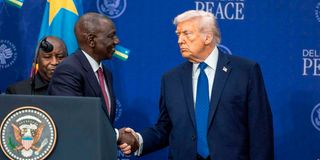
President William Ruto and US President Donald Trump after witnessing the signing of a peace deal between DRC and Rwanda in Washington DC, USA, on December 5, 2025.
In recent weeks, Kenya has found itself at the centre of a heated national debate. The bilateral agreement between President William Ruto and US President Donald Trump to establish specialised Ebola care and research facilities in Kenya has triggered an avalanche of public anxiety, scepticism, and political rhetoric.
However, this controversy is not a crisis of public safety, but a public perception issue. To navigate this moment, we must strike a delicate balance between our national and public interests.
Our national interest will look to our long-term strategic, economic, and geopolitical positioning while public interest will greatly be concerned with demands for the immediate health, safety, and reassurance of our citizens.
To do this effectively, we must let science, evidence, and rigorous engineering lead the conversation, firmly casting aside the myths, fallacies, and primal fears that often hijack complex national discourses.
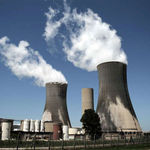
At the Nuclear Power and Energy Agency, we confront similar phobias daily. When people hear the word “nuclear” their minds often leap to catastrophic, apocalyptic imagery rather than the reality of clean, baseline grid power, advanced cancer radiotherapy, and enhanced farm productivity.
Both nuclear technology and high-level medical containment suffer from the same vulnerability: they are highly sophisticated scientific fields easily distorted by misinformation.
Just as modern nuclear reactors are built with redundant, passive safety systems that make meltdowns virtually impossible under scientific law, bio-containment facilities operate under stringent negative-pressure environments, absolute filtration, and rigorous military-grade protocols. It is no wonder that the Kenyan facility has been proposed for Laikipia Air Base – an active military facility.
We cannot build a modern, industrialised economy if we allow fear of the unknown to paralyse our development. When we allow myths to override science, we lose. When we allow expert scientific consensus to guide policy, nations prosper.
This partnership is not a unilateral favour. It is a high-yield strategic investment for Kenya.
First, the infrastructure injection will be unprecedented. The US brings world-class, state-of-the-art diagnostic, isolation, and therapeutic equipment that will permanently elevate Kenya’s clinical infrastructure.
Second, the human capital gains are immeasurable. Our local healthcare professionals – doctors, nurses, epidemiologists and lab technicians will work alongside global leaders in virology and bio-defence.
They will gain hands-on, first-tier experience in managing the world’s most complex medical conditions. This exposure ensures that if a highly contagious pathogen ever naturally emerges within our borders, Kenya will possess the internal expertise to neutralise it immediately without waiting for foreign intervention.
Geopolitically, this deal elevates Kenya’s standing on the global stage.
By embracing this partnership with a clear eye on safety and a strategic focus on the future, Kenya will secure its health, power its industries, and command the respect of the global community.
The writer is the chief executive officer of the Nuclear Power and Energy Agency.