Ask Wairimu Keriri about the fitness routine that has made her have an athletic physique of someone decades younger, and she won’t name just one exercise.
“I turn 50 in five months,” she says with a chuckle as she unpacks her gym bag at Hood Gym along Nairobi’s Naivasha Road, an unassuming place that could easily be mistaken for a neighbourhood garage.
It may not be as sleek as many gyms in malls, but inside, the clang of metal plates and weights hitting the floor as fitness enthusiasts lift, push, and pull is a reminder that this is a place built for training, not looks.
It feels like a workshop where bodies are being rebuilt, and it is here that Ms Keriri feels she gets the best out of herself.
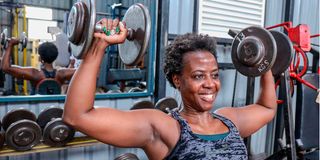
“I like the environment here. It immediately puts you in the mood to exercise. Today I’ll be training my arms and legs,” she says.
Looking at her toned frame, it is easy to assume she spends most of her week in the gym. She only strength-trains twice a week.
Consistency, she explains, rather than spending endless hours lifting weights, has been her secret.
Wairimu Keriri performs a hack squat exercise on a hack squat machine during a workout at Hood Gym in Nairobi on July 16, 2026.
Photo credit: Bonface Bogita | Nation Media Group
After more than 20 years of exercising regularly, she has found a routine that works for her body without following the typical four or five strength-training sessions many fitness enthusiasts swear by.
“I swim three times a week, strength-train twice a week, and do calisthenics twice a week. Staying fit and in shape is not about living in the gym. It is about finding the right balance and sticking to it and being consistent,” she explains.
But how exactly did she get here?
“We have to go back to the days of PE (physical education). I have always been an active soul. But it is in the early 2000s that I became more serious with my workout routine.”
During her primary school days and later at Kenya High School, she played hockey, threw the discus, and spent countless hours in the swimming pool.
Like many fitness enthusiasts, when she started being serious about her fitness journey, she joined the popular group classes: Taebo, aerobics, and a bit of spin classes, most of which are cardio and endurance exercises. Then she fell in love with running.
“There was this one time I was training for a half-marathon. Then I said, ‘I’ve done so many half marathons, let me challenge myself with a full marathon and it became a thing. I have run several marathons,” she says.
Wairimu Keriri performs a leg press exercise on a leg press machine during a workout at Hood Gym in Nairobi on July 16, 2026.
Photo credit: Bonface Bogita | Nation Media Group
First child at 37
The hours she had spent doing cardio and endurance training paid off when she became pregnant with her first child at 37.
“After I had my son, [he’s 13 now], I went back to running almost immediately. I would wake up early, run between 10 and 12 kilometres, and come back just before he woke up, attend to him, and then go to work.”
But her second child changed that rhythm.
“My daughter is nine now. She wasn’t as calm as my son when young. Most nights she didn’t sleep, so I could no longer keep up with the routine of going for morning runs and going to work on time. I turned to swimming and cycling.”
She would then discover Kenya’s triathlon community during the Covid-19 pandemic, an encounter that took her workout routine to a higher level.
“I have done two triathlons, one in Nairobi and one in Diani, and I absolutely loved them. It is a three-discipline sport where you run, swim, and cycle. It is an endurance training that works the entire body in ways you can’t imagine.”
Wairimu Keriri performs a seated cable row exercise during a workout at Hood Gym in Nairobi on July 16, 2026.
Photo credit: Bonface Bogita | Nation Media Group
Restless fitness junkie
For about two years, she combined triathlon training with weightlifting before curiosity pulled her to try boxing, which she quickly fell in love with, but for only a short period.
“I did boxing for four years before losing motivation, then I went back to swimming, which has always been a constant in my workout programmes.” Joining a master’s swimming team (people above 40) made her realise she needed strength training designed specifically for swimmers.
“It gives you the discipline to train. You’re not just swimming for the sake of swimming,” she says.
Ms Keriri admits she is not one to stick to doing one thing for so long.
“At this stage, I am in a season of swimming, strength training, and calisthenics. Previously I was in the season of waking up at 4.30am to run 12km. Maybe next year I will be doing something else; I don’t know. And it is okay to keep trying new challenges. The most important thing is to always keep moving.”
She discovered calisthenics in 2024.
“It kept popping up on my Instagram, and that got me curious,” she says. “Calisthenics isn’t about weight. It is you and your body. If you can’t lift your own body, then there’s a problem. That got me sucked up, and now I do calisthenics twice a week. In calisthenics, many movements focus on mobility and flexibility, which are essential to the body because, as you get older, your body gets stiffer. And you need to remain agile.”
It is one discipline, she says, that deserves far more attention than it receives. She describes it as the natural movements children instinctively perform when playing, such as squats, frog walks, and handstands.
Wairimu Keriri performs a one-arm dumbbell row during a workout at Hood Gym in Nairobi on July 16, 2026.
Photo credit: Bonface Bogita | Nation Media Group
Handstands tone
“For me, even doing handstands has changed my body. It has helped my shoulders, my strength, and especially my butterfly swimming.”
She also likes that it requires no expensive equipment.
“It’s something you can do into your 80s and 90s. You can even do it at home.”
Of all her exercises, she ranks strength training as the best for her body.
“I am in the peri-menopause stage, and strength training is ideal because it helps me to sleep well. Peri-menopause can be a menace with hot flashes and all that, but with strength training, I can cope. As women, we need muscle. It is the organ of longevity, and nothing will help you build muscle if it's not strength training. There is no shortcut.”
Balancing workout and workloads
Monday is usually for swimming. Tuesday and Thursday are calisthenics. Wednesday may be a recovery day, sometimes with an evening swim, while Friday can include both gym work and swimming.
“I like doing the hardest exercises in the morning. The energy carries me through the day,” she says.
However, she says she is at a point in her life where she doesn’t feel so guilty about missing a session. And that's just how she balances her work, social life, and workouts.
“My trainer gets really upset when she doesn't see me for two weeks, but I don’t worry too much. The most important thing is staying consistent, and being consistent doesn’t mean showing up every single day.”
More than anything, exercise has become her way of resetting.
“If I’m having a bad day, I come to the gym and work out. I like meeting people. I enjoy going to gyms because I meet people who enjoy the same things.”
Wairimu Keriri performs chest-supported rows on a chest-supported row machine during a workout at Hood Gym in Nairobi on July 16, 2026.
Photo credit: Bonface Bogita | Nation Media Group
Many fitness junkies avoid eating wheat products, but not Ms Keriri.
“I told myself I must eat chapati, but only half. I eat many halves.”
Protein is a priority. Breakfast is usually an egg with toast, accompanied by black coffee or black tea. Lunch is often fish with spinach or kunde (cowpea greens). “I try to eat lots of roughage.”
Midday snacks might include almonds or boiled maize, while dinner is often chicken with some rice.
As much as she loves strength training, it is swimming she cannot do without.
“Swimming is therapeutic. Because of my busy lifestyle, swimming gives me one and a half hours during which nobody can talk to me. It is me and my problems in the water,” she says, adding, a typical session covers about three kilometres, roughly 120 laps.