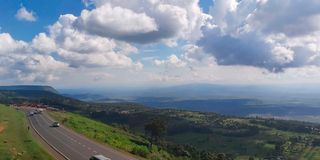
Geologists say the Great Rift Valley was formed by the Earth's tectonic plates pulling away from each other, about 30 million years ago. The process continues, they say, at about six mm per year, with an eventual split. A new ocean basin will separate parts of East Africa into a new island continent. But don’t worry yet, it will take another five million years!
Beyond geology, rather specialised branches of science study the Rift. Plate tectonics studies how the Earth’s lithospheric plates move and pull apart to create the Rift. Geomorphology focuses on the physical features of the valley floor, such as the escarpments, mountains, and how erosion shapes them.
Volcanologists study the numerous volcanoes (like Menegai, Longonot and Suswa) and the magma activity triggered by the thinning crust. Seismologists monitor the earthquakes and tremors that occur as the ground continues to fracture. And because the Rift preserved many early-human fossils, Paleoanthropologists study human evolution from it.
An economist, I’m no expert in these sciences. But my wife and I frequently enjoy the incredible natural beauty that plate tectonics created. This Easter, together with friends, we visited various spots along the escarpment in Laikipia and Samburu, overlooking the rift floor – from Subukia, to lakes Bogoria and Baringo, and the Suguta Valley, further north.
We took an afternoon trip to the Malaso Viewpoint, a dramatic, steep escarpment in Samburu County, about 25 minutes northwest of Maralal town. The sudden, vertical drop of over 2,000 metres from the Losiolo escarpment down to the floor of the Suguta Valley is absolutely awe inspiring.
In Samburu legends, the Malaso escarpment is the profound boundary between the physical and mythological worlds. The legend of the ancient lake tells that the Suguta Valley was once filled by an ancient water body (Lake Suguta) that stretched to present day Lake Turkana.
From atop the escarpment, the Samburu ancestors observed this lost world. The sunset at Kamwenje is out of this world. We brought friends the next day.
A breathtaking vista, with lake Baringo dominating the valley floor, stretches out in front of you. Situated along the edge of the escarpment, it is characterised by a rugged, challenging, landscape that blends agricultural farmlands to the east, with wild, untamed terrain to the west.
Looking west into the Rift, the prominent features are deep valleys, sharp escarpments and thick gorges, covered in vast forests and dense thickets. To the east, small-scale farmer cultivated maize fields.
On the whole, Laikipia and Samburu have many undeveloped and emerging tourism sites that offer exclusive, off-grid experiences focused on conservation and the wilderness. These hidden gems offer the big-five experience, incredible views, cultural experiences with local communities, and dramatic landscapes.
Many areas are excellent for walking safaris, hiking and biking.
They include the biodiversity-rich Rumuruti Forest, scenic western landscapes around Tableland, Mochogoi and Kamwenje. Rumuruti forest is an untapped area for nature lovers, hosting diverse wildlife such as elephants and buffaloes, along with opportunities for birdwatching.
The entire landscape is suitable for tourists seeking to escape conventional tourism, focusing on self-drive, eco-friendly accommodation, incredible vistas and intimate, uncrowded wildlife encounters, well suited for domestic travelers.
All these resources are ripe for development. And, the sector is growing. Kenya's tourism is experiencing a major rebound. At 2.7 million, international arrivals were nine percent last year. The sector earned Sh500 billion, a 15 percent growth over 2024.
Domestic tourism remains a major driver, with 5.2 million visitors in 2024, a 15 percent growth in bed-night stays from 2023. The United States is a major source of international arrivals, accounting for 12.8 percent of visitors.
Proliferation of digital platforms, increased flight connectivity, and diversification, are key growth drivers. The increased interest in eco-tourism, cultural experiences, and adventure tourism outside traditional hotspots, is a perfect fit for Laikipia and Samburu.
We made our way from Tandare to Kamwenje. Travelled the Laikipia and Samburu plains to Maralal. Went up to Poro and the great Malaso. The roads are serviceable and all weather. The incredibly beautiful landscape is all green, thanks to recent rains. But it is more than that. The people are warm, welcoming and generous.
Heading back to Nairobi, we travel through Nyeri. The direct but unpaved road takes you from Rumuruti to Checkpoint, to Sirima. The tarmac starts as you wind down the valley towards the Ngobit river. The descent, as later towards Chaka from Mweiga hill, treats you to amazing landscapes.
Ndiritu Muriithi is an economist and partner at Ecocapp Capital. He is also the chairman of KRA and former governor of Laikipia County. Email: [email protected]
Unlock a world of exclusive content today!Unlock a world of exclusive content today!