The leather value chain contributes an estimated 1.5 percent to the gross domestic product. Fittingly, it received particular attention at the Kenya International Investment Conference last week. A dedicated side event was house-full. There was a large delegation from the Italian government and private sector in attendance.
Among the deals signed were the memoranda of understanding between KCB and the Kenya Leather Development Council (KLDC), and between the Bank, Alpharama Ltd, and Ranch Experts. KCB announced its intention to make available $100 million for the sub-sector.
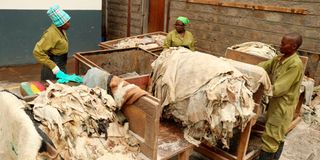
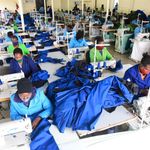
KLDC is developing a new National Hides and Skins Improvement Program, and the KCB financing will come in handy to support value chain players. The programme targets livestock farmers, slaughterhouse operators, flayers and butchers, hides and skins aggregators, tanneries, and leather products manufacturers.
The sector generates an estimated 3 million hides and 18 million skins annually, but a significant portion of the raw materials is not being tanned and is wasted, exported for food and gelatin production. Some of the larger tanneries are importing both raw hides as well as wet blue leather.
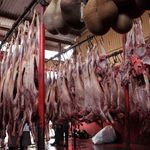
Quality of hides is a key issue, greatly influenced by the conditions of the slaughterhouses, the quality of the flaying, and post-slaughter handling. This is why both are subject to licensing.
The training and licensing of flayers is an important step. Such training is offered at the Training and Production Centre for the Shoe Industry (TPCSI) in Thika, KIRDI, Garissa University, and a number of Vocational Training Centres.
Some slaughterhouses in Nairobi also offer on-the-job training. Laikipia and Kericho counties have reported programmes to train and license flayers.
More than 8 million Kenyans depend on livestock for their livelihood. Pastoralism, where animals move in search of pasture, is the predominant production system. Laikipia and Taita Taveta counties have large ranches, but increasingly, you will find mini feedlots, where animals are finished over an intensive three- to four-month period.
Feedlots are a response to climate change and increase the productivity of the livestock sector, including hide quality. Laikipia has attracted one medium-sized feedlot with 5,000 head of cattle, and dozens of smaller ones. They may yet grow into large-scale vertically integrated beef businesses.
With feedlot anchors, the business model links with breeding operators who supply weaner calves or steers, buy fodder from contracted farmers, and have large meat processing. Zambeef Products PLC is an example of what the model looks like at scale.
Earlier plans for the Laikipia Beef SPV were put on ice once there was a change of county government. However, the Drive Program that was to provide some funding to help crowd in the private sector into the investment went ahead.
The Drive Program provides both index-based insurance and investments in four countries in the Horn of Africa. With renewed interest from financiers, these ideas may make a comeback. These would involve anchor enterprises supporting hundreds of SME feedlots, which in turn off-take weaner calves and steers from tens of thousands of pastoralists.
Disease-free zones, a popular Kibaki-era idea, were designed to enable us to regain international export markets for beef and mutton. This hit a snag because lands previously used as holding grounds, stock routes, and pasture banks had been put to alternative uses.
The stock routes, pasture banks, holding grounds, and outspans were arranged to allow animals to walk towards terminal markets, where they received veterinary care, including cleaning from Rift Valley Fever and other diseases. In counties like Laikipia, the stock routes were neglected and interfered with, forcing pastoralists to use ordinary roads when moving livestock.
The disease-free idea progressed to certification of disease-free compartments. If the whole country could not achieve disease-free status, perhaps individual farms or ranches could. A number of Laikipia ranches attained the status and were reportedly able to export Boran embryos to South Africa.
Modernisation of the Branding of Stock Act presents an opportunity. Enacted in 1907, the act has been amended several times over the last century.
This crucial law creates a livestock property registry. Properly used, this registry will unlock the full potential of livestock as valuable assets.
Ndiritu Muriithi is an economist and partner at Ecocapp Capital. He is also the chairman of KRA and former governor of Laikipia County. Email: [email protected]
Unlock a world of exclusive content today!Unlock a world of exclusive content today!