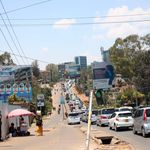
The Nairobi county government plans to increase parking charges to at least Sh535 and roll out a time-based tariff under a new pricing policy.
The Nairobi City County Government Tariffs and Pricing Policy 2025 to 2030, published last week, seeks to implement a zonal and time-based parking fee system reflecting the cost of providing a single parking service that has been estimated at Sh535 per day.
The county government seeks to generate higher revenues from the new rates to more than recover expenditures which include direct costs like paving and tarmacking, salaries for parking attendants, administrative and cleaning.
The policy suggests that parking fees in and around the central business district (CBD) will rise from the current daily rate of Sh300 to more than Sh535 which has been determined as the cost of providing a single parking service.
“Nairobi City County shall implement a zonal and time-based parking fee system that promotes congestion management, fairness, and transparency, supported by digital platforms and real-time data monitoring,” the policy says.
“The county government shall provide the following services for the parking tariff, including street lighting, cleaning services, security, paving, non-motorised transport (NMT) public transport services, traffic management, and demarcation of parking areas.”
Nairobi’s parking rate has held unchanged at Sh300 per day in recent years amid backlash from motorists to lift the daily charge and difficulties in implementing zonal tariffs which had been proposed previously.
City Hall previously proposed charging hourly parking rates to motorists in 2021 but did not follow through with the plan.
The county seeks to categorise parking spaces into two zones; zone one covers the central business district (CBD), Westlands, Upperhill, Industrial Area, Kilimani and Nairobi West.
All areas outside zone one are classified as zone two.
The county shall develop a framework to determine designated parking areas in the city, including loading and unloading zones, reserved parking and market areas.
Top revenue stream
Parking fees are among Nairobi county’s top revenue stream, alongside trade licenses, building plan approvals, market access tariffs, county housing, health-related fees, wayleave tariff and outdoor advertisement. The revenue stream accounted for 80 percent of the city county total revenue.
Parking fees were Nairobi’s fourth top revenue stream after land rates, hospital services and unified business permits in the financial year ended June 2026 as per the county revenue data.
The county collected Sh15.39 billion in own-source revenue for the 2025/26 fiscal year, up from Sh13.8 billion previously.
Nairobi County estimates its parking spaces at 17,000 implying a total service cost of Sh9.1 million against current receipts of roughly Sh5.1 million a day.
The county government says it has lacked a unified policy framework to link fees directly to the services rendered, resulting in inconsistencies and a misalignment between service provision and revenue collection.
“Historically, the county has relied primarily on the Finance Act and other legislative instruments in determining service charges, without a unified policy framework that links fees directly to the services rendered,” the policy adds.
“Despite the constitutional provision requiring each county to formulate a tariffs and pricing policy to guide the determination, adjustment and administration of fees and charges for public services, Nairobi City County has continued to rely on county laws and other legal frameworks inherited from defunct local authorities to set its fees and charges. This practice has led to inconsistencies, ineffectiveness, and gaps in revenue collection.”
The proposal to review all the city’s tariffs and pricing seeks to plug inconsistencies by articulating key policy objectives including the cost of providing public services, promoting efficient, sustainable and equitable revenue generation and providing clarity to Nairobi residents on what services they receive in return for payments made.
The county government is betting on the review of all its tariffs to recover the costs of service provision which usually beats its revenue allocation from the national government.
The total cost of all services provided by the county is estimated at Sh46.9 billion annually for the last three years, starting in the 2022/23 cycle to the 2024/25 financial year.
The county estimates its average annual cost for the provision of energy and lighting services at Sh4.84 billion. Sh359 million for the operations and maintenance of streetlights, Sh40.6 million for mobility and logistics and Sh350.6 million for ICT services.
The inability to link service delivery to costs has been deemed to affect operational sustainability, resulting in non-transparent and unpredictable charges, fragmented tariff structures and revenue leakages from weak pricing.
The push for higher parking fees is expected to face opposition from motorists, deeming them exorbitant.
Nairobi City County Government last lifted the fees by more than two-fold to the current Sh300 from Sh140 at the start of 2014 after lengthy court proceedings.
Higher rates
The High Court allowed City Hall to adopt the higher rates after determining that the tariff was reasonable, convenient and properly levied.
Last year, the county government said it had left the parking fees rate unchanged at Sh300, even as it began setting the stage for the 2025-2030 tariffs and pricing policy.
Hall insisted that any new charges would still require approval and enactment through the County Finance Act to be legally enforceable. The county noted that any new charges would be guided by value for money for residents.