At a training in Narok County, one of the counties where the TEEB Agrifood Kenya programme is being implemented, farmers debate an unusual topic for an agriculture meeting: natural capital, meaning the things that nature gives us for free.
The project, a collaborative initiative led by the United Nations Environment Programme in partnership with Strathmore University Business School, introduces farmers to true value accounting. It works with several counties in the Mau Forest Greater Ecosystem, including Bomet, Narok, and Kericho, bringing farmers together to rethink the economics of food production.
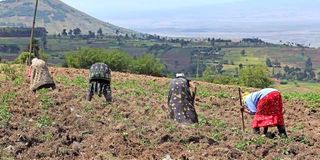
At the centre of the discussions is a simple but powerful framework. Agriculture depends on four forms of capital: human capital, which encompasses farmers’ knowledge and skills; social capital, including networks and cooperatives; produced capital, such as machinery and inputs; and natural capital.
It is the fourth capital that is often ignored. Natural capital is what nature provides freely: healthy soils, clean water, pollinators, earthworms, microorganisms, and biodiversity. It is the invisible foundation beneath every harvest.
As conversations unfolded, chemical fertilisers and crop protection products featured prominently. Many farmers acknowledged that synthetic inputs have supported yields over time. Crops appear greener, harvests can increase, yet beneath that surface productivity, deeper concerns were emerging.
Some farmers spoke of soils that no longer respond the way they once did. “We add more, but harvest the same,” one observed. Others described rising input costs that compress margins long before the produce reaches the market.
Through the true value accounting lens, these experiences point to pressure on natural capital. When soil loses organic matter, biodiversity declines, or water systems are strained by runoff, the cost is hidden from market prices. Over time, this erodes the foundation of production.
Importantly, the training was not framed as abandoning farm inputs, but it emphasised trade-offs and balance. Farmers explored integrating organic manure, composting, crop rotation, and other nature-positive methods alongside more precise synthetic application.
The farmers visited model farmers applying these blended approaches. On their farms, manure restored soil texture, mulching conserved moisture, and diversified cropping attracted beneficial insects. Input costs were moderated, soils appeared healthier, and yields remained stable. The narrative was changing from maximising output at any cost to sustaining the capital that makes output possible.
The implications extend beyond the farm gate. Global markets increasingly demand traceability, residue compliance and sustainability standards. A production system that considers this strengthens long-term competitiveness.
True value accounting expands the ledger. Produced capital can be purchased, but natural capital must be stewarded. In the counties where this programme is unfolding, farmers are beginning to see that protecting what nature provides is not an environmental luxury. It is an economic strategy.
Unlock a world of exclusive content today!Unlock a world of exclusive content today!