Time flies with great content! Renew in to keep enjoying all our premium content.
Prime
Science, sovereignty, and survival: Kenya positions itself as a health leader in Africa
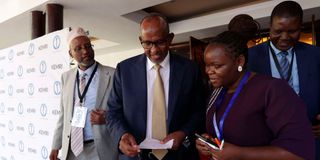
From left: Kenya Medical Research Institute (Kemri) Board of Directors Chairman Dr Abdullahi Ali Ibrahim, Health Cabinet Secretary Aden Duale, Kemri-Phd Student Melanie Awino Abongo and Kemri Acting Director General and CEO Prof Elijah Sangok at Safaripark Hotel in Nairobi on February 10, 2026 during the 16th Kemri Annual Scientific and Health (KASH) Conference.
From February 10 to 13, Nairobi hosted one of the country’s most consequential scientific gatherings as the Kenya Medical Research Institute (Kemri) convened the annual Kenya Annual Scientific and Health Conference (KASH) 2026.
This brought together researchers, policymakers, academics, and industry leaders under the theme, “The Future of Health: Scientific Research, Innovation, Technologies and Manufacturing for a Resilient Universal Health Coverage.”
Now firmly embedded in Kenya’s research calendar, KASH has evolved into more than a conference. It is a strategic platform where science meets policy and innovation aligns with national development priorities.
Across four days of deliberate and forward-looking discussions, the message was clear: Kenya is steadily positioning itself as a leader in Africa’s health innovation ecosystem.
Officially opening the conference, Health Cabinet Secretary Aden Duale reaffirmed the central role of research, innovation, and local manufacturing in advancing universal health coverage (UHC). Strengthening vaccine research and production, he observed, is not simply a scientific agenda but a matter of economic competitiveness and national sovereignty.
The Covid-19 pandemic offered a sobering lesson. When vaccines were scarce, Africa found itself at the back of the queue. Dependence is expensive, risky, and at critical moments, it can cost lives.
Prof Elijah Songok, acting director-general of Kemri, captured this urgency by describing vaccine research, development, and manufacturing as pillars of national health security and economic resilience. Science is no longer confined to laboratories; it is a strategic economic asset capable of shaping a nation’s future.
Encouragingly, Kemri has been elevated into a strategic national institution with an expanded mandate to link science to industry while advancing mission-driven research in genomics, climate and health, and emerging diseases. This is the kind of institutional clarity that transforms countries from consumers of innovation into producers of solutions.
Dr Abdullahi Ali, the Kemri board chairman, emphasised that the strength of future health systems will depend on robust research ecosystems, dynamic innovation pipelines, and strong local manufacturing capacity.
Among the most strategic conversations was Africa’s ambition to produce 60 percent of its vaccines locally. Delivering on this goal will require talent, financing, regulatory efficiency, and sustained political commitment. Kenya is not waiting on the sidelines. The country has the scientific base, institutional leadership, and policy momentum to help drive this continental shift.
The broader takeaway from KASH 2026 is unmistakable: Health security is economic security, scientific capacity is geopolitical leverage and innovation is sovereignty. Kenya is ready to lead, and the task now is consistency. Conferences must translate into sustained investment, supportive policy, and deliberate partnerships.
When the next global health crisis emerges, preparedness will not be judged by what was said in conference halls, but by what Kenya chose to build before the storm.
The writer is a climate action enthusiast and a communications specialist at Windward Communications Consultancy.
Unlock a world of exclusive content today!Unlock a world of exclusive content today!