The flower horse that stopped visitors, and told a bigger story

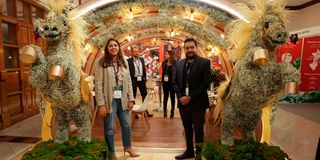
Anjili Shah (left) and Sanir Shah of Ole Engai Growers pose beside flower horse sculptures at their exhibition stand during the International Flower Trade Exhibition (IFTEX) at the Visa Oshwal Centre in Nairobi on June 2, 2026.

Photo credit: Evans Habil | Nation Media Group

As visitors streamed through the aisles of this year's International Floriculture Trade Exhibition (IFTEX) in Nairobi, many found themselves pausing at one particular stand.

Towering above arrangements of fresh-cut blooms was a life-sized horse sculpture crafted entirely from flowers. Built by Kenyan exporter Ole Engai Growers, the installation quickly became one of the exhibition's most photographed attractions, drawing visitors eager to capture its intricate details and imposing presence.
Yet beyond its artistic appeal, the floral horse told a deeper story about the realities of Kenya's flower industry. Despite growing pressures, the industry continues to grow in ambition and resilience.

Designed to mark the Chinese Lunar Year of the Horse, the sculpture was constructed using flowers grown on Ole Engai's farms in Kaptagat, Eldoret. Gypsophila formed its luminous white body, while carefully selected blooms in white, green and cream tones were used to create its flowing mane, muscular contours and dynamic posture.

"The inspiration came from the zodiac and the idea of energy, endurance and growth," said Anjili Shah, the company's co-director. "The horse symbolises all of that, and we wanted to translate it using the flowers we grow ourselves."

Business growth

The concept was developed by the company's creative management team and executed by a senior designer. The effort earned the company a Silver Award for Design Excellence at this year's IFTEX.

Visitors during The International Flower Trade Exhibition (IFTEX) exhibition at Visa Oshwal in Nairobi on June 2,2026.

Photo credit: Evans Habil | Nation Media Group

For Ole Engai's founders, however, more than exhibition creativity, the sculpture reflected the scale and diversity of a business that has steadily expanded its presence in international flower markets.

Operating on approximately 29 hectares in Uasin Gishu County, the family-run enterprise produces premium cut flowers for export. While gypsophila remains its flagship product, the farm also grows a wide range of varieties, including delphiniums, asters, kangaroo paws, dianthus and kiwi mellow cultivars.

"We are essentially a family-run flower business, with partners working together," said co-founder and director Sanir Shah. "Our main production is gypsophila, but we also grow a wide range of varieties depending on market demand."

The company exports an estimated 1,200 tonnes of flowers annually, serving primarily European markets while expanding its presence in the Middle East. Like many flower exporters, however, its growth ambitions are increasingly shaped by factors beyond the farm gate.

Rising uncertainty

Behind the colourful displays and commercial deals at IFTEX lies an industry grappling with rising costs, climate uncertainty and intensifying competition.

Freight costs, in particular, have emerged as one of the biggest challenges.

"Five years ago, we were paying around $1.40 per kilo for freight. Now it is over $4 per kilo," said Shah. "That is a massive increase. You can imagine the pressure on margins."

For flower exporters, whose products must reach overseas markets quickly and in perfect condition, transport costs can determine profitability.

The Kenya Flower Council (KFC) says rising freight charges, coupled with fuel price increases, have become a major concern across the sector.

Speaking during the official opening of IFTEX 2026, KFC chief executive Clement Tulezi said escalating logistics costs were placing significant operational pressure on exporters.

According to the council, freight rates have risen from approximately $3.10 per kilogramme to nearly $5.00 per kilogramme in a relatively short period. During peak seasons, freight can account for more than 40 percent of total export costs.

The industry is also contending with higher fertiliser prices, increased production expenses and delayed tax refunds, factors that have squeezed cash flow for many growers.

Sh10 billion VAT refunds

KFC is urging the government to release pending VAT refunds worth approximately Sh10 billion and to consider tax relief measures on key agricultural inputs.

Flower horse sculptures displayed at the Ole Engai Growers stand during the International Flower Trade Exhibition (IFTEX) at Visa Oshwal Centre in Nairobi on June 2, 2026.

Photo credit: Evans Habil | Nation Media Group

Competition from neighbouring countries is adding further pressure.

Exporters say countries such as Ethiopia continue to enjoy lower logistics costs, making it difficult for Kenyan growers to remain competitive in some international markets.
"We cannot easily increase flower prices because the market is very sensitive," said Shah. "When freight costs increase, we are hit directly."

Global events have further complicated operations. Conflicts affecting international flight routes have occasionally disrupted cargo availability, while changing weather patterns have made production planning increasingly unpredictable.

"This year, we expected a dry spell in January, February and March, but instead we had unexpected rain," Shah said. "You cannot fully predict the weather anymore, and that affects everything from planting schedules to quality control."
Despite these headwinds, Kenya's flower industry remains one of the country's most important export earners.

The sector generated approximately $845 million in 2025, contributing around 1.5 percent of GDP and maintaining its position as the largest segment within horticulture.

Kenya exports flowers to more than 60 countries, with roughly 70 percent destined for the European Union. The Netherlands remains the primary gateway into European markets, while demand from the Middle East, Asia and Eastern Europe continues to expand.

The 2026 edition of IFTEX, themed "Shaping the Future of Floriculture", brought together more than 200 exhibitors from across the value chain, including breeders, growers, logistics providers and input suppliers.

Follow ourWhatsApp channel for the latest business and markets updates.

PAYE Tax Calculator

Note: The results are not exact but very close to the actual.