Time flies with great content! Renew in to keep enjoying all our premium content.
Prime
Ruto ends Uhuru-era Sh362bn roads project in shift to bond financing
Road construction in Bomet East on September 16, 2025. Kenya’s payment of Sh56.9 billion in pending bills has revived road projects and lifted construction growth.
Photo credit: Vitalis Kimutai | Nation Media Group
The government is set to wind up a Sh362 billion rural roads programme launched during former President Uhuru Kenyatta’s administration and replace it with a securitisation model, under which it plans to issue a bond backed by future collections from the fuel levy.
The National Assembly’s Transport Committee disclosed that the government had resolved to scale down the annuity programme, citing the high cost of maintaining this variant of the public-private partnership (PPP) that the Jubilee government conceived as a means of reducing Kenya’s heavy debt load from road projects.
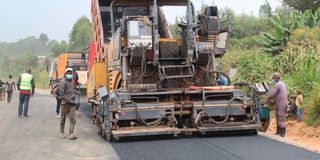
Dubbed the ‘Roads 10,000 Programme’, the annuity model involves private contractors designing, building and maintaining roads for a predetermined period.
The contractor and the government will each meet agreed portions of the total construction cost.
The government will then repay the contractor its portion, largely from funds it receives from the fuel levy in equal instalments (annuity) over a set period from the time a road is completed.
However, in its review of the budget estimates for the financial year starting July, the Transport Committee said the programme had become too costly to sustain, prompting the government to shift its focus to a securitisation plan anchored on a bond backed by the Sh5-per-litre fuel levy.
“The Committee on Transport observed that the government has scaled down the Roads Annuity Programme due to high project costs and no new project will be procured under the annuity funding model,” the National Assembly Budget and Appropriations Committee said in a report on the budget estimates for the upcoming fiscal year.
The committee added that the Sh3 per litre that used to go to the annuity fund will be reduced to Sh1.50, which will only cater for payments relating to the three completed annuity-financed projects.
The road projects that have so far been completed include Ngong-Kiserian-Isinya/Kajiado-Imaroro (Lot 33); select town roads in the Central region (Lot 15); and select town roads in the western region (Lot 18).
This reduction will ultimately reduce future flows into the annuity fund, leading to its end.
“In this regard, the Sh3 per litre charge to the flow to the Annuity Fund will be reduced to Sh1.50, while the proceeds from the surrendered Sh1.50 per litre will support the securitisation process supported by the Sh5 per litre allocation,” reads the report, adding that securitisation has already begun.
The government expects to float a bond of Sh120 billion, which will be backed by collections from the fuel levy.
The annuity programme has been used to offset the traditional reliance on the annual budget to construct rural roads whose use is limited.
The National Treasury previously noted that the traditional reliance had resulted in significant challenges, including budgetary constraints, high unit costs and slow project completion.
The Roads Annuity Programme was approved by Cabinet in March 2015 and planned for the upgrade of up to 10,000 kilometres of road.
The private sector has assumed commercial functions traditionally held by the government, shifting the projects’ risk away from the State.
The annuity programme has been crucial in overseeing the construction of major roads, including the 91-kilometre Ngong-Kiserian-Isinya-Imaroro Road Project (Lot 33) in Kajiado County, which was implemented through the Kenya Rural Roads Authority, where Intex RAF Limited financed the bulk of the costs.
Other projects are Lot 15, which upgraded 44.7 kilometres of identified town roads across six counties, including Nyeri, Kirinyaga, Murang’a, Embu, Tharaka Nithi and Laikipia.
Lot 18, meanwhile, focused on 35.1 kilometres of identified town roads across western Kenya, spanning Kakamega, Vihiga, Bungoma and Busia counties.
In January 2024, President Ruto’s government indicated that it would abandon the roads annuity programme, citing poor standards of roads being constructed using the low-volume seal roads technology introduced in 2014 by the then Uhuru Kenyatta administration. While the technology reportedly reduced construction costs by up to 60 percent, the quality of roads put up was deemed poor.
“When we constructed these roads, we anticipated that they would be for private vehicles and public transport use only, but they have since been used by even commercial vehicles that carry heavy loads,” said Kipchumba Murkomen, the then Transport Cabinet Secretary.
Under the 2024/25 budget, however, the then National Treasury Cabinet Secretary, Prof Njuguna Ndung’u, scaled up the allocation for the programme fivefold to Sh14.09 billion from Sh3 billion previously.
The programme was approved with a total investment of $2.8 billion (Sh362.4 billion).
The Sh1.50 residual allocation to the Annuity Fund will transition to support the securitisation of road sector pending bills where the government has raised up to Sh175 billion in commercial bank bridge facilities to clear arrears owed to road contractors.
The government has indicated plans to raise Sh120 billion from a Kenya Roads Board (KRB) bond, with investors being compensated using collections from the Road Maintenance Levy Fund.
“In this regard, the Sh3 per litre charge to flow to the Annuity Fund will be reduced to Sh1.50 per litre, while the proceeds from the surrendered Sh1.50 per litre will support the securitisation of the Sh5 per litre allocation,” the BAC committee added.