Time flies with great content! Renew in to keep enjoying all our premium content.
Prime
Motorists to get court option under revised NTSA instant fines rules
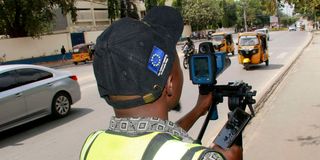
A National Transport and Safety Authority (NTSA) officer with a speedgun checks the speed of motorists driving along the Nyerere Avenue in Mombasa in this photo taken on December 22, 2025.
Motorists will have the option of declining to pay instant traffic fines and instead challenge the penalties in court under revised guidelines issued by the National Transport and Safety Authority (NTSA), marking a major shift in the rollout of the controversial automated traffic enforcement system.
The revised framework follows criticism from civil society groups, lawyers and motorists who argued that the digital penalties regime violated constitutional protections on fair hearing, criminal justice and data privacy.
Under the new framework, motorists accused of minor traffic offences will no longer be compelled to immediately settle penalties generated by the automated system. Instead, they may either admit liability and pay the prescribed fine or dispute the offence before a court of law.
The changes were announced by NTSA Director-General Nashon Kondiwa, who said the transport regulator had reviewed the implementation framework with stakeholders including the police, the Judiciary, the Office of the Director of Public Prosecutions and other enforcement agencies.
Camera clamp
The instant fines system relies heavily on smart traffic cameras and digital monitoring infrastructure to automatically detect traffic violations such as speeding, failure to wear seat belts and disobeying police instructions.
Once an offence is detected, the system generates a notification to motorists through SMS, email or digital traffic enforcement platforms. The notice contains details of the offence, including the date, time and location, the prescribed penalty and payment timelines.
“Upon receiving a notice, motorists have two options: they may admit liability and pay the prescribed fine within the stipulated period, or they may dispute the allegation in court,” said Mr Kondiwa.
He added that motorists who opt to settle the fine would avoid appearing in court, although courts would retain powers to reduce or refund penalties depending on mitigating circumstances.
The regulator also warned that motorists who fail to respond, pay fines or appear in court when required could face harsher penalties imposed through the judicial process.
Court battle
The revised framework follows a temporary suspension of the system by the High Court after a petition filed by civil society organisation Sheria Mtaani and advocate Shadrack Wambui.
The petitioners argued that the automated penalties scheme fundamentally alters how traffic offences are detected, prosecuted and punished in Kenya.
“The impugned notice purports to introduce a nationwide enforcement regime that fundamentally alters the manner in which criminal liability for traffic offences is determined, enforced and penalised in Kenya,” the petition states.
The court barred NTSA and other state agencies from issuing or enforcing instant penalties generated through algorithmic or automated decision-making systems pending the hearing of the case.
Another Nairobi motorist, Kennedy Maingi Mutwiri, also moved to court seeking to stop the implementation of the system, arguing that it punishes motorists without giving them an opportunity to defend themselves before a court of law.
Revenue drive
The automated fines regime forms part of a broader Sh42 billion smart driving licence and traffic management project being implemented through a public-private partnership (PPP).
The project is backed by KCB Group and Pesa Print, a local technology firm partly owned by businessman David Njane together with politically connected investors Jabir Abdul Nassir Abdalla Al-Kindy and Faryd Abdulrazak Sheikh.
The consortium plans to recoup its investment over a 21-year concession period through revenues generated from instant traffic fines, smart driving licence fees and other user charges.
NTSA documents show that motorists will pay Sh3,000 for the new smart driving licences, while traffic offenders will face penalties ranging from Sh500 for failure to wear seat belts to Sh10,000 for offences such as speeding and driving vehicles without valid inspection certificates.
The project also includes the installation of more than 1,000 smart traffic cameras across major highways and accident-prone roads.
About 700 fixed cameras will be mounted along strategic highways and urban centres, while 300 mobile units will target speeding hotspots and high-risk corridors.
The government argues that the system will improve road safety and help reduce accidents caused by speeding and reckless driving.
Kenya has increasingly turned to PPP arrangements to finance major infrastructure projects amid mounting fiscal pressure and shrinking public revenues.
Treasury data shows the government collected an average of Sh1.7 billion annually from traffic fines between July 2020 and June 2024. However, officials expect collections to rise sharply once the automated fines system is fully implemented.
The smart licence project was initially launched in 2017 under a Sh2.03 billion contract awarded to a consortium led by the then National Bank of Kenya. The arrangement was later converted into a PPP model after the government accumulated pending bills owed to Pesa Print.
Auditor-General Nancy Gathungu has previously flagged delays in the implementation of the project, noting that it is several years behind schedule.