From banking to fashion: Why Wandia Gichuru wants Africa to wear its own brands

Vivo Fashion Group Co-Founder and CEO Wandia Gichuru poses for a picture after an interview at her office on May 20, 2026.

Photo credit: Francis Nderitu | Nation Media Group

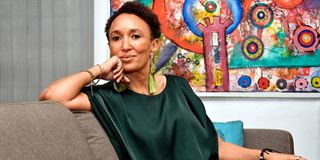
At Spring Valley Coffee café, an enamoured waitress, not an hour older than 20, approaches our table with a menu held close to her chest like a hymn book. "I love your outfit. You look so good!" The compliment isn't directed towards me but towards Wandia Gichuru, founder and CEO of Vivo Fashion Group. She is wearing a loose, dark green satin blouse with the softest of sheen, large olive-green tassel earrings, delicate gold chains layered at different lengths with a pearl accent and on her fingers several minimalist rings in gold and silver.

If this was a novel she would be the character described as 'sweeping through a room in a gale of green'. But this is life. And she explains that she has two major events after this; a panel at the Retail Trade Association of Kenya summit and later that evening a gathering around Graça Machel who is visiting.
At 15, Vivo Fashion Group is East Africa's largest homegrown women's fashion brand – 30 stores across Kenya, Uganda and Rwanda, and hundreds of employees. Wandia co-founded it in 2011 with a friend, out of her living room, with savings and no plan, after leaving a career that had taken her through Citibank, the World Bank, JP Morgan in London and the UN in New York.

She is, at her core, an economist who found her argument in a fitting room. The argument is now 15 years in the making: Africa is dressed by everyone but itself. Almost everything East Africans wear belongs to somebody else. The clothes in global fashion chains are not made in Europe, they are stitched here, exported, marked up, then sold back, or they arrive as mitumba. "So who is dressing us," she asks, with a hard unwavering stare, "and who is making the money?"

For her, Vivo is a proof of concept. That locally made clothing can be affordable. That fashion manufacturing, still too complex for robots, still requiring human hands, is one of the most viable job-creation engines on the continent. "Every generation carries its own responsibility," she says, borrowing from Graça Machel. "Our generation's responsibility is making sure Africa is no longer left behind."

Do you get this a lot; people walking up to you paying you compliments for your sense of fashion?

[Laughs] Not so often, I’m not a fashionista. There is a difference between being a fashionista and running a fashion brand. I mean, you could be either, you could be both, you could be neither. I'm much more interested in the business of fashion than I being a fashionista.

How do you feel when you see people wearing your style? We saw someone walk by in one of her outfits. Do you feel validated?

[Pause] Gratitude. Gratitude is the predominant feeling. But I also know it’s not a favour, and people are willing to pay for it. If you could turn around, you see that lovely basket that lady is carrying? It is exactly an African style but I guarantee you it’s imported.

The business of fashion is the economic aspect of it. And I feel like Africa doesn't have its act together yet. We have to understand the opportunity. Of course, there’s pride and identity and all that, but there’s also manufacturing, exporting our own brands instead of just producing for other people.

We celebrate setting up mostly American brands here, and yes, that creates jobs, but mostly at the lowest level. You go into those EPZ factories and ask: where has that institutional knowledge spilled over into the rest of the country? Nowhere. It’s all walled off. People aren’t trained into management positions, so they remain workers.

And that’s still better than no jobs, of course. But we don’t own the brand. We’re still operating at the lower end of the value chain. That’s what I mean by the business of fashion. Look around. Ninety five percent of the brands East Africans wear belong to somebody else. So who is dressing us? And who is making the money?

I interviewed you 10 years ago. Vivo was only five years old. Now you are celebrating your 15th birthday. Are you surprised at your trajectory?

I had no plan for the brand when we met. Really, no plan at all. And I was drowning at that point. Six stores, 60 employees, no board. I knew I needed help. Then a friend forwarded me a WhatsApp about Stanford Seed, a programme for business owners, and I applied. That was the turning point.

The plan that came out of it was ambitious: a billion shillings in revenue, 30 stores, two or three other countries. Then Covid hit and gave us a real slump. But we recovered. By 2024 we had hit 20 stores, slightly behind schedule, but many of the bigger goals we either achieved or came very close to.

What did you find to be the greatest tension in growth?

Systems. And mindset. I can't naturally sit here and think, we'll hit ten million shillings this year and a hundred million in a few years. I grew up with a civil servant father and a schoolteacher mother.

I wasn't surrounded by wealthy, successful business people, so even imagining you could build something massive, that you could be capable of that, doesn't come naturally. And as a woman, you don't see it modelled that much either.

Vivo Fashion Group Co-Founder and CEO Wandia Gichuru poses for a picture after an interview at her office on May 20, 2026.

Photo credit: Francis Nderitu | Nation Media Group

I sometimes think men either fake the confidence better, or genuinely have more of it. [Laughs] My thinking is still quite linear. We opened two stores last year, maybe we can open three next year. That kind of thinking.

Has it got easier now that your brand is more established than it ever was?

I honestly don't think so. New players enter the market every day. You can't afford to get comfortable. Geopolitics shifts your costs and pricing. I recently discovered that half my design team were all moonlighting for the same competitor. I take nothing for granted. Clothing isn't like food. If tomorrow everyone decided not to buy clothes for six months, they'd survive.

If you were to live to 90, what else would you want to put in this basket of life, apart from being an entrepreneur? Or are you also just happy you did this and you did it to your best knowledge?

I think about this a lot. I think life is really just an accumulation of many good days. Not a checklist of things to accomplish. Were most of my days good days? Did I laugh? Did I connect with someone I love? Did I learn something? Did I contribute something? Was I present for the people who matter most? Because I grew up with a father who gave all his energy to the outside world and came home grumpy. Then when he died, everyone said how funny he was, how much they'd miss him. And I remember thinking, who is this person you people knew? I lost my mum not long ago…

Oh, I’m sorry.

I hadn't seen her for a year. She was in Canada. That year I went to the US four times but never crossed over. She kept saying: “You’re coming again and you’re still not coming to see me?” and I kept saying, next trip. My Canadian visa had expired and in my mind that was always the excuse. I finally got it. The visa arrived on a Friday. She died the next day. All the things I was chasing in the US, all that work, it's gone now. [Closure of US store]. But I didn't see my mother.

So when I think about 90, the first thing is; will I have children and grandchildren who actually want to spend time with me? I want to be the kind of old person people gather around. And I still want to wake up with goals. I never want to feel like my life is done.

What do you remember about your childhood?

I have three brothers, and I remember always wanting to be with my friends because I wasn’t a tomboy. Whatever my brothers were doing, I wasn’t interested. I wanted to do girly things.

I remember my mother being very stressed, probably depressed in hindsight, because life was hard and my dad wasn’t contributing much, so she was carrying everything.

Looking back now, I can see it was pretty dysfunctional, but at the time it didn’t feel that way. It just felt normal because that’s all you know as a child. There were very few rules in the house because my mum was busy all the time. She was teaching during the day and doing counselling at night, and my dad was mostly in bars.

So we were basically free-range children. That’s actually how my daughter describes my childhood. Like free-range chickens. [Chuckles] There was very little supervision. If we ate dinner, we ate. If we didn’t, we didn’t. If we showered, brushed our teeth…it was all kind of up to us.

What was the impact of that in you as an adult?

I think it made me very responsible. Nobody was checking whether I’d done my homework or telling me what to do. If I got in trouble at school, that was on me. So I think I developed a very free mind and a strong sense that my actions are my responsibility. But the downside is probably the same thing.

I don’t do well with being confined or controlled. Structure is fine if it’s my structure. But when something feels imposed on me, I resist it almost instinctively because I didn’t grow up like that. I don't have great emotional education.

What does that mean?

I don't know how to self-manage when I get upset.

You fly off the handle?

Not in a crazy way. I watched Trevor Noah's latest Netflix special where he talks about how it has taken him several relationships to realise it's not always in his best interest to say whatever is on his mind. I completely related to that. Being upset, feeling something strongly, but knowing this is not the right moment, waiting, I don't do that very well.

What therapy helped me understand is that self-regulation is actually taught to you as you grow up. A parent helps you regulate until you learn to do it yourself. I don't think we really got that. Sometimes I'll say something in therapy and my therapist will look at me and say, 'You know other people don't do that, right?' And I'm like, really? [Laughs].

Is there anything new you've discovered about yourself during therapy that really surprised you?

I haven’t gone to therapy consistently, but I have gone at different times for different reasons. It helps one understand their personality, change, learn new habits, rewire their thinking.

Vivo Fashion Group Co-Founder and CEO Wandia Gichuru poses for a picture after an interview at her office on May 20, 2026.

Photo credit: Francis Nderitu | Nation Media Group

For me, understanding my attachment style and seeing how it plays out helps me recognise when I’m the one causing certain patterns, because it’s so easy to blame the other person.

If I know I’m entering relationships with certain tendencies, then I can catch them. For instance, I’m hyper-vigilant to any sign of abandonment. I’ll sniff it out from two miles away. Sometimes I’ll even imagine it when it’s not there at all. Then I’m gone. [Chuckles]

Does that come from your experience with your dad?

That comes from watching my dad, watching my parents, and subconsciously forming certain beliefs about men and relationships without even realising it.

Which part of leadership, because you’ve been doing this for a while now, do you feel still needs work?

Patience. I can be very [makes cutting gestures to mean regimentary]. I’m always like let's do this, what are we waiting for. I wish I could lead from behind. [Pause] Yeah. I also don’t praise as much as I should. They say ‘criticise for every five praises.’ I’m doing so badly on that front. [Laughs]. I just…I just notice problems. I'm very observant. So I will walk into a store and immediately see problems.

Why are these hangers not straight, why…you know…if you are wise you greet people first, ask how they are doing. Don’t start with criticism. Truth is people, people get tired. I’m working on it but not succeeding as quickly as I want to.

What's the one thing you're working towards achieving this year?

This year I made a commitment to get physically stronger by the end of year. I’d read Atomic Habits and it gave me a framework for understanding habits. One of the things the book says is that if you keep saying you want to do something but you’re not doing it, you need to understand what’s creating the friction. Driving to the gym was a friction. So I hired a trainer who comes to the house.

Now the friction is gone because she’s there at 6:30am whether I feel like it or not. I’m also trying to apply that thinking elsewhere too, with my finances, with being more intentional, more conscious.

Putting systems around budgeting and planning because those aren’t things I naturally had. And then lastly with my children and my partner. Because they don’t live here, I’m trying to be intentional about scheduling time with them so I don’t repeat what happened with my mother, where I prioritised everything else.

Follow ourWhatsApp channel for the latest business and markets updates.

PAYE Tax Calculator

Note: The results are not exact but very close to the actual.