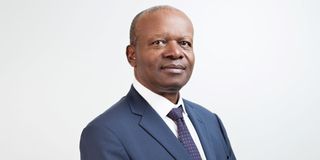
It takes a full three-course meal for Vincent Rague to fully exhaust his professional resume. And not that he speaks slowly.
The resume is, admittedly, earned. Over four decades, he moved through the Central Bank of Kenya, trained with Citibank in Athens and NatWest in London, climbed through the World Bank's IFC to become its first African Regional Director for Southern Africa, setting up the Johannesburg office from scratch, at a time when there were quiet doubts inside the organisation about whether an African could carry that role in that environment.
He moved through Washington, Eastern Europe, and Central Asia before coming home to advise Kenya's National Treasury on trade and financial reform - specifically the movement of goods from the Port of Mombasa inland, cutting through the checkpoints and bottlenecks that had long strangled commerce.
He co-founded Catalyst Principal Partners, chaired Financial Sector Deepening Africa for seven years, and has sat on the boards of MTN, UAP Old Mutual, and JamboJet, among others. His philosophy, distilled: "You cannot wait for the market to be right for you to go in. The day you do that, you lose. As they say, you blink, you lose." He has never blinked.
By any measure, a man who has earned his dessert.
An even more interesting conversation, it turns out, is not just about what he built but what comes after. He retired on purpose — and he is at pains to tell you this is rarer than it sounds. Most men of his standing don't retire.
They slow down while pretending otherwise, or they stop and quietly unravel, stripped of the structure that gave them shape. He watched this happen to his peers and made a decision: when he left his full-time executive life, he would do so with intention. Deliberately. Because "I've seen how quickly people can decline when they disengage," he says. "I didn't want that."
Vincent’s three-course meal, it turns out, has no dessert menu. Just more courses. Only lighter ones.
Do you remember what you wanted as a young man?
After my exams, my father received two admission letters: Alliance and Strathmore. He never disclosed the former, but handed me the latter. I was disappointed and upset because I wanted to attend Strathmore to pursue accounting immediately after O-levels, rather than going through A-levels.
In retrospect, my father was wise; he understood my character. I was too young then to become a professional and start earning what, at the time, was considered good money. I saw it with friends who took that route - some did well, but many were destroyed early by the sudden high income.
I never saw myself as a lawyer or a doctor - even though I was a good student. Some of my teachers thought I should become an engineer, but from early on, I was more inclined toward mathematics, around the economy, though at the time, I didn’t quite know it as economics.
What season of your life did you find yourself to be more stimulated intellectually?
I would say when I was part of the Kenya delegation negotiating what is now the World Trade Organisation (WTO). I was quite young and wasn’t entirely sure I was qualified to be there. But the people who selected me had confidence in me, and that gave me a certain sense of confidence, even as I stepped into something that felt bigger than me. I had to prepare intensely. I spent a lot of time reading, going through documents, and sitting in meetings. Most of the time, I was the youngest person in the room.
I remember a delegate from Zambia who kept looking at me, almost puzzled. At one point, she asked, “Are you an intern?” [Laughs] I think there was some surprise—but also, I had to carry myself in a way that justified being there. That period pushed me intellectually. I had no one to rely on at the moment - I had to be prepared for everything. Not just to participate, but to understand the issues deeply enough to contribute meaningfully.
Over time, I found my footing. In fact, at some point, the group asked me to take on the role of rapporteur - essentially keeping track of proceedings and synthesising discussions, sometimes after long, intense sessions. So yes, that period, leading up to the signing, was probably when I felt most intellectually stretched and stimulated.
And which season did you find most challenging?
My brother’s passing. That wasn’t easy. He was doing well for himself. Died from alcohol related complications. Yes, that wasn’t easy at all.
It sounds like the word success can be attached to your story. Are you comfortable with the word?
Yes, but I’ve always seen success in a broader way. It’s not just about what you achieve personally - it’s also about what you do with it. For me, that has meant staying connected to where I come from. I sit on the board of trustees of my alma mater, the University of Virginia’s Darden School of Business, and support it where I can. I’ve always felt a responsibility to give back.
The same applies to mentorship. I believe in supporting others - guiding, opening doors where possible. In some ways, I’ve been fortunate. You could even say blessed. And that comes with an obligation. So, when I think about success, those things are part of it, not separate..
Looking back, what would you do differently or not do at all?
In retrospect, of course, there are things one might do differently. But I don’t dwell on that, because the outcome is a result of all those decisions -good and bad.
From a career standpoint, I wouldn’t change much. At one point, I made a decision that went against what many people considered sensible - both financially and socially. I had a good life. I was working at the Central Bank, had just bought my first house in a good neighbourhood in Nairobi, and I was driving a nice car. By all measures, I was comfortable. And people asked me, “What are you doing?”
Vincent Rague, retired executive and co-founder of Catalyst Principal Partners
Photo credit: Pool
But I had to ask myself a different question: do I just settle into this, or do I take a risk? So I chose to leave. I sold my car to raise money, took a break from the Central Bank, and went to the US to study.
At the time, it didn’t make sense to many of my friends. But once I came back, even those who had questioned the decision said it had been the right move. Looking back, it was an important turning point for me. In a way, you could say it was a defining moment.
You have two adult sons. Did you enjoy fatherhood?
I was probably better at it after the birth of my secondborn. With the first child, you’re figuring it out as you go. You don’t know what kind of father you are yet. Should you be tough, should you be soft? You’re learning in real time. By the second, you have a bit more perspective. A bit more understanding.
But I wouldn’t say I was good at it. I was okay - but not great. I did what was necessary. With fatherhood, you’re constantly learning. The most challenging part is finding the balance between listening to your children and exercising authority, between hearing what they want, what they feel, and still making decisions as a parent.
For me, one of the biggest lessons has been that you shouldn’t be afraid to consult them. Not in the sense of letting them decide everything, but understanding what their desires are, what matters to them. Then you decide: do you guide that, shape it, or accept it?
It sounds like you spent a great deal of your life abroad. Do you have any roots in your ancestral home, to your people?
I don’t really have a “village” in the traditional sense. We didn’t grow up with that anchor. My parents didn’t retire back to a rural home, they bought land and settled somewhere new, somewhere that wasn’t really tied to either side of the family. So I never developed that deep, inherited sense of place. In a way, that has made me more adaptable - more fluid.
But there’s a cost to it. It can make it harder, emotionally, to form deep roots or lasting friendships. So what grounds me isn’t necessarily a place. It’s more a sense of movement, of familiarity across spaces.
I can go for long periods without seeing relatives, but when we meet again, it’s as if no time has passed. That continuity matters more to me than physical proximity. I also value a certain level of comfort. Not extravagance - just ease. Access, efficiency, and the ability to move.
These days, Nairobi makes more sense to me. I don’t need permits or permissions to be here. It’s well connected - you can be in Johannesburg in four hours, Cairo in five. The US is 14 hours away. That distance starts to feel heavier over time. And as you get older, you realise your resilience isn’t quite what it used to be. You become more intentional about where you base yourself.
There’s also the pull of family. We’ve had those conversations - around the table - with my family about presence, about time. But the rhythm of life changes; one time you are the one who is busy flying in and out the next it’s your children. My son is now married and he has a busy life of his own and I was reminding him of what he used to remind me: that he needs to make time for us. [Laughs]
What's the most common question you find leaders asking you?
CEOs and investors most often enquire about markets. They want to understand whether the opportunity they’re looking at actually exists, and whether it’s sustainable. Beyond that, the conversations tend to stay within professional boundaries.
Men are not comfortable being vulnerable. So while there are a few who will open up about personal challenges, family, or crossroads in their lives, most prefer to keep the discussion on safer ground. They will talk about almost anything else, but not the things that expose them.
What do you fear now at this stage of your life?
I wouldn’t call it fear, exactly - more a concern. What concerns me is how our society is evolving, particularly around how we care for people as they grow older. In more developed environments, there are structured systems -senior living arrangements where you can downsize but still have support. It’s managed. You pay for services - whether it’s medical care, assistance, or even something as simple as transport if you need it. We don’t quite have that here yet. Not in a fully developed way.
Traditionally, the family would step in. But as family structures change and become more dispersed, that support is not always guaranteed. So the question becomes: have we put in place the right systems to take care of ourselves when that time comes? I’m not afraid of it happening. It’s inevitable. But I am concerned about whether the structures will be there when it does.