The poetry of sight can only be fully appreciated by those who lose it. Nobody said those words, but they should have. As the General Manager of Lions SightFirst Eye Hospital, Rizwana Peerbhoy is in the business of restoring sight, which, in a way, makes her a poet. And for that, she receives flowers. Virtual ones in the form of handwritten notes and texts, but also real ones – like this extravagant bunch of lilies waiting on her desk.
Behind the lilies is a serious operation. Twenty-five doctors. Twelve ophthalmology specialists. Six satellite clinics from Eastleigh to Village Market. Five hundred walk-ins a day, and another 500-800 screened at camps each week. She doesn’t just witness miracles. She runs the infrastructure that produces them. Sight, it turns out, is not just a medical issue. It is logistical. Financial. Cultural. It depends on supply chains, donors, and systems that work –until they don’t. It depends, sometimes, on something as fragile as a cornea.
Kenya has a waiting list of at least 3,000 people who need corneas. The real figure, she suspects, is closer to 30,000 or 40,000. For now, the hospital sources them from Europe, the US, and Sri Lanka, a solution that won’t hold forever. Local donation remains a quiet, complicated conversation, one she is having gently, persistently, with church leaders, imams and communities for whom the idea is new, but no longer unthinkable. Donors are few. But they are coming.
“A few weeks ago, we got our first local African cornea donor,” she says. “It was a nun who pledged her cornea. So it’s coming.” If she does one thing in her time at the hospital, it is to set up a cornea bank. Local. Sufficient. No waiting list. “Like a blood bank,” she says.
Sight, she has learned, is not only something you see with. It is something you give.
Tell me about this cornea business and the religious angle of it, sounds mighty interesting…
We import corneas from Europe, the US, and Sri Lanka because locally, donation has not yet caught on. The Hindus have been quite generous, but the Christians and Muslims are not yet there.
Somewhere in The Book, it says you should go back intact, but that’s not possible, because nothing will remain. Your body is going to end up as ash…or dust. The soul will have departed. So, why not give this piece of your life? You could be giving 60 or 70 years of good life to a child who might be the next scientist, or the next president.
On World Keratoconus Day, we brought everyone together –the church leaders, the priests, the imams – and had all these recipients, people who had benefited from cornea transplants, tell their stories. The conversation was quite nice. They were impressed. We showed them that this is not even an organ; it is a tissue, like blood tissue. If you are allowed to donate blood, why not a cornea?
The window after death is only six to eight hours before the tissue starts shrivelling. We can’t browbeat anyone - it is a sensitive matter. But slowly, we are getting there. A few weeks ago, we got our first local African donor. It was a nun who pledged her cornea.
This isn’t a job, is it?
It’s a service. And that service is so gratifying. When you see that transformation—when you see someone who is helpless, who has put all their trust in you, who has come to a place they don’t even understand, only to be told their blindness will be reversed—you feel it. They come with that trust. And when they leave, they can read. You hear things.
People say, now I’ll be able to read my Bible. Someone else says, I’ll go back to farming. I’ll be independent, I’ll sustain myself. Others say, my children can now go back to school—I used to make them work the farm because I couldn’t see. We see it even with tea pickers. Something as simple as a pair of reading glasses doubled their productivity overnight.
Those are the most satisfying parts of the job. You might not get that anywhere else. Here, you see it. You see transformation happen to people who otherwise have nowhere to go.
That's amazing. How did you end up here?
Well, it was really an interesting story. I had applied for a position at MP Shah Hospital, but they had already taken on someone else. Then the chairman told me, we have something at Lions. Why don’t you go there as a visitor, see if it interests you? The general manager was retiring, and the hospital was looking to fill the role.
I came here, and they didn’t even tell the team who I was—they just said I was a potential donor. So, they took me around, showed me everything. And I thought, this is doable. This is nice. So, I decided to take it on. It’s been nine years now.
Before that, I used to work at Aga Khan Hospital, and then I lost my husband. I had to regroup. He died very suddenly 12 years ago. My girls were still in school. So I took on a consultancy as I figured things out, because I had to—everything had to keep moving. But it wasn’t enough. I needed something more permanent. By then, I had steadied things, and I said, “Alright, now we look for something”.
How old was he when he died?
Only 57. Terribly young. A heart attack. The girls were in high school. I had just turned 50, and two months later, I was a widow. You don’t even think about these things, that you can be a widow so young.
In the last few years—post-Covid—I think it has become something people are starting to take in their stride. But at that time, a young widow was seen as something very traumatic. It wasn’t common. Now you see it more, and much younger.
So you never think of the worst. You don’t see yourself there. And then one day you’re staring it in the face—with two girls. It was April. My daughters were sitting their final exams. One was finishing her AS level, the other was in her third year of pharmacy. Now they are big girls. One is a dentist, the other a pharmacist. I feel blessed they found their way.
What lessons did that experience teach you, as a young widow?
First, prayer. You need to hold on to your faith, whatever that is. And second, focus. It really is one day at a time. You start putting the pieces together from there. Because the girls were sitting their exams, I didn’t want their year disrupted, so I had to put on a brave front.
Sometimes, I’ll be honest, I don’t think I even had time to grieve. It all happened so suddenly. There was so much to do—the funeral, everything. I’m an only child, and I had lost my mother just a year before.
So you just take it in your stride. You tell yourself, “I have to do this today, then that”, and you keep going. But I always tell grieving women: if you need to cry, if you need to break down, do it. There’s never a good time, and it’s better to let it out. I didn’t. I bottled it in. It was only six months later, one Friday evening, when my girls were away, and I was alone, that the tears came.
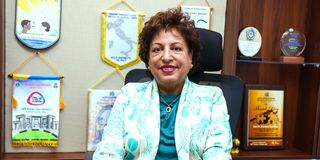
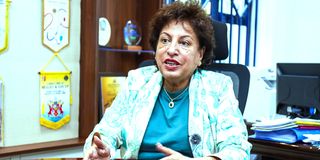
Dr Rizwana Peerbhoy, General Manager of Lions SightFirst Eye Hospital, during an interview at the hospital in Loresho, Nairobi, on March 31, 2026.
Photo credit: Bonface Bogita | Nation Media Group
I wasn’t even thinking about anything—they just came. And that’s when I realised I hadn’t given myself time to grieve. So you should grieve. You can vent. You can ask, “Why me?” You can fight with whatever you need to. If you do fall apart, which can happen, then you must seek counselling. But if you’re able to regroup, then you pick yourself up and keep going. Some days will be down, some up—but you carry on, you find your space.
And you learn to surround yourself with positive people—friends, family, those who lift you. Because culturally, as a widow, things change. You might find you’re not as accepted in some spaces, especially being without a husband in a space where your friends have husbands. So you learn to accept that too. And you decide where you want to be.
Fifty was pretty young to be a widow, not that there ever is the right age. Did you ever consider remarrying?
This is what I’m saying—you reach a certain point in life and think, okay, now things will ease. The children are still young, but old enough. You start to look forward to a different kind of life. And then—bang—you’re staring at emptiness. I didn’t consider remarrying.
I needed to focus on the girls more than myself. I had a good circle of friends, and I was content with what I had. I also threw myself into work. That became my therapy. I don’t regret it. It was good for them.
And I’m blessed. I can’t say it’s all me—they turned out to be fine girls. Now, years later, they’re all grown, and I’ve found my footing in my career. Would I get married again? I don’t know. But if I met a like-minded person, why not? A relationship—yes.
In fact, my girls told me early on, “Mum, if you find someone, we won’t stand in your way”. And I told them, “If that happens, I’ll let you know—but for now, I need to focus on you”.
If it was meant to happen, it would have. But they were right from the beginning — “It’s not fair on you,” they said. “We’ll have our own lives one day”. They’ve always had good heads on their shoulders.
At this stage of your life, what frightens you the most?
Ageing, especially if it comes with illness. I fear becoming dependent, becoming a burden. I want them (daughters) to live their lives. I want to support them, be there for them. They may go on to do their own thing, but I don’t want to reach a point where I am so unwell that everything begins to revolve around me.
Even if I have insurance cover or other things, it still weighs on them—that feeling that there’s no one else for mum, it’s just us. Not that they wouldn’t do it out of love, but they have their own lives, their own families, their own priorities. That balance matters.
I just hope I can stay up and about, reasonably well. But loneliness came earlier than that. Because no matter how close you are to your children—and I’m grateful for mine—there are things you will never share with them.
What else do you pour yourself into like you do this job?
Well, you know, besides friends and travel and all of that, I also am heavily involved in the mosque, teaching the children, setting policies for the religion and all that. For us, Islam is a way of life. It’s not something you set aside for a specific time of day. It’s in your work, your ethics, your daily conduct. Your integrity should reflect your faith at all times.
I take it that your spiritual health is sound?
Yes, strong. It’s just that sometimes, with work, I can’t do as much as I used to. I used to go to the mosque at four in the morning. For about two or three years, I even took duty—I would open it at three. It was very nice. It wasn’t just the religious side.
What I’ve found is that early morning—that hour, which every religion speaks about—if you meditate, or contemplate, or reflect, whatever you want to call it, your days become amazing. The way things unfold…you just see things differently. The discipline is very hard. But if you follow it, it’s incredible.
At the moment, I’m not doing it as much as I should. And I tell myself—that’s the best. The days I do wake up early are brilliant. Beautiful days. But then again, if you sleep late, how do you get up? You’re always balancing your world.
What do you struggle with running a place like this?
I think the struggle is mostly in the basics. Right now, for example, with what the health sector is going through—delayed payments from payers. That makes things very difficult, especially for us, because in many ways we are a partner to the government. Our social service arm supports a large part of that work. But we don’t turn anyone away. Nobody goes unserved.
So you’re delivering care, and at the same time trying to keep your creditors at bay because payments aren’t coming in on time. That’s probably the biggest challenge. Then, of course, there’s the global economy—supplies becoming more expensive or harder to secure because of wars and the after-effects of the pandemic.
But beyond that, our team is wonderful. The staff are really the heartbeat of this place. The compassion they show, especially during camps, is remarkable. If you read the testimonials, they’re incredible. In fact, just yesterday we had a patient...it really gives you a sense of what it means to people when they’re treated well and looked after.