Raul Martyres, the godfather of advertising, remains strong even in his stumble. He is turning 90 this year, so you’d expect him to have a bad knee. Unbowed is the posture of a man who has spent nearly five decades building one of Kenya’s most respected advertising agencies—Access Leo Burnett, which he founded in 1979. A pesky knee isn't going to get in the man’s way.
In the 1950s, he started writing hockey commentaries for The Standard, moved into insurance, then advertising, learning the craft in an era when media meant newspapers and the occasional radio. He watched television arrive and change everything. He lived through independence, through the evolution of brands, through the digital revolution that has upended his industry yet again. And he survived Covid-19. Through it all, he held onto a simple philosophy: Understand people deeply, build brands thoughtfully, and never compromise on integrity. “Success means very little,” he says, “if it isn’t achieved with integrity.”
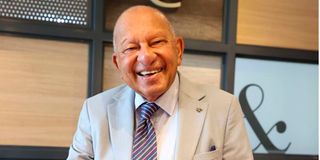
We meet at his office, where he still comes in as often as he can—not every day, but often enough to stay connected, to read the newspapers, to walk the corridors and exchange words with younger colleagues who probably don't fully grasp that they're working alongside history. He is the chairman now. Forty-five years later, the agency still stands, led by his daughter Annette, who took over as managing director in 2007.
I was actually born in Kisii—not Nairobi, as many people assume. My father was working for the government at the time, which was then the British government, in the medical department.
He was stationed at the hospital there, and that’s how my life began—at a time when there was almost nothing in Kisii. We didn’t stay long. I must have been about three or four when my father was transferred to Kisumu.
After that he moved around a bit, and eventually we settled in Nairobi, which is where I grew up for most of my life. My father was a very good man. I have great respect for him. We were brought up differently then—there was a strong emphasis on respect, especially for elders.
Access Leo Burnett chairman Raul Martyres during an interview at his Kilimani office in Nairobi on February 7, 2026.
Photo credit: Sila Kiplagat | Nation Media Group
My mother was there as well; even though the hospital was still being established, they managed to have me there. My father was actually part of the team setting it up. This was a long time ago—1936.
Eventually, we moved to Nairobi. I studied here for a while, then went to Goa, in India, for further studies. After that, I came back to Kenya and started working here.
Was there any indication earlier on in your youth that you’d end up in advertising?
Growing up, I played a lot of competitive hockey. I loved the game—played it seriously and followed it closely—and that pushed me into writing. After matches, I would write short commentaries and send them to The Standard, which was the only newspaper then. I’m talking about the 1950s. Almost invariably, they were published. The paper was run by the British at the time. That was my first real relationship with newspapers—my first understanding of media.
At the same time, I was working in an insurance company, still playing hockey, and still writing. Hockey mattered then. Kenya went to the Olympics and played teams like India and Pakistan—the giants of the game. It felt significant.
Eventually, I secured a job at an advertising agency called Famal—African Amalgamated Advertising Contractors. It was South African-owned, but they were good people. I worked there from about 1958 to 1961.
Around independence, the agency closed down, and I moved to S.H. Benson, a strong and respected British agency. I joined client service, though I began in production and later moved into media.
I built up the media department, working mainly with newspapers across East Africa and radio stations. That was the landscape then—advertising was regional and shaped by the colonial structure.
Later, S.H. Benson was taken over, and Ogilvy came in. That period was important for me. It was a great organisation, led by people who truly understood the craft. I flourished there. I spent about 15 years in client service, was appointed to the board, and was seconded to London for six months. That’s where my professional life truly took root.
You must have been very young. Were you married?
I was in my 20s then—late 20s, really. Being in London gave me proper exposure, a kind of training. You sit in those offices and begin to understand how that part of the world works, how decisions are made, how the industry thinks. I was already married by then. I got married quite young, actually—at 23.
Yes, I was already working at the agency at the time. I had known my wife from much earlier, from our teenage years. We used to meet at dances and clubs, the usual places. We had also gone to the same school originally—Dr. Ribeiro, which is now Parklands School. We grew up around the same area, our families knew each other... That’s probably why getting married young felt natural to us.
So you are working for Ogilvy in London…
I spent six months with Ogilvy in London, working out of their offices. I observed as much as I could and attended a few courses—marketing, presentation skills—but the real education came from watching how advertising was evolving globally.
When I returned, I was appointed to the board and served for about eight years. I even stepped in as acting managing director for a period. But I could sense I had reached the glass ceiling.
I wasn’t interested in moving to another agency; it would have been more of the same. That’s when the idea of starting on my own began to take shape. I was about 40.
Access Leo Burnett chairman Raul Martyres during an interview at his Kilimani office in Nairobi on February 7, 2026.
Photo credit: Sila Kiplagat | Nation Media Group
It took a couple of years to plan carefully. I felt a strong loyalty to the agency and didn’t want to take any of their clients. Eventually, an opportunity came through Nicholas Kiwi—a solid company with strong products like Clear Tone and Hair Glow, Kiwi.
They believed in advertising and did it properly. When you have a good client like that, the work is stronger. I had worked with their managing director years before, and when he was looking for a smaller agency that could give them focused attention, the timing felt right.
You jumped ship…
I took the leap and started on my own. My wife, Evelyn, played a huge role in that decision. When you make a move like that, you need your wife fully on your side.
Some friends thought I was making a mistake—leaving a good position, already established. But she believed in it. We both understood that in the beginning, we would have almost nothing while we built the business. And that’s exactly how it was. I started with three or four people. It grew slowly and steadily. That was around 1979—about 45 years ago. The early days were exciting. There were approvals to secure, and plenty of running around. I was still young enough to move fast.
From the start, we were clear about the kind of agency we wanted to build. We weren’t trying to be the biggest or the loudest. We worked quietly. What mattered was building brands, grounded in deep human understanding.
Anyone who joined us had to understand people—their nature and how it changes. Looking back, I’m proud of the work we did. In those early years, I brought in outside artists and specialists when needed. It was a good time.
I can imagine….
As the agency grew, we formed an affiliation with DMB overseas. Through that, we secured the Procter & Gamble account and launched Always in Kenya in 1995. It was a sensitive category at the time, so we handled it carefully with testimonial storytelling. It became a leader. I learned early that you don’t build an agency on short-term deals. You build it on brands and long-term thinking.
We created Copycat from scratch, grew Hair Glow, Clear Tone and Aspro, and did consistent work for Kiwi Shoe Polish. We developed Brookside into a strong brand and designed its logo in the mid-90s.
We also ran a weekly radio show for Hair Glow and introduced a structured shoe-shining programme through Kiwi that taught basic business discipline.
Our work attracted Leo Burnett as an equity partner, later part of Publicis Group, connecting us to a global network for over 25 years. We also won and launched Orange Telecom in Kenya.
Markets changed—especially with digital—but the fundamentals of good advertising did not. The principles remain the same: understand people deeply, respect the craft, and act with integrity. I used to walk through supermarkets myself to see what people actually picked up. That kind of learning matters.
Leadership, I found, is not about having all the answers. It’s about creating an environment where talent can grow while holding firm to standards—integrity, quality, and respect for the audience. That was always our compass.
What has surprised you about the changes in advertising?
Change has been fast—dramatic—and you have to be ready for it. Television first created real movement. Radio has always been there and still offers a strong reach for certain audiences.
Access Leo Burnett chairman Raul Martyres during an interview at his Kilimani office in Nairobi on February 7, 2026.
Photo credit: Sila Kiplagat | Nation Media Group
Digital, however, has shifted the landscape entirely, introducing new ways of seeing, consuming and reacting. The dynamic has changed, especially for younger generations. It’s largely positive—but it must be handled carefully. You can’t assume that because digital exists, you understand everything.
The business environment has changed just as much. Clients expect faster service and quicker results. Digital has created a sense of urgency. But speed alone is not enough. There still has to be thought, structure and principle behind the work.
Standards matter—how you approach the craft and how you build solutions. We’ve adapted and continue to thrive because we’ve held onto those fundamentals while learning to operate in a faster, noisier world.
If you were to do things all over again, which career would you choose?
Advertising.
What do you want to be remembered for?
I’ve covered most of what surprised me—the pace of change, especially with digital. But I’ve come to believe that every generation has its own media revolution.
Digital is simply the latest chapter. What truly matters is not the platform, but the quality of thinking behind it. Technology should serve creativity, not replace it.
As for why I chose advertising, it was always about ideas, about understanding people, and about shaping messages that mattered. And when I think about what I would like to be remembered for, I hope it’s this: building an agency that valued people as much as performance, ideas as much as results, and ethics as much as growth. Success means very little if it isn’t achieved with integrity.
Your legacy should be about work...
That's been my life.
What regrets do you have?
On a personal level, there are regrets, of course. I lost my wife, and those are things of a different order altogether. But work-wise, I honestly don’t think I have any regrets.
I feel at peace with the choices I made and the path I took. There is, however, one very important part I was about to talk about—something that really matters.
Go ahead…
[Shuffling pages] I handed over to Annette in 2007. I suppose my passion was a little contagious—two of my daughters joined the business, which is a legacy I’m proud of.
Annette studied in England, earned her degree there, and later trained at the School of Communication Arts, where she also worked in administration.
After returning to Kenya and joining us, she received a USAID scholarship to study in the US. She completed her Master’s in communication at Syracuse University, came back, and in 2007 became managing director. That’s when I stepped back.
She has now led the agency for nearly 20 years, and I remain involved in a supportive role. My youngest daughter, Carla, worked in London for an international news organisation before returning home. She now heads our finance department.
Did you long for sons at some point?
I never really worried about it. Of course, it might have been nice to have a son, but it honestly didn’t matter to me—or to my wife. It never even occurred to us as an issue. We were quite happy with our girls.
Did you ever think about remarrying when your wife passed on in, what, 2014?
No.
Why not?
Because I had a very good relationship with my wife. I still feel close to her. I pray for her, I carry her with me, and I keep going. And I have my daughters around me. That has been enough.
Does it get lonely?
I live with one of my daughters. The house has an upstairs and a downstairs, so we share it. We eat together and spend time together, so it’s not lonely. She has twin boys who finished school here and later went to Vancouver. They’re now married, each with three daughters.
Access Leo Burnett chairman Raul Martyres during an interview at his Kilimani office in Nairobi on February 7, 2026.
Photo credit: Sila Kiplagat | Nation Media Group
So yes, I’m a grandfather to many little girls—and I enjoy it very much. They were all here for Christmas, and we had a wonderful time.
What do you enjoy most at this stage of your life?
I used to play golf, but I had to stop because of my knees. These days, I walk a lot, and I read—a lot. Reading, especially, has become a real pleasure. I mostly read professional and business books rather than novels. I enjoy authors who offer insight, who make you think about how things work and why they work the way they do.
What do you seek to accomplish this year?
You might be surprised to hear that in a day or two, I’ll be going into the hospital to have my knee replaced. I’m going in on Sunday. I’ve reached a point where I had to make the decision, even at my age, to the surprise of many people. But the truth is, if I go on like this, I’m left with a limp. I can’t climb stairs properly with this leg anymore.
Do you think about mortality a lot?
I hadn’t even fully taken it in myself until recently—that I’m turning 90 this year. Ninety. It’s a long life, really. When I turned eighty, I thought, “well, this must be it now”. But the years just kept moving, and suddenly here I am at ninety. So I told myself, let me do this knee and get on with it. As long as God allows, you keep going.
So how often do you come here?
I don’t come in every day, but I come as often as I can. The good thing about it is that it gives me a reason to wake up, to think about the office, to get dressed and come in. When I’m here, I sit around, read the newspapers, look around, and walk around a bit. It keeps me connected.
Do they give you duties?
I don’t have a specific role, but they consult me from time to time. Annette will sit with me to discuss particular issues. When I’m here, I feel good.
I enjoy meeting the young people—they say hello, and we exchange a few words. They don’t ask much on their own, but if I call them in, we talk about the business here and there. I like explaining things simply.
And it’s not only advertising. We talk about sports—hockey, of course. These days, tennis as well. And football. Arsenal is my team now. It used to be Manchester City.
I tell those still stuck on Manchester United that you don’t support a name—you support the team and the manager. The new Arsenal manager has learned a lot and pushed the team forward, so I give him my support.
What is the big question you are asking yourself now?
Questions? I don’t think I have any questions left.
Is there something you wish you had done in life that you didn't do?
Not now, no. I don’t have anything else. I’ve lived my life. I think I’ve done a fairly good job. I stay close to my family—wherever they are in the world, we keep in touch. They write to me, emails and messages, all of that. It keeps me alive.