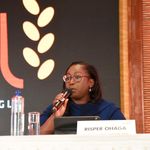
Lunch at the Pinks Restaurant at Muthaiga Country Club. Risper Ohaga is having soup under an umbrella facing the swimming pool. It is a beautiful day, slightly overcast, but still beautiful, the kind of Nairobi afternoon that feels borrowed, because in a few days, the city will be underwater. For now, though, it is a good day. And if you are Risper, it's even better.
She is about to become Group CEO of APA Apollo, one of East Africa's most storied financial services groups, stepping across from six years as chief financial officer (CFO) at East African Breweries Limited (EABL). She will be a leader of leaders. It is the kind of move that looks inevitable in hindsight, and terrifying in the moment.

She has spent a career in rooms where she was often the only woman, frequently the only Kenyan, always the one who had raised her hand to be there. At KPMG, at Barclays across 13 African markets, at Barclays Zambia as CFO, at EABL.
Each time, she said where she wanted to go, her intention declared boldly. "They'd never have offered me if I hadn't said I'm interested," she says. Nobody handed her a career. She pointed at the next thing and said, “that.”
"Put up your hand," she says. It sounds simple. It isn't. It requires a particular kind of chutzpah, the type backed by experience – the knowledge that you have made your bones, survived the rooms, crossed the markets, and earned the right to want more. End of June, she will cut a farewell cake, maybe pop a balloon at EABL, then start her new post in July. No rest, because comfort, she will tell you, is the enemy.
Dark clouds have gathered now. The bread is ignored. Risper is gone.
Someone, a younger woman, told me, 'Ask Risper how someone gets such jobs?' She wants to know if one gets to a career galaxy when these jobs float toward you.
As I mentioned, before your little recorder failed us, I had expressed interest, and the board already had a succession process in motion.
A global recruiter, a long list, then a short list.
My first interview was with the shareholder representatives, which helped. I already knew them from the board; we had worked through the company's strategy together.
After that, a larger panel, questions around growth, people, leadership. Then an assessment, six hours in total, personality exercises, then a strategy game on Zoom, solving problems in real time. It was actually a lot of fun.
What stayed with me was something the facilitator said at the start: "You are here today because they really like you and they want to give you the job. This process is to make sure you will also be happy here." I had never experienced recruitment handled that way. It told me a great deal about the people I was about to work with.
So, you didn’t send your CV, your CV had already gone ahead of you?
[Chuckles] Well, of course, I had to send my CV, but you still have to make it work. You have to make it happen. First, you have to be impeccable at what you’re doing. Then you deliberately look for opportunities where you can apply what you know. For me, it was financial services, so I thought, let me go there, contribute, learn, grow and give back, and do that well.
And finally, you have to declare your intention. They would never have offered me the role if I hadn’t said I was interested. Otherwise, they might have thought, well, she’s probably very happy where she is, why would she move into insurance? So, you have to put up your hand and say, “I’m thinking of a move. It might look like this. What do you think?” And then sometimes they say, “But what about us?”
Risper Ohaga, incoming Group CEO of APA Apollo.
Photo credit: Pool
I’ve always done that. I’ve always put up my hand. Very few roles have simply come to me. Even when someone mentioned my name somewhere, like at Barclays, once I got in, I asked: This is the kind of role I want, what do I need to do to get there? And when you do that, you often find people willing to support you.
Do you suffer from imposter syndrome at this stage?
My friend Anne and I hate that question.
Anne? Anne Muraya?
Because it makes it sound elevated, like it has been turned into a disease when it really isn’t. On any normal day, if you’re doing something big or scary, you will feel some anxiety, some doubt. That’s natural. The key is simply to work through it and keep doing what you need to do that day. A little anxiety is a good thing.
What kind of CEO do you intend to be?
For me, it always starts with people, the right people, the right leadership, the right culture. High empowerment, high accountability. It’s a service industry, so how your people feel really matters. But there also has to be a strong focus on innovation and creativity, challenging the idea that we’ve always done it this way.
What informs this? Is there a leader you wish to model your leadership around?
It comes from a number of places. When I started my career at KPMG, the philosophy was that you hire the best people and spend time getting that right. So, if things go wrong, the first place you look is inwards as a leader, not immediately at the person who made the mistake. That philosophy shaped a lot of my early thinking about leadership.
Over time, I’ve also admired leaders who operate in a similar way. I’ve worked with leaders who never raise their voice. They’re not mean or unkind. Of course, I’ve encountered a few who were, but for the most part, I’ve worked with very strong leaders and learned a lot from them.
I also read a great deal about leadership. But experience has probably taught me the most. When I’ve led teams myself, the best results come when you truly see your people and care about what matters to them, because when you do that, they care about the work.
Are there any pressing questions you’re asking yourself now?
Honestly, I’ve had very little time to even think about it. They’ve [EABL] been keeping me extremely busy.
Do conversations around gender reduce significantly the higher you go?
That’s a tough question [pause], because yes, you are a woman, but you’re also a leader. At some point, what matters first is that you’re a good human being and a good leader, and the fact that you are a woman is simply part of who you are.
Risper Ohaga, incoming Group CEO of APA Apollo.
Photo credit: Pool
Over time, you stop worrying too much about what people think or say. Instead, you focus on building relationships and doing the work. And if you’re working with the right people, they show up for you. So, I don’t know that there’s a simple answer one way or the other. I just know that I don’t dwell on it. I don’t spend time thinking, I’m a woman, I’m being judged. I focus on the work and the relationships.
And nothing reminds you of it?
No. I focus on getting the best people — if they happen to be women, that’s fine; if they happen to be men, that’s fine. What matters is building a strong and diverse team so that people bring different ways of thinking. Maybe I made peace with this a long time ago.
Earlier in my career, especially working in multinational environments, I worried about it. You sometimes ask yourself: am I being promoted because I’m a black woman, or because I’m good at what I do? At some point, I realised it doesn’t really matter. The important thing is to just get on with the work.
Tell me about your husband. Earlier on, before this recorder decided to embarrass me, we talked about how he handles your rise and if there ever is any insecurity or intimidation on his part to watch you shoot for the skies.
He is always part of the process. In fact, I often say we, because we started out together very early. I met him when I was 19, and we got married when I was 24, so we’ve really grown together. He often says that when he first met me, he knew I was someone on a mission. When it comes to decisions, we always sit down and talk them through.
He’s very pragmatic. When I start to get emotional about something, he’s very good at cutting through it and saying, “Okay, this is what we’re dealing with. Let’s think about it like this.” He helps me frame conversations and decisions. In many ways, he’s like my unpaid therapist and coach.
So, he is very much part of the process, and I respect his opinion deeply. He’s smart, he’s wise, and he always looks at things from the perspective of what’s best for the family. It’s never about an individual decision - it’s about us and what works for our family.
I don’t think people talk about it enough, but the more I interact with other successful women, the more I realise how many of them have very supportive spouses or partners who have sacrificed a lot for the family and who stand firmly behind them. We just don’t talk about them very much. I don’t know whether it’s cultural, but there are actually quite a few of them out there.
Was this on your vision board? Is this part of your career journey?
I’ve never been the kind of person who makes five or 10-year plans. As long as I feel I’m progressing, that’s enough. I keep returning to the same pillars: Finances, family, children, career, spirituality. Those don’t change. And I don’t feel I’ve 'arrived' in any of them. In the end, you’re really just competing with yourself. There’s always something you can do a little better, so you keep trying to improve.
Which areas of your life do you feel need work in this season? Certainly not career…
[Laughs] Career always needs work, which is probably why we spend so much time on it. But really, all areas of life need work. I’m always working on myself.
Risper Ohaga, incoming Group CEO of APA Apollo.
Photo credit: Pool
What’s the one thing that you’re terrible at?
Keeping fit. [Laughs] My trainer actually comes to the house, which means there’s really no excuse. Yesterday he came through the rain - completely soaked - and I felt so bad for him. When someone shows up like that, you can’t say you’re tired or skip it. [Chuckles] You just have to go out there. It has pretty much killed all my excuses about going to the gym.
We usually train three or four times a week. Sometimes we just go for a walk, which I find really clears my head, so that helps. I’m in a good place. The other day, my boss said to me, “You seem so happy - you’re radiating joy. What’s going on?” I hadn’t really thought about it, but I told her maybe it comes with turning 50. I turned 50 last October, and perhaps there’s a certain peace that comes with that. I can’t quite explain it, but you begin to feel more settled — a quiet sense of this is who I am.
Any fears that came with 50?
To be honest, I spent much of the year before turning 50 in a kind of mild depression. There was this fear of, ‘oh my God, this is it - I’m 50. What do I have to show for it? What happens after this? Is it all downhill?’ You start imagining silly things - weak knees and all that.
So, I went through a period of reflection, just thinking, wow, it’s been 50 years. But as the day got closer, I began to see the celebration in it rather than fear. Instead of what's next, it became wow - 50 years.
You have to come to terms with it because it’s a big milestone. Forty didn’t feel quite the same, but 50 makes you reflective. In the end, I leaned into it. I had a big party with almost 100 friends.
At first, I thought, who would even come? But between Peter’s family and mine, and friends from school, university and childhood, the room filled up. My parents were there too. Standing there looking at all those people, I just felt an enormous sense of gratitude - how fortunate I am to have so many people in my life.