Time flies with great content! Renew in to keep enjoying all our premium content.
Prime
Why we grow plants in our rented apartments
A collection of succulents and ornamental houseplants hangs by a window at the home of journalist and nature enthusiast Njoki Gitahi in Kasarani Hunters, Nairobi, on May 26, 2026. Wilfred Nyangaresi | Nation
Photo credit: Wilfred Nyangaresi | Nation Media Group
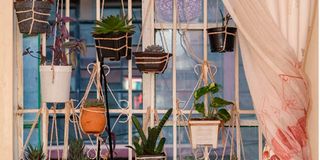
The first thing you notice when you walk into Njoki Gitahi's rented apartment in Kasarani is the sense that something alive is filling the room.
There are about 31 plants, arranged with care and knowledge of where each one belongs.
There is a zebra plant climbing towards the window, an echeveria in a terracotta pot with thick, architectural leaves, and a young pothos on the shelf that she bought in March, which is already outgrowing its spot. On the floor stand three snake plants with tall, striped leaves in pale green and gold.
“This space reflects who I am and what is in my heart," she says.
However, there is a particular kind of grief that comes with renting, especially in Nairobi, which is rarely spoken about directly. Leases end, landlords sell up, buildings are converted for other uses, and neighbourhoods change.
You move in, you make a home, and then, at some point, you have to leave. After experiencing this enough times, most tenants learn to live lightly and keep the walls plain and the shelves sparse.
Two years ago, Njoki started her indoor gardening, and as a journalist by profession, she thought she had brought the same careful instinct to choosing the plants for her house. At her favourite nursery on Ngong Road, she chose a snake plant, a monstera and a few succulents. Within days, the succulents were gone, and, within weeks, everything else had followed.
"I didn’t give up, and in fact, I went back for more," she says.
Before making that first purchase, she had been planning to buy artificial plants, but a friend made her change her mind.
“Why not get living plants, nurture them well, and enjoy the process?” he told her. At the time, this was an unfamiliar idea to her. I didn't know anyone who kept houseplants," she recalls.
This time, she did her research. She followed plant content creators on social media, mostly Americans talking about topics such as indirect light, drainage and soil composition, until the logic became clear. Then she started her second batch with a better understanding of what she was doing.
She now knows that general advice such as 'water once a week' and 'keep in bright light' is just a starting point, not a rule.
“My apartment is not like the one in the tutorial. My window faces a different direction, and my soil dries at a different rate,” she says.
Because of this, she waters her succulents from the bottom by setting the pots in a basin of water and fertiliser, letting them absorb it through the roots.
She also learnt the hard way that direct afternoon sunlight through glass can burn leaves, after finding scorched patches on a plant that had been moved too close to the window. She now checks the soil with her finger before watering. If it still feels damp, she leaves it.
“You can Google it all you like," she says. "But you still have to learn for yourself.”
Journalist and nature enthusiast Njoki Gitahi poses for a portrait at her home in Kasarani Hunters, Nairobi, on May 26, 2026.
Photo credit: Wilfred Nyangaresi | Nation Media Group
"Keeping plants has taught me patience," says Njoki. "Growth takes time. You either show up regularly or you don’t, and plants make the consequences of that choice very clear. Learning to appreciate them as they are has made me softer and more thoughtful, not just with plants, but with people too.”
Across town in Utawala, interior designer Dickson Mwangi keeps six plants indoors and a dozen more on his balcony. He travels frequently between Nairobi, Mogadishu and Addis Ababa, so most of his plants are hardy. When he is home, he wakes up at three or four in the morning to water them thoroughly, knowing they must survive until he returns.
“When a plant dies, you don’t want to be around it. But when they’re thriving, I just don’t want to be anywhere else,” he says.
Unlike Njoki, Dickson learnt through experience. His connection to plants stems from childhood memories of two rose bushes at home — red at the front and white at the back.
People collected them for Valentine’s Day, and although he didn’t understand why, the roses captured his imagination.
Curiously, he does not know the names of most of his plants. “To me, a plant is not its name. It’s their colour, their posture, the way they fill a corner or catch the afternoon light,” he says.
The only plant he knows by name is the spider plant, valued for its air-purifying qualities.
His most expensive purchase was a Dancing Lady orchid for Sh5,600. His most recent acquisition cost nothing: a cutting that was knocked loose by a landscaping tractor, which he carried through a 12-hour shift wrapped in a wet serviette.
Three days after planting, it had rooted.
Frequent travel means he has to choose drought-resistant varieties and cluster balcony plants together for shade. He also has to inform vendors of his schedule before buying. Nevertheless, he estimates that he has lost seven plants in the past month alone. He even blames his Wi-Fi router: "Every plant I put near it died within three weeks. I then moved the router.”
Snake plants at the home of journalist and nature enthusiast Njoki Gitahi in Kasarani Hunters, Nairobi, on May 26, 2026.
Photo credit: Wilfred Nyangaresi | Nation Media Group

Dickson believes that plants can sense energy, and that visitors with bad intentions cause them to dry up. He has stopped inviting certain people back.
“You might read all of this as superstition, but it is at least partly the result of paying very close attention to living things over a long period of time,” he says.
In Rongai, Aisha Kamau has 11 plants on the shelves around her one-bedroom apartment.
Twice, her two-year-old son Zuri has pulled leaves off the pothos on the kitchen counter. She could not scold him. “He’s just curious. He wants to know what everything is.”
Before buying any plant, she made sure that it was safe for children. The pothos sits high on the counter because it is mildly toxic if eaten.
The lower shelves only hold non-toxic varieties. "John, my plant vendor, told me which ones to avoid. I went home and confirmed it online. I wasn’t taking any chances.”
The cat was another matter, though. Her kitten, Ndovu, knocked over pots, chewed through her monstera and pulled her echeveria off the shelf until the pot broke and the plant died. “I tried everything. I moved the plants around. I got him toys. Nothing worked. He wasn’t a bad cat. He just didn’t care about the things I cared about.” She eventually gave Ndovu to her cousin in Kiserian.
After Zuri was born, Aisha began keeping plants, initially to improve air quality. However, she continued for a different reason: 'When everything is loud, the plants are still. They don’t need anything from me urgently.” Zuri now points at the plants, waiting for their names.
She tells him the names, and he repeats them, often mispronouncing them. She tells him again anyway.
Rose Losenja has run her nursery opposite Jamhuri Primary School for 25 years. She has watched Nairobi’s indoor plant market grow steadily, with a large proportion of her customers now being apartment dwellers.
“Bathrooms suit violets and small succulents that can tolerate humidity and low light. Kitchens benefit from golden palms, monstera and herb pots containing rosemary and mint.
Bedrooms are ideal for monstera and spider plants. Hallways with little natural light suit Brazilian green plants and other low-light varieties.
But why do so many apartment plants die?
Rose blames vendors who sell without providing guidance. “They just want to make a sale, so the buyer goes home with a plant and no information about how often to water it, how much light it needs, or what kind of soil it requires. When that plant dies, it’s often not the owner’s fault, but the result of poor guidance.”
The most common mistake she sees is overwatering. “Water them twice a week at most. Doing it every day can drown the roots.”
She advises asking before buying if you have children or pets. Some plants are toxic: For example, dieffenbachia causes mouth irritation if chewed, philodendron and pothos are harmful if ingested, and peace lilies are toxic to cats and dogs.
Placement is key: keep toxic plants on high shelves rather than avoiding them altogether. “A knowledgeable vendor will be able to tell you which plants to avoid. If they cannot answer that question, go somewhere else.”