Njoki Kamau has had plants in her home office for the last 14 years. Before that, her desk was buried under paperwork. Files and documents were stacked everywhere, and surfaces were covered in paper.
“Bringing plants in meant first clearing space for them, which meant reorganising everything else. The desk I work at now holds a laptop, a desktop computer, a diary, a pen holder and three small plants,” she says.
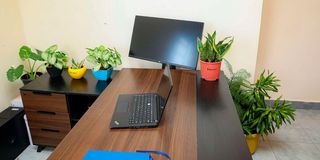
Her favourite is a snake plant that she has named Imani, meaning 'hope' in Swahili. “It’s always thriving,” she says. She also has a plant called Uugi, which means 'wisdom', and another in her guest bathroom named Ikara Thii, a Kikuyu phrase meaning 'sit down', which a host says to welcome a visitor.
"Naming the plant that way was intentional,' she says. "It reflects the feeling that guests are truly welcome."
To her, the plants are not just decoration. They are a record of the seasons she has moved through, the things she has experienced and the values she is trying to hold onto.
"People can often tell what emotional season I am in just by looking at the plants in my office," she says.
During Advent, she placed four plants in purple pots on her desk and prayed a novena; the plants were part of the atmosphere she was creating. At Easter, two cacti stood on the desk, reflecting the solemnity of the Passion season. At Christmas, the arrangement 'almost screamed' celebration.
“Plants often carry meaning beyond aesthetics,” she says. "For me, they help create the mood and emotional weight of certain moments in my life."
She tends to her plants throughout the day, not according to a fixed schedule, but when they need it. She checks the soil, wipes the leaves and sometimes even talks to them.
While performing other tasks, she often finds herself zoning out while looking at one of her plants. She says that this is more refreshing than staring at a plain office wall and that she returns to her work with a clearer mind.
"Plants respond well to regular care, patience and attention, and I think that reflects many aspects of personal growth and business."
Ms Njoki is not alone. For the last two years, Levy M has been sending fresh flowers to his wife's desk in the newsroom every two weeks.
He buys them, arranges them, and has them delivered to reception. She is usually somewhere else in the building when they arrive — upstairs finishing a story, in a meeting, or on the phone — and reception calls to tell her that there is a package.
"Someone told me that when she’s having a bad day, she comes to smell my flowers and then goes away feeling better. They don't just make me happy. They make the people around me happy, too.”
Njoki Kamau with her office plant at her home in Membley Estate on May 24, 2026.
Photo credit: Lucy Wanjiru | Nation Media Group
Her favourite flowers are chrysanthemums — large, bold blooms in mixed colours.
Stress reliever
Josphat Nguro has been tending to the plants on his desk for eight months now. Before the plants arrived, his desk was just a plain surface with a screen and a keyboard.
"It felt so corporate. The kind of desk that could belong to anyone."
He was working in a high-pressure environment, putting in long hours to meet tight deadlines. He found himself looking for an outlet that wouldn't drain the little energy he had left at the end of each day.
He needed something that would allow him to relax with minimal effort.
After thinking about what would survive in his office, he brought in two plants: "With the addition of the two pots, the office looks greener, calmer and more personal. The desk is still the same; the workload hasn't changed. But you can now tell that someone specific works here."
He got pothos, a fast-growing vine with heart-shaped leaves that spill over the edges of the pot and trail towards the floor if left unchecked.
He keeps his care routine simple, involving watering once a week, wiping the leaves two or three times, and checking for dust or signs of stress.
Monday mornings, however, now have their own structure. Before opening his emails or checking his schedule, he waters the plants. Five minutes, nothing more.
"It's a reset before the week gets busy," he says. He adds that the ritual is not really about the plants. It's about taking five minutes for himself before the week's demands take hold.
A study published in the Journal of Environmental Psychology found that workers in spaces containing plants had lower heart rates and blood pressure than those in bare environments. A separate study found a 15 percent increase in productivity alongside improved well-being.
Josphat says that when he is stuck on a problem and can't see a way through, he looks at his plant for 30 seconds, after which the tight, pressurised sensation that makes thinking difficult loosens just enough to allow him to re-engage.
He remembers a time when he was caught up in a series of back-to-back meetings with no time to catch his breath. He noticed a yellowing leaf on one of his plants, so he trimmed it off.
Josphat Nguro posing next to his flower farm in Karen, Nairobi on October 9, 2025.
Photo credit: File | Nation Media Group
"Trimming that leaf gave me a two-minute mental break," he says, "and I came back feeling focused."
Six indoor plant options
Ms Njoki's first question to anyone who comes to her wanting an indoor plant is always the same: 'What's your light situation like? You can work around everything else, including watering, size and how quickly it grows. Light, however, is non-negotiable.
Snake plant: Start here if you are not sure. It tolerates low light levels, only needs watering every two to three weeks, and is almost impossible to kill through neglect.
ZZ plant: Ideal for windowless offices. Its glossy leaves reflect whatever light is available, and it can survive for weeks without water.
Golden Pothos: It grows quickly, so you will notice a difference week by week. It has heart-shaped leaves that trail over the edge of the desk, with new growth constantly pushing out.
Jade plant: It grows slowly and compactly, resembling a small tree. Its unusual appearance makes it a popular talking point and useful in a client-facing space..
Peace lily: The only flowering plant on this list. It has white blooms and dark leaves, and it clearly shows when it is thirsty by drooping.
Spider plant: It produces offshoots that dangle from the parent plant and can be potted separately. This means that one plant can be given to a colleague, providing an organic way for greenery to spread through an office.