Time flies with great content! Renew in to keep enjoying all our premium content.
Prime
Where to get authentic Thai food, sometimes infused with omena
An assortment of signature Thai dishes is served at Bang Bang Thai Restaurant in Village Market, Nairobi, on July 14, 2026. Featured are Yum Som O (pomelo salad), Pla Neung Manao (steamed fish with lime and chilli), Devil Sen Khao (spicy rice and noodle mix with prawns), and Thai curry, showcasing the restaurant's blend of traditional Thai flavours and contemporary presentation. Wilfred Nyangaresi | Nation
Photo credit: Wilfred Nyangaresi | Nation Media Group
If you enter BangBang Thai Restaurant in Nairobi’s Village Market, you would assume that the man whose photos are framed on the walls is a living legend.
BangBang is created by artificial intelligence (AI) but whose story is on the walls on this restaurant that is attracting many foodies.
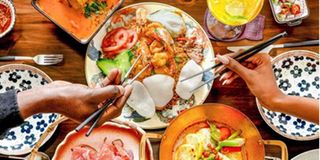
Diners get to interact with Thai food, and the relics of BangBang life, photographs tracing his extraordinary life, championship trophies, signed guitars, framed movie posters, a pair of boxing gloves, even some rocking chairs of his Grandma Mae. If you spend enough time in the restaurant, it is hard to believe that this man actually never existed.
“We started BangBang about three years ago because we saw a gap in the market for authentic Thai food,” says Richie Barrow, the Food and Beverage General Manager at Tribe Hotels Group, which is behind BangBang restaurant. “There were a couple of existing places, but we wanted to open something a little different.”
According to Mr Barrow, the Thai restaurant has defied the trajectory typically followed by many new restaurants: “Many restaurants experience an initial surge in demand before sales drop by about 20 percent and eventually level off,” he says.
“But BangBang hit its peak and maintained consistency. Even on our slower days, typically weekdays, we serve at least 150 customers. On busier weekends, that number can exceed 250 a day, with lunch and dinner being the busiest times.”
Richie Barrow, General Manager – Food and Beverage, during an interview at Bang Bang Thai Restaurant in Village Market, Nairobi, on July 14, 2026.
Photo credit: Wilfred Nyangaresi | Nation Media Group
The sustained demand has also prompted the restaurant to expand both its kitchen and dining areas to accommodate its growing clientele.
Mr Barrow credits the restaurant’s success in part to increasingly adventurous diners: “Kenyans have been travelling a lot, and they’re coming back with different taste buds,” he says. “And especially now that we have direct flights to Thailand from Kenya, many of them have either travelled there or have links to the country, so they are well-exposed.”
He further credits the restaurant’s executive chef, Milan Wazeehan, with delivering the authenticity those diners have come to expect.
“At the beginning, we struggled to find a chef who could deliver that until we met Chef Milan, who was working in Mombasa at the time, specialising in Pan Asian cuisine.”
Now 41, Chef Milan’s culinary journey began at the age of 13 after preparing a meal that impressed his father that it sparked a passion for cooking. Leaving his rural home in Mongolia as a teenager, he pursued a life and career in cooking, a decision that eventually led him to Thailand, where he spent years mastering the country’s cuisine before bringing that experience to Nairobi as the executive chef at BangBang.
“Thai food mainly balances five key flavours,” Chef Milan says. “Sweet, sour, salty, umami and spicy.”
Each flavour comes from a different source. Palm sugar provides the sweetness, lime juice and tamarind bring the acidity, chillies contribute the heat, while fish sauce delivers the salty, savoury umami flavour that is central to many Thai dishes.
BangBang’s menu is rooted in Isan cuisine, a style of cooking from northeastern Thailand known for its bold, punchy flavours.
While Chef Milan makes a few concessions to suit local palates, he is reluctant to stray too far from traditional recipes.
“We use a lot of garlic, ginger, kaffir lime, lemongrass, coriander, and basil, which all have very distinctive flavours but are, for me, non-negotiable,” he says. “Kenyans are not very familiar with very high chilli levels, so instead of using 10 chillies in one dish, I might use two or three. But as a custodian of Thai cuisine, I am not willing to water down the recipes too much.”
Chef Milan Wazeehan at Bang Bang Thai Restaurant, Village Market, Nairobi, on July 15, 2026. Wilfred Nyangaresi | Nation
Photo credit: Wilfred Nyangaresi | Nation Media Group
Omena in Thai food
But because Thai cuisine relies heavily on fresh ingredients rather than preservatives, concentrates or powdered substitutes, sourcing key ingredients has been one of the restaurant’s biggest challenges.
The restaurant imports several staples from Thailand, such as noodles, sticky rice, coconut milk, and fish sauce, while working with local suppliers and the Royal Thai embassy to build a more reliable supply chain.
“Coconut milk and fish sauce were available locally, but they tasted different. The fish sauces that we found, for example, were Chinese fish sauce, which changes the salt profile of a dish.”
Today, the restaurant partners with local organic farms to grow some ingredients specifically for its kitchen.
Even so, Chef Milan says working in Kenya has also led him to discover local ingredients that perform surprisingly well in Thai cooking.
“In Thailand, a lot of fermented fish is used to add umami,” he says. “But it was very difficult to import that because by the time it gets here and clears customs, it has gone bad. Looking for something more consistent, I walked through the Kenyan market and found omena. It is quite similar and works well, so I put it to good use.”
Of the nearly 90 items the restaurant has on its menu, some of the most popular ones include Pad Thai, the curries, some of the soups, and Thai Iced tea.
“But none of them can beat Pad Thai,” he notes. “We sell about 100 or more plates of that in a day.”
Who, then, is eating all this Thai food? “About 40 percent of our customers are Kenyan locals, 20 percent are Asian, and the rest are a mix of expatriates,” he says.
Beyond the food, and perhaps as a fitting tribute to the fictional legend introducing many Kenyans to Thai cuisine, the restaurant hosts the BangBang Cup every year.
This is a Muay Thai tournament that not only celebrates Thailand’s national sport but also gives Kenyan fighters a platform to compete.
“Muay Thai actually has a large following in Kenya,” says Mr Barrow. “We have plenty of talented local fighters, some of whom travel to Thailand to train, but there are very few opportunities to compete and earn from the sport here. Since we started the tournament two years ago, we’ve partnered with the Royal Thai Embassy to bring exhibition fighters from Thailand so the two countries can learn from one another. Last year we had both male and female participants including some from other African countries beyond Kenya.”