How Sh4,500 burgers found a spot on Kenyans’ plates

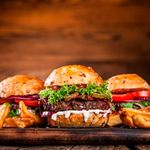
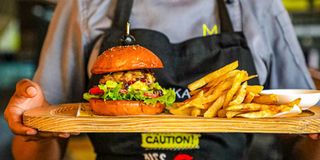
A freshly prepared beef burger layered with cheese and crisp vegetables, served with fries at Café Amka in Nairobi on April 16, 2026.

Photo credit: Lucy Wanjiru | Nation Media Group

A few years ago, it was hard to find burgers on the menu of a Kenyan household. Burgers were dishes a few adults grabbed between errands to reduce hunger pangs or purely a children’s snack. Today, burgers stacked with meats and vegetables, some so large they can feed four people, have become the go-to meal for many Kenyans, becoming a booming business for those in the food sector.
Rise of the 'experience burger'

Across Nairobi, burgers are getting bigger in ambition and size. At Harvest Restaurant in Nairobi, this shift is most evident in the introduction of their giant burger designed for four. It costs Sh4,500.

“We wanted to be different, so we came up with a giant burger offering that can be shared by four people or even more,” says executive sous-chef Felix Maluni.

This trend taps into a broader shift in lifestyle. Dining out is no longer just about eating; it has become about sharing moments and experiences. Says chef Felix,

A freshly prepared beef burger stuffed with cheese and vegetables at Café Amka in Nairobi on April 16, 2026.

Photo credit: Lucy Wanjiru | Nation Media Group

“We make our buns in-house, considering the size. For the meat, we mince beef chuck and beef brisket. We do ratios of 60 to 40 to get the right combination.”

This replicates a level of precision that is commonly associated with fine dining rather than fast food.

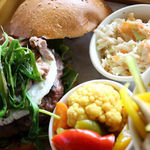
“We have elevated the dish beyond the usual burger accompaniment of fries. We came up with a green salad and a mixed vegetable salad to make the dish more appealing and look more complete.”

This particular burger has meat, cheese, grilled onions and gherkins alongside a salad. The result is a plate that feels curated, not cobbled together.

A global journey, reinterpreted locally to understand the burger’s transformation, one has to look beyond Nairobi. At Café Amka, Maureen Njeri, a chef, traces the burger’s roots back to Europe.

“The burger originated in Germany, and it is only when some Germans migrated to the US that they brought with them their staple; it was called a Hamburg steak. It was basically minced beef that was eaten with side dishes like potato and rice, but not bread,” Chef Maureen explains.

The now-familiar burger format emerged later.

“Slowly it started to be cooked as street food as well. For fast food, you don’t want to eat something that’s messy; they formulated a recipe where they compressed the minced beef to now become a pâté; they introduced the bread,” she says.

Felix Maluni, Executive Chef at Harvest Restaurant, prepares a signature burger at Tribe Hotel in Nairobi on April 17, 2026.

Photo credit: Wilfred Nyangaresi | Nation Media Group

In the US, the burger evolved further into a full meal.

“Some of the food chains in the US also invented their own way of serving it, by adding fries and soda, making it a full meal.”

From there, chefs began to elevate it, for instance including premium cuts like Wagyu and brisket, to elevate the taste from just basic minced beef. That global evolution, in the African remix, is being filtered through local identity.

“We have two different burgers, the beef burger and chicken burger. Our beef burger is called Ng’ombe moto burger, the chicken Kuku laini burger,” Chef Maureen says.

But the concept goes beyond naming. “Since our restaurant is very African themed, our burgers are more of an African journey of flavours,” she explains, adding that each layer is intentional.

“A brioche bun is followed by a layer of spice, spicy mayo that awakens the palate. Then there’s some fresh lettuce that adds some freshness and mimics how African dishes balance spice with low or lightly dressed vegetables.”

There is also a deliberate play on flavour contrasts.

“We then add an enhancer of acidity, which is the tomato, which also adds juiciness to the burger. And to add some richness from the land, our guacamole adds that creamy and earthy richness.”

Even the seasoning carries a local signature.

“Our burger pate is exactly 120 grams for both the beef and the chicken. They are handcrafted and seasoned with a mayakwa, which is a mix of onions, carrots and celery. And for our signature African twist, we have the mango mayo that lends richness, fruitiness and a tropical identity,” she adds.

Redefining what ‘full’ means globally, the idea of a “complete burger” has shifted, and restaurants are keeping pace.

“A full burger today is defined by that extra side and a particular drink. You can have a burger with potato or veggies or sweet potato and a soft drink or a cocktail,” Chef Maureen offers.

This mirrors trends in Western markets where burgers are now paired with craft beverages, artisanal sides and even tasting menus. In Kenya, although preferences still lean on the traditional, they are evolving. The variety of beef offerings is, for instance, expanding. Other than the beef and the chicken, some eateries are offering lamb and a variety of vegetarian offerings.

A signature burger served with loaded fries, dipping sauces and a fresh side salad at Harvest Restaurant in Nairobi on April 17, 2026.

Photo credit: Wilfred Nyangaresi | Nation Media Group

The shift of the burger from a snack to a full meal is also happening in specialty brands. At Java House for instance, diners can move from the familiar beef burger and cheeseburger to their more layered options such as the Hawaiian caramelised onion burger, bacon cheese burger, umami burger and guacamole bacon cheese burger. At the centre is their “full house burger,” priced at Sh1,250, available with either a beef or chicken patty.

A similar narrative unfolds at Artcaffé, where the burger menu balances classics with more expressive options such as the Tex-Mex burger, while the Texas burger and the “Beet It burger” point to a growing vegetarian and alternative offering.

Then there are niche players like Drip Burgers, which are redefining the category through focus and identity. Here, burgers are not part of the menu; they are the menu. Their signature offerings come paired with fries. Options lean into bold, indulgent flavours: the Big Bacon Burger, Mushroom Burger and Hawaiian Burger sit alongside more distinctive creations such as the Big Smoking Burger, Drip Chicken Burger, Double Drip Chicken Burger, the All-in-One Burger and their increasingly popular Smash Burger.

These burger offerings include other speciality brands that push the burger meal narrative and, in many ways, make the serving a full meal.

Follow ourWhatsApp channel for the latest business and markets updates.

PAYE Tax Calculator

Note: The results are not exact but very close to the actual.