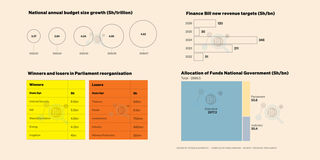
Kenya is heading into a new financial year from next month with a budget deficit of Sh1.1 trillion, exposing the persistent gap between what the government collects in revenue and what it spends.
Treasury projections show the government plans to spend about Sh4.82 trillion against expected revenues of about Sh3.67 trillion, leaving a financing hole of more than Sh1.1 trillion.
Kenya’s annual budget deficit has crossed the Sh1 trillion mark for the third straight year, forcing the government into deeper reliance on domestic borrowing to finance a persistent gap between revenue collections and spending needs.
The deficit stood at Sh1.02 trillion in the financial year ended June 2025, before rising to about Sh1.3 trillion in the current fiscal cycle and is now projected at Sh1.1 trillion in the upcoming budget.
Treasury projections show the government plans to spend Sh4.82 trillion against expected revenues of about Sh3.67 trillion in the upcoming financial year set to start next month.
The deficit has persisted despite repeated promises of fiscal consolidation, reflecting insistent pressure from debt repayments, salaries, infrastructure spending and other recurrent government operations.
At the centre of the trend is Kenya’s weak revenue mobilisation, with tax collections repeatedly falling short of Treasury targets even as expenditure remains sticky and politically difficult to cut.
The result has been a deeper dependence on borrowing to bridge the gap between spending ambitions and available income.
The challenge is compounded by Kenya’s debt servicing burden, which now consumes a significant share of ordinary revenue collections every year.
Kenya is now leaning far more heavily on domestic borrowing after access to cheaper foreign financing became constrained by delays from multilateral lenders and rising global debt risks.
Official documents show that the upcoming financial year’s budget will be financed through external borrowing of Sh99.5 billion, which is about 0.5 percent of the country’s Gross Domestic Product (GDP), and domestic financing of Sh1.01 trillion (4.8 percent of GDP).
This marks a major shift from previous years when Kenya relied more aggressively on external loans from Eurobonds, the World Bank, and bilateral lenders to finance deficits.
The global lenders have become more expensive as interest rates remain elevated internationally, while Kenya’s debt profile has also come under closer scrutiny from investors and rating agencies.
As government aggressively borrows from local banks and investors, it competes directly with businesses and households for available credit, potentially squeezing private sector lending.
Economists describe this as “crowding out,” where banks prefer lending to government because Treasury securities are safer and often offer attractive returns compared to private borrowers.
The government has previously attempted to narrow deficits through spending cuts and tightened tax measures, but implementation has remained uneven amid political resistance and economic slowdown concerns.
In 2024, for instance, anti-tax protests forced the withdrawal of proposed revenue raising measures, complicating Treasury’s fiscal plans and weakening future collection projections.