Time flies with great content! Renew in to keep enjoying all our premium content.
Prime
Treasury avoids IMF loans in new budget
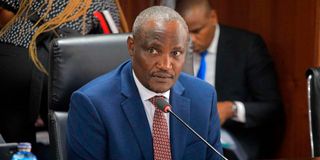
Treasury Cabinet Secretary John Mbadi addressing members of the National Assembly's Departmental Committee on Finance and National Planning at Bunge Tower, Nairobi, on November 18, 2025.
Kenya has omitted funding from the International Monetary Fund (IMF) in the national budget for the year starting July in the wake of uncertainty whether fresh talks tied to tough conditions could unlock multi-billion shilling loans.
Documents tabled in Parliament show the Treasury is not expecting new inflows from any of the IMF’s funding options, including the extended credit facility (ECF), the extended fund facility (EFF) or the resilience and sustainability fund (RSF).
This will see the country escape tough lending conditions attached to the fund’s support, including higher taxes, job freezes and spending cuts.
The government has been seen to approach fresh IMF talks with caution after the termination of Kenya’s loan facility in March last year over breached conditions, which saw the country miss out on the final tranche of debt worth $850.9 million (Sh109.8 billion).
The fund completed a staff mission in Nairobi in March and held further meetings at the April IMF-World Bank Spring Meetings, which was expected to unlock a new lending programme.
The World Bank Group, a sister organisation to the IMF that mostly disburses funds for development projects, is widely expected to cover the bulk of Kenya’s external cheap financing through its development policy operations (DPO) tool.
The DPO will anchor cheap external financing, with the Treasury projecting inflows of Sh170.5 billion in each financial cycle, beginning in the 2026/27 fiscal year to 2029/30.
The IMF had prescribed painful conditions in the wake of its surging loans post Covid-19 pandemic, including the need to increase tax revenues, cut budget deficits and restructure State-owned enterprises.
World Bank loans, which tend to be long-term, often carry less stringent conditions when compared to the IMF aid, which is short- to medium-term and tackles immediate economic instability.
The lack of IMF funding in the budget coincided with a budget proposal that had not imposed new major taxes or increased existing ones, after deadly protests broke out in 2024 against the government's measures to raise revenue.
The Treasury is also fretful about introducing new taxes in the budget that comes before the General Election in August 2027.
Treasury Cabinet Secretary John Mbadi previously noted that IMF resources should not be used to plug revenue shortfalls.
“I want Kenyans to understand that the IMF’s primary responsibility is not to fund the budgets of member countries and is instead for balance of payments support,” Mr Mbadi said.
“Going forward, we are trying to minimise our focus on the IMF, but it doesn’t mean that we are stopping our engagements.”
Last month, Kenya emphasised the importance of a funded programme with the IMF as it looked to double down on available cheap external financing sources to offset pressure on domestic borrowing, which has largely plugged the deficit in the face of disrupted foreign debt flows.
“Support from the IMF and the World Bank would be from the fact that we are getting concessional financing, and it would replace expensive domestic borrowing, reducing debt vulnerabilities by cutting interest costs,” Central Bank of Kenya (CBK) Governor Kamau Thugge said.
The IMF terminated a multi-year programme with Kenya in March 2025 before it disbursed a final Sh109.8 billion ($850.9 million) tranche.
This was after Kenya failed to honour conditions agreed upon, including the restructuring of the national carrier Kenya Airways and putting restrictions on the use of cash from the fuel stabilisation fund, which was diverted to other uses.
The country failed to meet 11 out of 16 conditions, with others being the placing of curbs on spending, bolstering tax collection and settling suppliers’ dues.
Kenya has faced a dilemma in exercising its access to IMF resources as it seeks to appear as a mature economy that can meet its financing requirements from the international capital markets.
At the same time, shocks presented by the US-Israel war on Iran have increased the odds that the country could be locked out of international capital markets by high interest rates, forcing it to turn to the IMF for funding assistance.
The dilemma was captured at the IMF/World Bank Spring Meetings last month, where Kenya continued discussions with the fund.
“Kenya is, of course, a market access country or switching towards market access. These days, market access has become very volatile, and the government is cautiously rethinking how to best address its financing needs,” said Abebe Selassie, the outgoing Director of the African Department at the IMF.
“They (Kenya) have done a lot of liability management operations to push back big lumpy repayments. As market conditions become difficult, Kenya has been thinking of relying on IMF resources.”
Like other nations that are heavily reliant on energy imports, Kenya is scrambling to stave off shortages of essential commodities, including petrol, while managing cost increases that could drive up inflation.
Kenya is the first larger emerging economy to publicly confirm a formal request to the World Bank for emergency funding to manage the economic shocks triggered by the Iran war.