Time flies with great content! Renew in to keep enjoying all our premium content.
Prime
Tax pain as Treasury eyes Sh201bn in new budget
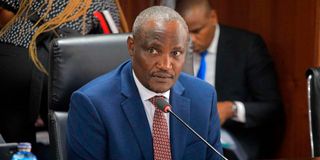
Treasury Cabinet Secretary John Mbadi addressing members of the National Assembly's Departmental Committee on Finance and National Planning at Bunge Tower, Nairobi, on November 18, 2025.
The Treasury will seek an additional Sh201 billion in tax revenue in the next financial year, signalling potential new taxes in the Finance Bill and a crackdown on tax cheats.
The Kenya Revenue Authority (KRA) will be required to collect Sh2.985 trillion as tax revenue for the year starting July, up from Sh2.784 trillion, according to Treasury documents tabled in Parliament, reflecting a 7.21 percent increase.
The Finance Bill, 2026 is expected to deliver most of the revenue haul, with the Treasury projecting new tax measures to generate Sh120 billion, up from Sh30 billion it targeted via the Finance Act 2025.
The push for increased tax collection comes against the backdrop of a weaker economic outlook in the wake of exposure to shocks caused by the US-Israeli war against Iran.
To shore up revenue, Kenya has deepened its crackdown on tax cheats and it is expected to be more aggressive in an election period when the State is hesitant to introduce major tax increases.
“Additional resources have been allocated to the Kenya Revenue Authority (KRA) to strengthen revenue mobilisation,” the Treasury said in its final budget estimates tabled in the National Assembly.
“This includes Sh19 billion provided in the 2025/26 financial year and earmarked for digital transformation initiatives to support system upgrades, data integration, and deployment of real-time compliance tools aimed at improving efficiency, broadening the tax base and sealing revenue leakages.”
The KRA is betting on the use of technology such as electronic tax invoice management system (eTIMS) and increased reliance on third-party data to weed out tax evaders and boost revenue by billions of shillings.
It is also seeking to expand the tax base and rope in more small businesses and the informal sector to raise additional revenues.
The KRA’s enforcement unit has been using various databases to pursue suspected tax cheats, including bank statements, import records, motor vehicle registration details, Kenya Power records, water bills and data from the Kenya Civil Aviation Authority (KCCA), which reveals individuals who own assets such as aircraft.
Car registration details are also being used to smoke out individuals who are driving high-end vehicles but have little to show in terms of taxes remitted.
Kenya Power meter registrations are also helping the taxman to identify landlords, some of whom have been slapped with huge tax demands.
The taxman has also sought details of suppliers and contractors hired by county governments in the quest to tighten the noose on individuals and firms evading tax.
“Further, the National Treasury has developed tax amendment proposals with an estimated combined revenue yield of Sh120.3 billion, which are expected to reinforce revenue performance,” said the Treasury.
The netting expected from new tax measures is a far cry from the Finance Bill, 2025, which sought to raise Sh30 billion after public protests over aggressive taxation forced the withdrawal of the Finance Bill 2024, with Sh345 billion.
A copy of the Finance Bill, 2026, available in general circulation but not yet confirmed to be the official document tabled in the National Assembly, reveals that the bulk of new tax measures are concentrated in tax administration reforms.
The tax administration measures include the expansion of anti-avoidance rules, reducing the steps taken by the KRA to issue agency/tax demand notices to banks and establishing reporting obligations and definitions for virtual asset service providers (VSPs).
In addition, there is a proposal to extend the tax amnesty programme, which unlocked over Sh40 billion in receipts and lapsed at the end of last year, to December 2026.
The draft Finance Bill further proposes a clean-up of the VAT Act by making input taxes irrecoverable for the manufacturers of electric buses, bicycles and motorcycles, animal feeds raw materials and inputs for the manufacture of pharmaceutical products.
The Bill proposes to increase the rate of residential rental income from 7.5 percent to 10 percent.
The higher revenue projection will be put to test by a deterioration of the economic outlook on the effects of the US-Israel war against Iran Kenya, like many other African countries, is heavily reliant on energy imports.
The Iran conflict has left it scrambling to stave off shortages of essential commodities like fuel, and the war’s ripple effects are expected to spur inflationary pressures that could dampen Kenya’s growth prospects.
The Treasury has revised its growth projection for 2026 from 5.3 percent to five percent and expects output to be much lower if the conflict persists.
The current account deficit has also been projected to expand from 2.2 percent of GDP to three percent on higher international oil prices, lower receipts from services, slower growth in remittances inflows and reduced exports.
Domestic revenue mobilisation has already been under sustained pressure as the economy struggles to generate enough taxes to fund most of the budget.
Taxes collected through six months to December 2025 were, for instance, Sh110.6 billion below target and totalled Sh1.24 trillion against the Sh1.35 trillion expected.