Time flies with great content! Renew in to keep enjoying all our premium content.
Prime
Personal tax growth at a 4-year low on strained households
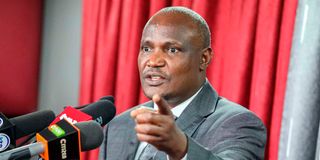
The Cabinet Secretary for the National Treasury and Economic Planning John Mbadi addressing the media on the Financial Year 2026/27 budget and the economic measures to support Kenyans at the National Treasury, Nairobi on May 25, 2026.
Taxes paid by Kenyans on their income, profits and capital gains recorded the weakest growth in four years in the nine months to March 2026, underscoring mounting pressure on households and salaried workers that has now drawn the attention of the country’s top leadership.
Latest Treasury data shows receipts from individual taxpayers rose by a modest 4.4 percent to Sh486.3 billion in the July–March period of the current 2025/26 financial year, compared with a robust 19.1 percent growth recorded in the same period a year earlier.
The Kenya Revenue Authority (KRA) collected an additional Sh20.5 billion from individual taxpayers during the review period, a sharp slowdown from the Sh74.8 billion increase recorded in the previous financial year.
The latest growth rate marks the weakest expansion since the 2022/23 financial year, signalling that workers and households may be reaching the limits of their ability to absorb higher taxes and statutory deductions after several years of aggressive revenue-raising measures.
The strain on household budgets has become so pronounced that President William Ruto and Treasury Cabinet Secretary John Mbadi have both pledged to ease the burden on low-income earners.
In February, Mr Mbadi pledged tax cuts of between Sh731 and Sh2,127 a month for workers earning Sh50,000 and below, and indicated that those earning Sh30,000 or less could be fully exempted from pay-as-you-earn (PAYE).
“We have agreed with the President that low-income earners in this country should be given a reprieve,” Mr Mbadi said at the time.
The proposed changes, which were to be introduced through a Tax Laws (Amendment) Bill 2026, were later shelved after the Treasury dropped the standalone Bill. Mr Mbadi told lawmakers in March that the timing was too close to the Finance Bill 2026 process.
The promised PAYE relief was also omitted from the Finance Bill that was subsequently approved by Parliament last week.
Records from the National Assembly show that calls for reforms to PAYE tax bands dominated submissions on the Finance Bill 2026, with stakeholders including the Kenya Private Sector Alliance (Kepsa), the Institute of Certified Public Accountants of Kenya (ICPAK), the Kenya Bankers Association and the Law Society of Kenya pushing for changes.
Kepsa proposed capping the highest PAYE rate at 30 percent and increasing monthly personal relief from Sh2,400 to Sh3,000 for all workers.
The business lobby argued that the proposal would leave an estimated Sh28.1 billion in workers’ pockets annually, potentially generating a Sh42 billion expansion in economic output and supporting up to 36,000 jobs.
The National Assembly Finance and National Planning Committee similarly acknowledged the growing burden on salaried workers.
“The Committee recommends that the National Treasury relook at overhauling all the tax bands. With the increased contributions to the Social Health Insurance Fund (SHIF) and the affordable housing levy, this has increased the burden on salaried employees,” said committee chairman Kuria Kimani in its report on the Finance Bill following public participation.
“We tried to do that in our report but realised that the data we need to analyse would be immense, so we are asking the National Treasury, which has the tools to do the analysis, to do the overhaul on all PAYE bands.”
The concerns follow a series of tax changes introduced by the Ruto administration through the Finance Act 2023, including PAYE bands of 32.5 percent on monthly income between Sh500,000 and Sh800,000, and 35 percent on earnings above that threshold.
Kenya’s PAYE system also imposes a 10 percent tax on monthly income of up to Sh24,000, which is effectively offset by a personal relief of Sh2,400. The rate rises to 25 percent for income between Sh24,001 and Sh32,333, and 30 percent on earnings up to Sh500,000.
Although personal tax receipts reached a record Sh486.3 billion in the first nine months of the current fiscal year, the pace of growth has slowed sharply, suggesting that taxable incomes are no longer expanding fast enough to sustain the gains seen in recent years.
The slowdown stands in contrast to overall tax collections—including VAT and excise duty, which are levied on the consumption of goods and services—which rose 9.8 percent to Sh1.96 trillion during the period.
Individual taxpayers generated only Sh20.5 billion of the Sh175.1 billion increase in total tax collections in the review period, meaning they accounted for less than 12 percent of the additional revenue raised by the government.
The figures show that the share of total taxes contributed by individuals fell to 24.8 percent from 26.1 percent a year earlier, indicating that other tax categories such as VAT, excise duty and corporate taxes played a larger role in driving revenue growth.
The emerging picture is one of a tax base under strain, with households facing higher deductions, elevated living costs and slow wage growth.
That challenge has now become increasingly political ahead of the 2027 presidential election.