Time flies with great content! Renew in to keep enjoying all our premium content.
Prime
Finance Bill 2026: A mixed bag budget
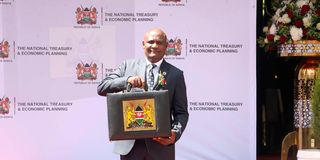
National Treasury Cabinet Secretary John Mbadi displays the Budget briefcase ahead of unveiling the government spending plan for the financial year 2025/2026 in Parliament on June 12, 2025.
Salaried workers are major casualties and will now wait longer for relief on their pay taxes as the National Treasury Cabinet Secretary kept mum on the much-publicised promise, even as the State juggles financing its growth plans and appeasing businesses and a restless public squeezed by the high cost of living.
While the State tried to appease businesses, with a roadmap to settle Sh155.3 billion in pending bills over the next two years, the realities of tight fiscal positions forced it to stay silent on promises of billions of shillings in salary tax relief for millions of workers.
The promised reliefs on pay-as-you-earn (PAYE), which included raising the tax-free threshold from gross earnings of Sh20,000 to Sh30,000, had been highly publicised, with President William Ruto offering his backing despite concerns on the creation of a funding hole by the exchequer.
The National Treasury had mulled the PAYE reliefs in February this year but was forced to rethink the proposal after the start of the US-Israel war with Iran in March, which has since weakened both the country's revenue and growth outlook.
The exchequer reckoned that the move would have cost State coffers about Sh35 billion annually after a technical working committee assessed the impact of the proposed PAYE reliefs. However, President Ruto signalled that the government was ready to forgo the revenue.
"Some people in the National Treasury came back and said that it is going to be costly for us in the budget, but I told them, 'Let's do it!'," President Ruto said at the end of May.
The PAYE proposal included a five-percentage-point reduction in the tax rate levied on earners with gross salaries between Sh30,001 and Sh50,000 to a top tax rate of 25 percent from 30 percent.
While Mr Mbadi skirted around the PAYE relief in his second budget statement, the CS still acknowledged the pain salaried workers face, including the heavy burden of taxes, as most other Kenyans escaped the dragnet.
The CS noted that revenue-raising measures in the Finance Bill, 2026, were aimed at expanding the tax base by sealing revenue loopholes and improving tax compliance and administration, rather than introducing new taxes.
"Today, only 3.1 million working Kenyans contribute to Pay as You Earn. Yet millions of other Kenyans who make money in our economy do not contribute to the taxes we collect. The burden of developing this country has therefore been on a few of us," Mbadi said.
"I have deliberately chosen not to introduce new taxes or increase tax rates that would further overburden the hardworking Kenyans and their families."
The bulk of measures contained in the Finance Bill, 2026, focus on reforms improving efficiency in tax collection, fairness in the tax system and broadening the tax measures.
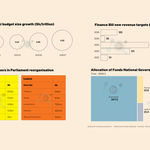
Combined, the measures contained in the Finance Bill, 2026 and the common external tariff for the East African Community (EAC) are expected to yield Sh98.9 billion in new revenues for the Exchequer in the 2026-27 fiscal year.
The National Treasury is under pressure to raise adequate revenues to fund an expanded Sh4.82 trillion without passing on a heavier tax burden on most Kenyans, even as the impact of the Middle East war on collections looms.
The exchequer has, for instance, given up Sh12.9 billion by halving Value Added Tax (VAT) on petroleum products for three months since April to mitigate the surge in the price of the commodity.
Revenue collection is projected at Sh3.63 trillion, with taxes/ordinary revenue making up Sh2.995 trillion while ministerial appropriations-in-aid (AiA) are expected to stand at Sh644.8 billion, with grants consisting of Sh43.6 billion.
This is expected to leave behind a budget hole/fiscal deficit of Sh1.146 trillion, which will be plugged by Sh1.03 trillion in net domestic borrowing and Sh116.2 billion in the next external financing.
Recurrent spending in the financial year starting July 1 is estimated at Sh3.568 trillion, while development spending stands at Sh750 billion.
Counties are expected to receive Sh428 billion from the equitable share of revenue and Sh74 billion in conditional transfers.
The National Treasury revised down its growth forecast for 2026 from 5.3 percent to five percent to reflect the uncertainties emanating from the war in Iran, which could impact revenue collection and job creation in the domestic economy.
"The outlook for 2026 has been revised down to five percent from an earlier projection of 5.3 percent, reflecting the adverse impact of the ongoing conflict in the Middle East on domestic economic activities," Mr Mbadi said.
PAYE cuts could still emerge from the public participation stage of the Finance Bill, 2026, if the National Assembly Finance and National Planning Committee adopts the views of stakeholders on the matter, including the Kenya Bankers Association (KBA) uniform payroll taxes remedy.
National Assembly Majority Leader Kimani Ichungwa indicated earlier on Thursday that the committee was likely to table its report on the consideration of the Finance Bill, 2026, on Tuesday next week.
KBA recommended a five percent uniform reduction in PAYE across all income bands, arguing that it would release Sh28.1 billion in the economy annually, generate Sh42 billion in immediate GDP output and create 36,000 new jobs per year.
"Kenya's PAYE tax bands are narrow and steep, with high marginal rates applying at much lower incomes than in peer countries," Raimond Molenje, KBA chief executive officer, told the Kuria Kimani-chaired Finance committee last month.