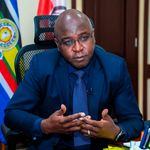
Former Kenya Revenue Authority (KRA) Commissioner-General Humphrey Wattanga refused to resign, prompting the board to oust him.
The authority on the Wednesday evening said he would take leave with immediate effect, cutting short his three-year term and suggesting a fallout with the board.
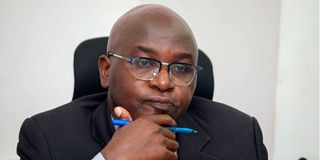
“The KRA Board informs the public that it will not be renewing Mr Wattanga’s contract of service as Commissioner-General. Consequently, and in accordance with his Contract of Service, he is proceeding on terminal leave effective immediately,” KRA chairperson Ndiritu Muriithi said in a statement.
A source at the board reckoned that Mr Wattanga rejected the Treasury’s push to have him resign.
“He was asked in the morning [Wednesday] to resign, but he declined. The board pulled the trigger early afternoon. Top Treasury officials felt he was not doing enough on the technological front to push for higher tax collections despite huge tech upgrades. The system downtimes had surged,” said the source who spoke on condition of anonymity because the matter is confidential.
““He was fixed by tech. Treasury people complained that there was no return on huge technology investments.”
Lilian Nyawanda, the Commissioner of Customs and Border Control, will act as the interim head of the KRA.
The changes come amid pressure on KRA to weed out tax evaders and boost revenue through the use of technology.
Mr Wattanga was among a group of commissioners appointed shortly after President William Ruto took office in September 2022, as the new administration sought to overhaul the country’s tax system.
The role proved challenging, with the KRA bearing the brunt of public anger over aggressive tax measures aimed at steering the country away from debt distress.
Nonetheless, the KRA failed to meet its revenue targets since Mr Wattanga was tapped for the top job.
The board order cut short his first term, which was due to end in August, and came weeks after the KRA announced it had completed a revamp of its executive suite that started last July.
President Ruto on Wednesday evening nominated Mr Wattanga as Higher Commissioner for Pretoria, South Africa.
The Treasury last year launched a probe over a suspected insider job at the KRA as a possible cause of tax system outages.
It said the system failure had a major impact on revenue collections when the country is racing to boost revenues and cut reliance on debt.
The Integrated Customs Management System (iCMS) failed earlier, halting clearance of goods through entry points such as the Port of Mombasa, the Jomo Kenyatta International Airport and inland container depots and container freight stations (CFSs).
State House has previously accused the tax collection agency’s staff of cutting government revenue by engaging in corruption, colluding with tax evaders and taking bribes.
President Ruto also accused KRA staff of resisting and sabotaging attempts to digitise revenue collection.
In terms of tax collected as a proportion of annual economic output, Kenya has been underperforming other nations like South Africa as it struggles to widen the tax net.
This week, Mr Wattanga said the KRA was ramping up use of technology and enforcement tools to raise Sh932 billion in the final three months of the current financial year in a bid to meet its Sh2.97 trillion annual revenue target.
The aggressive final-quarter push comes after the agency collected Sh2.038 trillion by the end of March—the first time it has crossed the Sh2 trillion mark within nine months. The receipts were Sh209 billion, or 11.43 percent, more than the Sh1.83 trillion haul in a similar period the year before.
The revenue, however, fell short of the Sh2.122 trillion target, leaving a gap and piling pressure on the KRA to accelerate collections in the final stretch of the financial year.
KRA has introduced a WhatsApp-based filing service powered by an artificial intelligence chatbot known as “Shuru,” alongside USSD services targeting taxpayers without smartphones in a bid to widen the tax base.
The tools are aimed at drawing more informal sector players into the tax net.
The electronic tax invoice management system (eTIMS) has also been deployed to enhance real-time monitoring of transactions, particularly in value-added tax, where fraud and underreporting have historically eroded collections.
Poached from the private sector, Mr Wattanga was tasked not only with boosting tax collection but also with transforming the image of the agency from one perceived as harsh and repressive. His reform push included plans to rebrand the KRA into the Kenya Revenue Service, one of several initiatives left incomplete.
An alumnus of Alliance High School, Mr Wattanga scored straight As in the Kenya Certificate of Secondary Education (KCSE), earning admission to Harvard University, where he studied biochemical sciences, before completing an MBA at the Wharton School of the University of Pennsylvania. He built a career in finance, operating in the rarefied world of investment management, most recently serving as managing director at Meghraj Capital.
He also previously served as commissioner and vice-chair of the Commission on Revenue Allocation for a constitutionally mandated six-year term.