Exporters eye Trump tariff relief with Agoa renewal deal

US President Donald Trump.

Photo credit: Pool

Kenyan exporters to America expect an extension of the Agoa arrangement to shield them from tariffs as much as 42 percent from 2026, preserving thousands of jobs for firms at export processing zones (EPZs).

Proposals for the expected three-year extension of Agoa, which allows it preferential access to the key market, are currently before the US Congress, and if successful, would temporarily restore duty- and quota-free access for eligible Kenyan goods, largely apparel and textiles.

Manufacturers say shipments to the US have been slapped with full duties ranging from 15 to 42 percent since lapse of Agoa last September, costs which are higher than earlier projected. Apparel firms had earlier projected tariffs to jump from zero to above 30 percent,

United Nations Trade and Development (UNCTAD) had backed these concerns, warning that the lapse of Agoa would nearly triple Kenya’s trade-weighted average US tariff from 10 percent to 28 percent.

In highly protected sectors such as textiles and apparel, UNCTAD said, the sudden tariff shock would disrupt long-standing supply chains and disadvantage exporters that had built their US presence around preferential access. The costs are further compounded by a 10 percent reciprocal tariff introduced in early August 2025 under President Donald Trump’s trade policies.

"Currently, manufacturers are paying a full duty range of 15 to 42 percent, plus a 10 percent reciprocal tariff. This is a high cost that would be waived through the negotiated agreement or Agoa extension,” Tobias Alando, the chief executive officer of the Kenya Association of Manufacturers (KAM), told the Business Daily.

“The Kenyan government, alongside the private sector, has been pushing for the extension of Agoa and a Kenya–US FTA to guarantee long-term and predictable trade policy. Currently, there is an Agoa in the US Congress that, among others, is proposing a three-year transitional extension as countries negotiate long-term agreements with the US.”

The House Ways and Means Committee in December passed a Bill, called H.R. 6500, which seeks to renew Agoa for three years without changes.

The Bill was endorsed by 37 lawmakers against three, paving the way for scheduling a full House vote.

Kenyan exporters view the powerful tax-writing committee’s endorsement as a strong signal that Congress recognises the economic disruption that has followed the lapse of the 25-year-old trade deal.

The jump in tariffs to the US, local exporters say, has exposed them to fierce rivalry from lower-cost producers in Bangladesh and Vietnam.

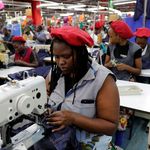
That has put about 70,000 jobs at tax-friendly EPZs — particularly in Athi River and Thika — at risk in the absence of Agoa and no bilateral deal under Trump’s reciprocal tariff policy.

Pankaj Bedi, chief executive of United Aryan Ltd — one of Africa’s largest apparel producers, supplying American brands such as Wrangler and Levi’s — had warned that failure to extend Agoa could force the company to lay off about 10 percent of its 10,000 workers on its payroll.

Apparel firms argue that thin margins in garment manufacturing mean that modest tariff increases can render orders unviable in the expansive American market, the world’s largest economy.

“The uncertainty is not only with buyers, but with lenders, the banks, and all that. Everybody's very nervous," Mr Bedi, who chairs Apparels Manufacturers and Exporters at the Kenya Association of Manufacturers (KAM), told AFP last September.

Data from the Kenya National Bureau of Statistics (KNBS) shows what is at stake. The 40 companies operating under Agoa employed 66,804 people last year, up 15.18 percent from 2023, and injected Sh38.27 Billion in new capital investment. Export earnings under the programme rose 19.2 percent in 2024 to Sh60.57 Billion, driven largely by garments and apparel.

The Ruto administration has struck an optimistic tone before and after the Agoa treaty lapsed, maintaining that Nairobi is actively lobbying Washington and expects a favourable outcome.

Investments, Trade and Industry Cabinet Secretary Lee Kinyanjui said engagement with US authorities has been “reassuring”, urging exporters to remain calm.

But there is growing recognition that the Agoa was never intended to be permanent. The AGOA treaty, initiated under the Bill Clinton administration in 2000 to integrate sub-Saharan Africa into the global economy and wean it off donations, was initially intended to last for 15 years from the year 2000 before being extended for a further 10 years in June 2015.

Maxwell Okello, chief executive of the American Chamber of Commerce in Kenya (AmCham Kenya), argues that the programme’s success lies in preparing countries like Kenya to compete beyond preferential access.

In an opinion piece published in the Business Daily on December 14, Mr Okello wrote that trade preferences were designed to build capacity and competitiveness, not to last indefinitely.

“The purpose of trade preferences was always to build capacity, strengthen competitiveness, and graduate to more sustainable trade models,” Mr Okello wrote. “Kenya has …built world-class manufacturing capacity that can compete anywhere. The question isn't whether we can survive without Agoa. It's whether we're brave enough to thrive beyond it.”

The Agoa pact allows the entry of more than 6,000 products, such as food and beverages, wood, plastics, and rubber, to the US market from sub-Saharan Africa. But Kenya has largely tapped the apparel line, alongside small quantities of macadamia nuts.

The Kenya Private Sector Alliance maintains that the extension of Agoa provides an opportunity to grow apparel exports from nearly $600 million (about Sh77.40 billion) to $2 billion (Sh258 Billion), potentially creating 200,000 new jobs through backward integration in textiles, yarn, and cotton.

AmCham Kenya has also flagged the competitive pressures from China, which has granted zero-tariff access for 98 percent of African exports.

With 90 percent of fabric inputs for apparel sourced from Chinese suppliers, the business lobby adds that retaining Agoa’s Third Country Fabric (TCF) provision— which allows manufacturers in eligible sub-Saharan African countries to utilise fabrics sourced from any country — is critical for Kenyan factories to remain competitive in the US market.

PAYE Tax Calculator

Note: The results are not exact but very close to the actual.