Time flies with great content! Renew in to keep enjoying all our premium content.
Prime
Why Africa, US must jointly champion renewal of Agoa
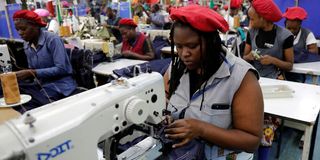
Kenyan workers prepare clothes for export under the US African Growth and Opportunity Act (AGOA) at the United Aryan Export Processing Zone (EPZ) factory in Ruaraka, Nairobi.
With barely days left before the expiry of the African Growth and Opportunity Act (Agoa), there is still no clarity on whether the programme will be extended, even temporarily.
For industries, workers and communities across Africa, this uncertainty is not an abstract policy debate. It is an existential threat.
Over the past week, delegations from Kenya, Madagascar, Lesotho, Tanzania and Mauritius joined forces in Washington, engaging with more than 30 offices across Congress, the Senate, and the United States Trade Representative.
The message was consistent: Agoa is not a giveaway, it is a strategic alliance that strengthens America’s own supply chains and safeguards Africa’s stability.
The conversations were encouraging, but this is not enough. The truth is simple: without champions on both sides, the curtains will close on Agoa, and with it, decades of progress.
The story of Agoa has already been tested, and the lessons are stark. When Ethiopia lost its Agoa eligibility in 2022, the consequences were immediate. According to Ethiopia’s National Bank, more than 11,000 jobs in industrial parks vanished almost overnight.
Madagascar’s experience was just as painful. After its 2009 political crisis, the country was suspended from Agoa. Within a year, more than 26,000 jobs were lost in the formal apparel sector, and exports to the US collapsed by over $200 million.
Before the suspension, the country’s Export Processing Zones employed close to 100,000 workers, many of them women. When the doors to duty-free access closed, the livelihoods of those workers and their families collapsed with them.
Kenya today stands on the edge of this same cliff. Agoa has always been more than tariff relief. It has been the backbone of Africa’s integration into the US economy, creating hundreds of thousands of jobs, particularly for women and youth, while anchoring billions of dollars in supply chain resilience for American brands.
Yet today, Kenyan manufacturers are facing cancelled orders, frozen investments, and a growing risk of layoffs because American buyers cannot commit beyond September.
Apparel being produced today in Athi River, Kitengela, and the Coast is destined for US stores. But without certainty of duty-free access, those orders are shrinking.
What the industry is crying out for is political leadership. Champions in the US Congress who call for Agoa’s renewal, whether temporary or long-term, cannot be lost in the shuffle of Washington’s heavy agenda.
Champions within Africa’s leadership need to rally, not passively wait, to ensure that Africa’s voice is heard at the highest levels. Without champions, Agoa will not just fade; it will collapse.
Agoa was never designed to be permanent, but it was always meant to be transformational. It has delivered that promise in many ways, from job creation to industrial growth, to supply chain resilience. But transformation requires continuity.
The costs of losing Agoa are too high, and history has shown the damage is not easily reversed. This is the moment for courage, leadership, and clarity.
Champions must step forward, because without them, Agoa’s expiration will not just be a policy failure, it will be a betrayal of decades of progress.
If Agoa lapses, US importers will face disrupted supply chains, higher costs, and greater dependence on competitors such as China.
African exporters will lose their competitive edge overnight, and the very purpose of two decades of policy investment will be undone in a matter of weeks.
Communities built around export zones across Kenya and beyond will face job losses that ripple into families, schools, and local economies. Banks and financial institutions, already cautious, will pull back further.
Consumption patterns will weaken, and the slow but steady growth of Africa’s middle class will falter. Investments worth millions of dollars, made in good faith on the promise of stable market access, will sour into bad debts.
Factories that borrowed to expand production floors or install new machinery will default, leaving behind idle infrastructure and financial scars.
This is not just about textiles and apparel. It is about sustaining the US–Africa partnerships at a time when there are shifting global geopolitics and the continent is being courted by multiple global players.
It would tell African nations that decades of partnership can be undone by silence. It would hand over influence and markets to others who are ready to step in with fewer conditions and quicker promises.
History has shown that once Agoa benefits are withdrawn, recovery is painfully slow. Ethiopia has not yet regained its place in U.S. supply chains. Madagascar is still rebuilding years after reinstatement.
If Kenya or other beneficiaries were to lose Agoa now, the human and economic toll would be just as devastating. These are not hypotheticals, but proven consequences.
Time is quickly running out. The US Congress has the opportunity to include Agoa’s renewal, even a temporary two-year extension, into ongoing legislative processes.
This would give African exporters and American buyers the breathing space to continue trading while long-term reforms and governance frameworks are debated.
On Africa’s side, leaders gathering at the United Nations General Assembly must use their platforms to press the urgency of extending goa, ensuring that Africa is not left standing on the sidelines while its future is decided.
Every day of uncertainty tightens the noose further. Buyers in the US are stockpiling goods ahead of September, creating artificial surges in American ports, but leaving African factories with empty order books for the months ahead.
Manufacturers are slowing down or freezing new investments. Employment is under strain, and financial institutions are pulling back. The urgency is real.
The question that must now be asked is simple: who will champion this? Who in the US will take ownership to ensure that AGOA is renewed before the deadline, even if temporarily? Who in Africa will rally their peers, speak with one voice, and make it clear that this issue cannot be ignored?
Without champions, the risk is clear: Agoa will expire, and both Africa and America will lose. With champions, however, this moment can become a turning point: protecting livelihoods today while shaping a stronger, more strategic future tomorrow.
The writer is the Apparels Manufacturers and Exporters (EPZ) Sector Chair and a Board Member of Kenya Association of Manufacturers.
Unlock a world of exclusive content today!Unlock a world of exclusive content today!