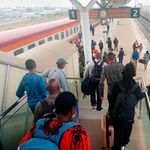
Kenya will need the backing of China to issue a 15-year bond of Sh390 billion for the extension of the standard gauge railway (SGR) from Naivasha to Malaba.
Treasury Cabinet Secretary John Mbadi said Kenya has opened talks with the China Exim Bank to drop a clause in a loan agreement that demands proceeds from the rail development levy be used to pay the debt used to build the Mombasa-Naivasha line.
The waiver will allow Kenya to use the levy, which is part of security for the loans Kenya tapped China Exim Bank for the Nairobi-Mombasa line, as security for a bond that will be issued to support the extension of the SGR to Malaba.
“What we intend to do is use the railway development levy to raise funds and have an engagement with Exim Bank on this because there is a provision in the agreement that ties the railway development levy to this loan,” Mr Mbadi said.
“We have not engaged with China to fund the railway from Naivasha.”
The government is mulling issuing a securitised bond where investors will be paid using the Sh39 billion collected annually from the levy, a 1.5 percent tax applied to all imported goods, to fund the extension of SGR from Naivasha to Malaba.
Under the SGR extension, the State could issue two bonds to raise $3 billion (Sh387 billion) for the extension of the railway, making it Kenya’s largest bond.
China has lent billions of dollars to countries in Asia, Africa and Latin America over the past two decades, much of it for large infrastructure projects linked to its Belt and Road Initiative.
But it has recently slowed down on lending to emerging countries like Kenya, triggering the need for Nairobi to consider the mega bond or a loan from development banks to extend the SGR line.
Kenya borrowed Sh655 billion ($5.08 billion) from the China Export-Import Bank in the fiscal year ended June 2015 for the construction of SGR from Mombasa to Nairobi and later to Naivasha.
Last year, the Treasury successfully renegotiated the terms of the loan, turning the three-dollar-denominated facilities into yuan loans and extending the maturity on the longest tranche to 2040 from 2035 previously.
The Treasury has shared limited details on the restructuring, citing a government-to-government negotiation that requires confidentiality, whose violations risk straining relations between Kenya and its largest trading partner.
Kenya had flirted with securing funding from the United Arab Emirates (UAE) for completing a regional railway after China initially showed a lack of commitment.
It later revived a push for Chinese funding during President William Ruto’s visit to China in April last year.
The bias to use a bond for the SGR expansion signals China’s reluctance to fund the project amid Beijing’s reduced infrastructure support.
“We have a good stream from the railway development levy, which is ring-fenced to build the railway. But if you look at it from a cashflow perspective, it’s not enough to build the railway in two or three years,” Roads and Transport Cabinet Secretary Davies Chirchir said earlier.
“We will basically look at financial markets and the available instruments… leveraging, of course, on the [RDLF] revenues. A railway should attract long-term borrowing, and we’re looking at a 15-year facility; the 2.0 percent RDLF charge is sufficient to support us,” he added.
Under securitisation, projected future revenue streams are packaged into marketable securities that are sold to investors.
In the latest development, the government has securitised the Sh22.7 billion per annum collections through the Sports, Arts and Social Development Fund in floating the 15-year Linzi Asset-Backed Bond, whose proceeds of Sh44.8 billion are building the Talanta Sports City Stadium.
The government has touted securitisation as a viable route in helping it tame rising external debt pressures in the economy.
The Kenya Roads Board (KRB) is seeking to allocate Sh12 of the Sh25 per litre Road Maintenance Levy Fund (RMLF) to compensate investors who will buy the two multi-billion shilling bonds.
Kenya increased the fuel levy from Sh18 to Sh25 per litre of fuel in July 2024, with the extra Sh7 generated from a litre of diesel and petrol being used to pay investors for the Sh175 billion bond, which will cater for the pending bills.
With Kenya's debt ceiling tightening, the government has now turned to the private sector to fill the financing gap, particularly for the SGR extension to Malaba, on the border with Uganda.
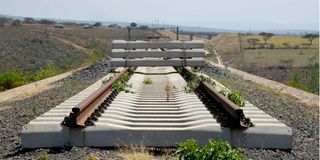
The railway connecting the port of Mombasa with landlocked neighbours, as part of China's Belt and Road Initiative, ended in Naivasha in 2019, 468 kilometres short of the border with Uganda, after a funding hitch.
The line terminates at Suswa, disrupting plans to efficiently move cargo to landlocked neighbours of Uganda, Rwanda, Burundi, and the Democratic Republic of Congo.
Nairobi and Kampala are keen to break ground on the SGR construction as soon as possible, but are held back by the lack of a ready financier.