Telkom Kenya shed over 160,000 mobile subscribers in the three months ended March 2026, extending a prolonged decline that has seen the operator tumble from the country's third-largest mobile network to fifth place within less than two years.
Fresh data from the Communications Authority of Kenya (CA) shows Telkom's active mobile subscriber base fell to 584,438 as of March from 744,902 recorded last December.
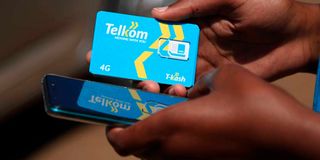
The decline represents a loss of 160,464 subscribers during the quarter, equivalent to more than one in every five customers on its network.
The latest contraction comes at a time when Kenya's overall mobile market recorded its strongest quarterly growth on record, highlighting Telkom's struggle to retain users even as rivals aggressively expanded their customer bases.
During the review period, active mobile subscriptions across the industry rose by a record 5.7 million to 84.1 million, driven largely by customer acquisition and win-back campaigns run by operators.
While competitors gained subscribers, Telkom continued losing ground, further widening the gap between itself and larger rivals Safaricom and Airtel Kenya.
The latest figures also cement Telkom's position as Kenya's fifth-largest mobile operator after being overtaken by both Equitel and Jamii Telecommunications Limited (JTL) in recent months.
Equitel first displaced Telkom from third position in the quarter ended September 2024, marking the first time the operator had fallen out of the top three since liberalisation of Kenya's telecommunications market.
The decline deepened further in the quarter ended December 2025 when JTL, which operates the Faiba mobile network, overtook Telkom to push it into fifth place.
As of March this year, Equitel's subscriber base stood at 1.5 million while JTL had 883,944 active mobile subscriptions, both substantially ahead of Telkom.
The latest losses extend a trend that has persisted for several years as the operator struggles to compete against larger rivals with deeper financial resources and broader network coverage.
Telkom's mobile subscriber base has been shrinking steadily despite repeated restructuring efforts, ownership changes and investments aimed at reviving the business.
Industry analysts have previously linked Telkom's subscriber losses to network coverage challenges, lower brand visibility and changing consumer preferences as customers gravitate toward operators offering wider service ecosystems.
The growing importance of mobile money and digital financial services has further strengthened the competitive position of larger operators.
Unlike Safaricom's M-Pesa platform and Airtel Money, Telkom has struggled to establish a similarly strong digital ecosystem capable of driving customer retention.
The operator's difficulties have also coincided with major shifts in Kenya's telecommunications landscape, where competition has increasingly moved beyond traditional voice services toward data and digital platforms.
As smartphone adoption rises, consumers are placing greater emphasis on network quality, internet speeds, and value-added digital services when choosing mobile providers. This has intensified pressure on smaller operators whose ability to sustain infrastructure investments often lags behind larger competitors.