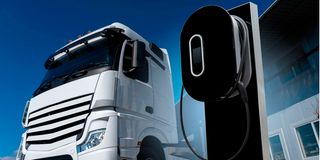
Electrified heavy lorries have been the missing link in Kenya's fast-growing e-mobility sector, overshadowed by a rapid rise of motorcycles, passenger cars and, more recently, buses.
High purchase costs, limited charging infrastructure and concerns over range have kept freight operators largely tied to diesel, even as fuel price volatility continues to squeeze transport businesses.
But in the last year, a growing number of global commercial vehicle makers have entered the Kenyan market with electric trucks, signaling rising confidence in the economics of e-freight transport.
Foton is among companies leading that push. Through its local distributor Mobimotors, the Chinese car maker has been rolling out light electric trucks targeting urban logistics operators.
Foton's Truck Mate carries a 1.5-tonne payload, has a 38kWh battery, a three-metre cargo body and a driving range of up to 220 kilometres on a single charge. The truck charges to 100 percent in 1.5 hours and costs Sh4.3 million.
The Chinese firm has also introduced heavy-duty electric trucks targeting the construction, mining, agriculture and retail distribution sectors.
The model is capable of hauling 4.5 tonnes, offers a driving range of up to 275 kilometres, charges in 1.5 hours and costs Sh11 million. Foton assembles the trucks locally while importing some models fully built from China, depending on demand.
However, Foton told the Business Daily the trucks are sold without portable charging equipment, unlike electric passenger cars and motorcycles. Instead, they use the CCS2 fast-charging standard, meaning buyers must separately invest in charging stations.
Another Chinese firm, JAC Motors, has also been selling an electric truck capable of carrying four tonnes with a range of 250 kilometres on a full charge, retailing at Sh11 million.
Similarly, Indian car firm Tata Motors entered the electric commercial vehicle market last month with a new line-up of battery-powered trucks that it plans to assemble in Kenya.
The company unveiled four electric models comprising tippers, pick-ups and mini-trucks targeting logistics, construction and mining operators.
Tata, which assembles vehicles locally through Associated Vehicle Assemblers (AVA), said it will test the electric trucks in Kenya this year ahead of a wider market rollout and eventual local assembly.
The line-up includes a 250kW light electric truck designed for urban logistics with a range of up to 180 kilometres and a larger 450kW electric tipper for mining and construction with a range of 220 kilometres.
It also includes a 29kW mini-truck for last-mile deliveries offering 155 kilometres of range, and a 72kW electric pick-up capable of traveling up to 211 kilometres on a full charge. Tata has not yet disclosed pricing.
Meanwhile, Isuzu East Africa, the local unit of Japanese manufacturer Isuzu, has also expressed interest in the market after announcing last year that it would begin testing electric trucks locally to assemble them from this year.
These manufacturers are faced with a huge price hurdle that electric vehicle players need to overcome to crack the Kenyan market.
Like other EVs, battery-powered trucks are significantly more expensive than their internal combustion (ICE) equivalents.
For instance, a diesel light truck with the same 1.5-tonne payload as Foton's Truck Mate costs about Sh3.6 million from dealers such as Isuzu, while a medium-duty ICE truck with a cargo payload of up to eight tonnes costs about Sh6 million.
Industry experts say financing will ultimately determine whether electric trucks gain meaningful traction.
While motorcycles and passenger cars benefited from aggressive regulatory lobbying to incentivise uptake, leasing models and asset financing that helped lower the cost of ownership, electric trucks are entering the market without similar financial support structures.
Because freight operators face much larger capital requirements, e-mobility researcher and consultant Edna Manyasa says it makes the business case harder to justify.
She says trucking is also the most demanding segment of the electric vehicle market because vehicle uptime – the length of time a vehicle is available for use – highly affects profitability.
“With logistics businesses operating on tight delivery schedules, concerns around driving range and charging times carry greater weight than they do for passenger vehicles,” says Ms Manyasa.
To ease the burden, some players such as Foton have partnered with lenders, including NCBA, to offer financing packages and attract buyers.
Local assembly is another solution, like what Tata is pursuing. Electric vehicle assemblers in Kenya are exempt from the 35 percent import duty charged on fully built vehicles and benefit from lower import declaration fees and Railway Development Levy rates on completely knocked down (CKD) parts.
They also enjoy a reduced excise duty of 10 percent and zero-rated value-added tax (VAT) on EVs. Together, these incentives can shave millions of shillings off the trucks’ final retail price.
At the same time, public charging infrastructure is another challenge. As of June 2025, the Electric Mobility Alliance of Kenya estimated that Kenya had 300 EV charging points, most of which were two-wheeler battery swapping stations.
Ninety percent of them were in Nairobi alone, making them inefficient for logistics out of the capital city.
Electric trucks require high-capacity charging systems, compared to smaller electric vehicles that can often be charged using portable devices at home or business premises.
Analysts estimate that establishing a public charging station costs between Sh4 million and Sh5 million, rising to nearly Sh7 million where developers must install their own electricity transformer because of the higher power requirements.
The Kenya National Highways Authority (KeNHA) and Kenya Power are working on setting up roadside charging stations nationwide, including facilities capable of serving trucks.
"The public sector would need to play a role (in setting up public charging stations), but I also think there's a strong role for the private sector in that space," Tata Africa chief executive Jacques Taylor told the Business Daily last month. "The private sector might move faster."
Ms Manyasa sees charging infrastructure itself as a significant investment opportunity, similar to how Tesla built the largest fast-charging network for electric vehicles in the United States.
"It is more efficient when the government provides part of the infrastructure, such as electricity transformers, or creates a regulatory environment that would attract,” she says.
“It could be the EV firms or other players seeking to tap just the charging infrastructure market.”
Currently, electric trucks are among the least adopted vehicle categories in Kenya. Passenger buses produced by local manufacturers BasiGo and Roam remain the only heavy-duty electric vehicles operating at meaningful scale.
National Transport and Safety Authority (NTSA) data shows that Kenya had 35,661 registered electric vehicles in January, comprising 33,374 motorcycles, 1,065 three-wheelers, 591 station wagons, 98 buses, 54 minibuses and matatus, 67 saloon cars, 13 vans, four lorries and two prime movers.
Manufacturers believe the economics will increasingly favour electrification, as the commercial transport sector continues to grapple with volatile fuel prices driven by geopolitical tensions in the Middle East and currency fluctuations.
Many fleet operators consider electric trucks as protection against future fuel price shocks despite their higher upfront costs.
Global trends also point to accelerating adoption. The Paris-based International Energy Agency (IEA) estimates that global sales of electric heavy freight trucks nearly tripled from about 84,000 units in 2024 to a record 230,000 in 2025, largely driven by the Chinese market. Sales of electric medium freight trucks rose 65 percent to 210,000 units over the same period.
With more global manufacturers now eyeing Kenya’s market, analysts say their success hinges on creating the financing and charging ecosystem needed to support them.
"Chances are businesspeople will not buy it because they are cutting down on emissions,” says Ms Manyasa. “For them, it's about money." The shift towards electrification of heavy trucks and lorries is gaining momentum.
Reuters reports that China rolled out a push to electrify heavy trucks, a policy that is likely to accelerate a shift away from diesel that is cutting into fuel demand even as it creates new opportunities for domestic truck and electric vehicle battery manufacturers.
By 2030, EVs will make up 40 percent of new heavy truck sales in China and 20percent of the total fleet, or 1.6 million vehicles, Reuters reported, citing a notice on the Ministry of Transport website . On some short-haul routes around Beijing, the target is 80 percent.