How long do electric motorcycle batteries last, can they be reused?

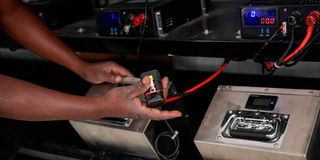
Technician Phildas Ongenga shows the charging system for electric motorcycle batteries, during the launch of Africa's first electric service station for the electric motorcycles, the Roam hub, on May 26, 2023 in Nairobi.

Photo credit: File | AFP

As electric motorcycles in Kenya gain traction, attention is shifting to what happens when the batteries powering them, also the most expensive component of the bikes, begin to lose capacity.

Most electric vehicles (EVs), like mobile phones and laptops, utilise lithium-ion batteries. Industry experts estimate that these batteries typically last between three and 10 years, depending on usage, charging habits, and environmental conditions.
Battery performance, often referred to as state of health declines over time due to repeated charging and discharging cycles.

Factors such as heavy loads, hilly terrain, extreme temperatures, and aggressive riding can accelerate wear, while practices like deep discharging (leaving the battery to drain to zero percent) or prolonged storage at low charge further degrade battery life.

Now, some of the electric motorcycle companies that have set up shop in Kenya over the last four years, primarily serving the motorcycle taxi sector, are introducing recycling, repurposing, and buy-back programmes to address the looming issue of battery degradation.

EV firm Spiro, which operates a battery-as-a-service model where the rider does not own the battery pack, says it uses an embedded Internet of Things (IoT) system to monitor performance in real time. Once a battery’s efficiency drops below optimal levels, it is removed from circulation.

“We do not see it as the complete end of life. We say it like first life, second life, and then third life,” Jitender Jangra, the company’s EV Energy Business Head for Africa, tells the Business Daily.

Batteries are typically taken off the road after about three-and-a-half to four years of heavy use, he said, although some can last up to five years depending on usage patterns. Spiro is repurposing them for energy storage systems (ESS), particularly in markets with unstable electricity supply, such as Nigeria.

“In Togo and Benin, the first batch of batteries has already begun degenerating in capacity, and we have taken them off the market. We are now using them in Nigeria for our energy storage needs,” Mr Jangra said.

Spiro is Africa’s largest e-motorbike company. It began operations in 2022 in Benin and Togo, before expanding into Kenya in 2023, alongside Rwanda, Uganda, and Nigeria. It has close to 20,000 bikes each in Kenya and Rwanda, and more than 21,000 in Uganda.

Mr Jangra said the company plans to scale this model across all its markets, effectively creating a circular system where batteries transition from powering motorcycles to supporting backup power solutions.

Other players that sell motorcycles together with their batteries are pursuing buy-back and replacement schemes.

Roam, which has deployed over 4,000 electric motorcycles in Kenya since 2022, is preparing a programme that will allow riders to return degraded batteries and upgrade to new ones at a discounted cost.

“We estimate the battery can do about 1,200 charging cycles,” said Allan Adala Adala, a spokesperson for the company. “This year, we are preparing a buy-back programme where owners can return batteries whose capacity has gone down, top up an amount, and get a new one.”

The top-up cost will be determined based on the degree of degradation, effectively spreading the replacement cost over time. Returned batteries will then be recycled or repurposed, most likely into home energy storage systems, Mr Adala said.

Electric motorcycles are gaining ground in Kenya, driven by lower running costs compared to petrol-powered bikes and growing policy support for clean transport.

E-motorcycles accounted for 31,869 of the 43,324 registered EVs in the country by the end of 2025, according to data from the Africa E-Mobility Alliance. Most are taxis, commonly referred to as boda bodas, reflecting the sector’s central role in the country’s transition to cleaner transport.

But experts have pointed out that lithium-ion batteries pose a significant environmental pollution challenge as they reach the end of their life. When improperly disposed of in landfills, they release toxic substances, including cobalt, nickel, and manganese, which contaminate soil and groundwater.

Battery replacement also remains a key cost concern for riders. By pushing for better charging practices and creating secondary uses for ageing units, companies are seeking to lower ownership costs while addressing environmental risks linked to disposal.

Follow our WhatsApp channelfor the latest business and markets updates.

PAYE Tax Calculator

Note: The results are not exact but very close to the actual.