Inside Nairobi’s specialty coffee boom where cups cost up to Sh2,000

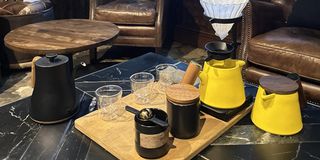
A speciality coffee brewing setup for hand drip extraction, featuring a conical dripper for precise control of the brewing process.

Photo credit: Sinda Matiko | Nation Media Group

Across most coffee shops in Nairobi, a cup of espresso usually costs between Sh300 and Sh600. But at a few speciality establishments, the experience is in a different league altogether.

At Cafe Amka in the city's CBD, for instance, you could be looking at Sh2,200 for a small jar containing two cups. A high-end V60 pour-over costs around Sh550, while premium brews made with carefully selected whole or freshly ground beans range from Sh900 to Sh2,200.
According to Café Amka co-founder Wangui Ndegwa, these prices reflect the rise of Kenya’s speciality coffee culture, which is slowly emerging.

“Unfortunately, most Kenyans don’t drink their best coffee, despite our country being one of the world’s top coffee producers,” she tells us.

She adds: “Most of our finest beans are exported, packaged differently, and then sold at prices that many people cannot afford. As a result, many of us end up consuming low-quality coffee products like the sachets sold for Sh10 in shops and supermarkets.”

From the data she has gathered, only about 11 percent of Kenyans consume premium coffee, with just three percent of that group being urban, working class individuals.

Since opening Café Amka in 2022, Wangui says she has noticed a glaring gap in Kenya’s coffee scene and has decided to try to create the kind of coffee culture she experienced abroad.

"When I came back to Kenya from Asia in 2018, there were lots of coffee shops, but I struggled to find really good coffee. We don't have a coffee culture in the true sense. We drink coffee for the caffeine kick. But coffee should be experienced in the same way as wine or whisky,” she says.

Wangui Ndegwa, Co-founder and Creative Director of Café Amka, poses with a cup of specialty coffee at Café Amka Coffee House.

Photo credit: Pool

She explains that the best coffees aren't bitter; they're layered and should be drunk at a temperature between 60 and 65 degrees celsius.

Depending on the roast, your nose should be able to pick up notes of dark chocolate, bright florals or juicy fruit from a well-made cup. She says that a slightly roasted bean brings out the best and most flavours.

"A good cup of coffee doesn't need sugar because that alters the flavours of the drink. It should be flavourful, not bitter. Depending on how the beans are roasted, you should easily be able to identify the different flavours.”

Wangui's knowledge deepened during her academic research. For her thesis, she spent several months in Ethiopia studying processing methods and immersing herself in a culture where coffee is not just a habit, but a ritual.

"In Ethiopia, coffee is more than just a drink. It’s a lifestyle. They consume nearly 50 percent of their own coffee,” she says.

She later moved to China, where she founded an African coffee-themed café, before eventually returning home to Kenya. There, a few friends who had witnessed her passion for years finally encouraged her to open her own establishment.

Serious investment

Building Café Amka required serious investment. Among the equipment she purchased was the Sanremo Café Racer, a high-performance commercial espresso machine costing around Sh1.2 million.

She describes her coffees as “farm to table” and personally visits farms to select the beans, curating what goes into each cup. She uses techniques such as carbonic maceration and anaerobic fermentation to coax more complexity and depth from the bean than conventional processing ever could.

“It’s this experience that keeps people coming back. Even though we serve other cuisines, we’ve become known for our coffee more than anything else.”

“A good cup of coffee doesn’t need sugar,” she says, recalling how she often stops customers from reaching for the sugar sachets on instinct. "If you don’t understand the process behind the coffee, you miss the whole journey."

Although the trend seems to be growing, aided by more coffee shops setting up and focusing on offering speciality coffee experiences, Wangui admits that Kenya’s coffee journey is only just beginning.

"When we started, speciality coffee houses were almost non-existent. Even the reputable ones offered commercial coffee. Now, more are appearing, and I have seen a few set up, which means that Kenyans are beginning to realise that they can actually have better coffee. We are seeing more curiosity now. People are starting to ask questions about the beans, the farms, and the flavours. However, we still have a very long way to go. Change starts with one customer at a time.

Wangui maintains that speciality coffee is not just about expensive beans. It's about identity, traceability, and craftsmanship, which can only be achieved if more coffee houses in Kenya start serving competition-grade coffees recognised globally.

"Speciality coffee has an identity. You can trace it back to the farmer, the farm, and even the processing method. If a farmer called David uses carbonic maceration, for example, that process alone can completely transform the flavour of the coffee.”

She believes that the future of Kenya’s coffee culture can grow further if the market also begins to value farmers.

“Most farmers have never tasted their best coffee. We must care about the farmers because that’s where the flavour of your coffee starts. If farmers are empowered and supported, they will continue to produce quality coffee instead of abandoning coffee farming altogether or cutting down the trees.”

Speciality coffee sits at the top of the hierarchy. At the bottom is commercial coffee, which is essentially mass-produced and inconsistent in terms of its structure and flavour. Above that is premium coffee, which is very good quality, clean and possibly single-origin, but without a deep, traceable story. Then, at the very top, is speciality coffee.

"Speciality coffee is bespoke. As I said, it is traceable. You can identify the farmer, the farm, the processing method, the terroir and even the pH of the soil, and how the coffee was harvested and dried. Every stage of production has a story," she explains.

Speciality coffee is also scored.

"In a standardised global grading system administered by certified Q grader-tasters who have undergone rigorous training, the cup must score above 856 percent. The same cup sent to graders in Brazil, the UK and Nairobi should receive consistent ratings based on body, acidity, flavour and finish.”

Wangui Ndegwa, Co-founder and Creative Director of Café Amka, poses inside Café Amka Coffee House.

Photo credit: Pool

Kenyan coffee, she says, is genuinely rare. "Because of its cup quality and the country's unique highland terroir, it has historically been used to enhance blends, imparting depth and brightness to coffees from other regions. Pure, unblended Kenyan speciality coffee on the international market is highly prized. But there's no sense of that here. No pride, no recognition."

Although Wangui believes that the culture is slowly growing, the Agriculture and Food Authority disagrees.

According to the authority, local consumption has risen sharply, with the number of coffee houses increasing from just 14 in 2022 to over 800 today.

Felix Mutwiri, director of the Coffee Directorate at AFA, noted that this trend reflects Kenya’s evolving urban lifestyle, as well as the growing speciality coffee culture that has taken root in Nairobi and other cities and major towns.

According to Mutwiri, local coffee consumption remained stagnant at around three percent of the total crop for years, as most Kenyan coffee was exported.

However, around 2,000 tonnes of the beans are currently consumed locally, signaling a cultural shift in how Kenyans relate to coffee, he says.

“Right now, we have over 800 coffee shops. That shows consumption is increasing,” says Mutwiri.

He added that quality of coffee is deteriorating in many producing countries due to climate-related stresses, adding that Kenya can fill part of the resulting premium market gap thanks to its reputation for high-quality Arabica coffee.

“We want to assure Kenyans and farmers that the government is committed to ensuring there is a market for their coffee,” he said.

Follow ourWhatsApp channel for the latest business and markets updates.

PAYE Tax Calculator

Note: The results are not exact but very close to the actual.