The tea sommelier turning around farmers’ fortunes

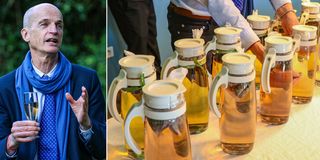
Francois-Xavier Delmas (left), acclaimed tea sommelier and founder of Palais des Thés, at the French Embassy in Nairobi, with prepared tea samples ready for guests during a tasting session, January 30, 2026.

Photo credit: Wilfred Nyangaresi | Nation Media Group

For a country that produces vast quantities of black tea consumed across continents, Kenya has yet to translate that scale into a distinct global identity. Its leaves are blended, traded and shipped in bulk, often losing their origin along the way.

It is this disconnect that has drawn the attention of François-Xavier Delmas, a French tea sommelier who describes himself less as an entrepreneur and more as a “tea seeker.”
Delmas did not begin his career in tea. Trained as a lawyer in France, a country widely associated with vineyards than teapots, he came to tea gradually. What began as curiosity evolved into a lifelong pursuit shaped by travel, tasting and long conversations with farmers.

From pursuit to global brand

Over four decades, that pursuit has taken him across tea-growing regions in Asia, Africa and South America, and led to the founding of Palais des Thés, now one of Europe’s leading specialist tea companies with more than 150 shops worldwide.

Yet despite building a recognisable global brand, Delmas resists being defined by the achievement.

“I am not in tea just to sell tea,” he says. “My passion is to visit the tea farmers, to understand what they do, and to share that with people.”

It is a philosophy rooted in the idea that tea, like wine, is shaped as much by place as by process. Growing up in a wine culture gave Delmas an early appreciation for terroir (natural environment in which a particular wine is produced, determing its flavour and character). In tea, he found a similar complexity.

“There are a lot of similarities between wine and tea,” he explains. “Half is done by nature, but half is done also by what you do to the leaves after that.”

Francois-Xavier Delmas, renowned tea sommelier and founder of Palais des Thés, preparing tea for guests during a tasting session at the French Embassy in Nairobi on January 30, 2026.

Photo credit: Wilfred Nyangaresi | Nation Media Group

This way of thinking has shaped how he approaches sourcing. Rather than buying bulk tea for blending, Delmas has built his reputation on identifying distinctive teas tied to specific regions and producers. In doing so, he has also observed how consumer preferences can evolve when given the opportunity to engage more deeply with what they are drinking.

In France for instance, he notes, tea culture has shifted significantly over the past two decades. Consumers have moved away from tea bags and toward whole-leaf teas, learning to appreciate flavour without the addition of milk or sugar. This transition, he says, emerged through gradual exposure, education and the growing availability of higher-quality teas.

“What is very interesting with Kenya is that many people globally still don’t associate it with the tea they consume, even though it is the largest exporter of black tea in the world,” he says.

Building recognition

The question, Dalmas says, is how to build recognition around that.

The answer, he believes, does not lie in increasing production, but in rethinking how Kenyan tea is positioned. He speaks of geographical indications, traceability and the need to highlight teas that carry the signature of specific landscapes.

In his view, moving even a small portion of production away from anonymous bulk exports toward identifiable, higher-value teas could begin to shift perceptions over time.

This is where his engagement with Kenyan farmers becomes central.

Across his travels, Delmas has seen how producers in different countries have experimented with moving beyond industrial methods toward more artisanal approaches. In tea, he notes, this often means shifting from machine-processed leaves to handmade, orthodox whole-leaf teas.

He encourages farmers willing to explore niche, higher-value segments of the global market to move away from industrial production and toward handmade, orthodox whole-leaf teas that command higher prices and create pride in craftsmanship.

This approach, he stresses, allows producers to earn better incomes while offering consumers teas that feel personal and traceable to specific landscapes.

Francois-Xavier Delmas (left), acclaimed tea sommelier and founder of Palais des Thés, at the French Embassy in Nairobi, with prepared tea samples ready for guests during a tasting session, January 30, 2026.

Photo credit: Wilfred Nyangaresi | Nation Media Group

“I encourage farmers because these teas can have more value, and they can also create more pride in what they produce.”

He sees this as a long-term model built on trust and quality rather than volume, speed or imitation.

Tastings and storytelling

Beyond Kenya, Delmas continues to divide his time between travel and education. While a management team oversees the day-to-day operations of Palais des Thés in Paris, he focuses on sourcing and on deepening relationships with producers, work that he describes as the most meaningful part of his career.

Back in France, his role shifts to helping consumers understand why origin and method matter. Tastings, conversations and storytelling become tools for bridging the gap between distant farms and everyday habits.

At the heart of this work is a simple idea: that tea is not just a beverage, but a form of hospitality.

“In a very fast world, tea invites you to slow down,” Delmas says. “It is something very simple, but very important.”

He often compares it to a quiet practice, akin to yoga, where repetition and attention bring a sense of balance. It is a perspective that sits in contrast to the speed and scale that define much of the global tea trade.

Yet even as he speaks of slowing down, Delmas is acutely aware of the demands of growth. Expanding into new markets remains one of his biggest challenges, requiring careful selection and significant investment. His recent focus has been on countries such as Italy, Switzerland and Spain, where tea culture is still developing.

Follow ourWhatsApp channel for the latest business and markets updates.

PAYE Tax Calculator

Note: The results are not exact but very close to the actual.