Time flies with great content! Renew in to keep enjoying all our premium content.
Prime
Inside the venture betting millions on Kenya’s potatoes
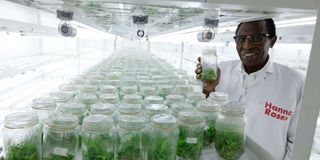
National Potato Council of Kenya (NPCK) Chairperson Kimani Rugendo displays Shangi variety of potato seedlings at Kevian Kenya Limited in Thika, Kiambu County on September 4, 2026.
Kevian Kenya Limited, the beverage manufacturer many Kenyans know from supermarket shelves, has spent the last decade evolving into a diversified agribusiness that develops potato seed, trains thousands of farmers, and processes produce at scale.
The company is 35 years old and employs more than 1,400 people across the value chain.
About a decade ago, the company realised that the raw materials feeding its beverage lines—mangoes, tomatoes, carrots, pineapples, oranges—were themselves agricultural products with untapped potential. That realisation pulled Kevian beyond drinks into snacking, dried fruits and potato-based products. Today its fruit processing capacity sits at roughly 200 tonnes a day, much of it supplied by farmers because Kevian cannot grow enough on its own land.
Potatoes, though, exposed a problem the fruit business hadn't fully prepared them for: price volatility. When production peaks, prices collapse. When supply tightens, prices spike. For a processor trying to plan production runs and secure consistent volumes, that swing is a nightmare.
"We were aware that the mother of them all is quality seed," Kimani says, pointing to the same lesson Kevian had already learned with fruit trees. Certified potato seed is scarce in Kenya, and its absence is one of the biggest reasons the industry underperforms. Potatoes are the country's second most consumed agricultural product after maize, yet most farmers were recycling their own seed year after year, with little knowledge of crop rotation or modern practices to compensate.
The results showed up in the yields. Average production hovered around 10 tonnes per hectare. Progressive farmers using better seed and methods can now hit 40 to 50 tonnes, and in some cases 60. "We found that access to quality seeds and access to modern farming methods were not in place. We decided to be pioneers in it," Kimani says.
At its facility in Gatanga, Murang'a County, the company propagates planting material through tissue culture, essentially cloning clean plant tissue under lab conditions before moving it through mini-tubers, micro-tubers and greenhouse systems that include hydroponics and aeroponics.
Agronomist Nathan Kyenze explains that tissue culture lets Kevian multiply enormous volumes of planting material from a single tuber. On a normal day, the lab produces around 25,000 in-vitro plantlets. When demand spikes, that figure can rise to 75,000 rooted plantlets before the next stage of multiplication in the screen house.
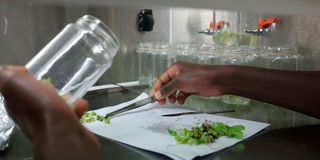
Plant tissue culture being carried out in a laboratory at Kevian Kenya Limited in Thika, Kiambu County on September 4, 2026.
Photo credit: Evans Habil | Nation Media Group
From there, seedlings move to the greenhouse, the bridge between laboratory and commercial field. David Kimuhu Muchiri, Kevian's potato seed manager, says the nursery currently propagates about 10,000 seedlings a week, or roughly 40,000 a month, enough to plant about two acres at nursery stage. Material from those two acres can eventually supply planting stock for about 20 acres four months later. A seedling is ready to leave the nursery once it reaches about 15 centimetres, with a strong stem, healthy leaves and a developed root system. After roughly three weeks of nitrogen, phosphorus and potassium feeding, it heads to the field, where yields currently run between eight and 10 tonnes per acre every four months, depending on variety and growing conditions.
Kevian's own farms, slightly more than 500 acres in the Meru region including its Timau operations, are never planted in full at once. The company works in blocks of about 20 acres, scaling up to around 100 acres at a time while resting the rest or rotating in other crops. It is a deliberate choice to protect soil health and keep disease pressure under control.
Kevian has invested roughly Sh300 million into potato seed production and the infrastructure around it: laboratories, training facilities, field trials across multiple locations. The investment has produced its own potato variety, RAM, approved by the Kenya Plant Health Inspectorate Service and now moving through commercialisation more than five years after approval.
Seed alone does not fix a broken value chain, so Kevian pairs it with extension work. The company partners with more than 3,500 farmer groups, sending agronomists to growers producing potatoes alongside mangoes, carrots, tomatoes and pineapples. It also runs a training facility in Kitengela under the TVET system, teaching both production methods and business skills. The model relies on training a smaller group of "trainers of trainers", who then return to their communities to pass on the knowledge, supplemented by outside specialists from seed companies, fertiliser firms and equipment manufacturers.
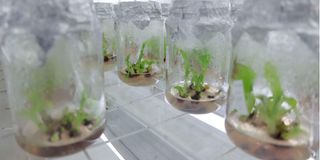
Tissue culture banana seedlings at Kevian Kenya Limited in Thika, Kiambu County on September 4, 2026.
Photo credit: Evans Habil | Nation Media Group
Kyenze insists the core problem hasn't been resolved. Most farmers still recycle their seed instead of using certified stock, and he urges growers to pair clean planting material with soil testing, correct fertiliser use, crop protection and strict adherence to pre-harvest intervals. “Testing soil pH and electrical conductivity tells farmers what their land actually needs before a single seed goes in the ground,” he notes.
Kenya produces between 2 million and 3 million tonnes of potatoes annually, worth more than Sh50 billion at the farm gate, with an estimated 3.5 million people depending on the crop for their livelihoods. Around 3.5 million acres are under potato cultivation, though much of that land is nowhere near its productive ceiling.
The irony, as Kimani sees it, is that Kenya grows enough potatoes to build a real industry around them, yet still imports processed potato products from Egypt, Europe and North Africa because local processors can't secure consistent supply of the right varieties in the right volumes. He points to fast-food chains like KFC as an obvious opportunity to replace imports with local product, if farmers boost productivity and processors build supply chains they can rely on.
"We have been living on maize for too long. It's time we embrace another crop," he says, listing potential uses in starch, snacks, frozen products and animal feed.
Kevian is already chasing some of that value itself, exploring dehydrated fruits, snacks and frozen potato products alongside its beverage business, while keeping its scientific facility focused purely on seed development.
For Kimani, none of it works unless every link in the chain makes money. "If it is not profitable, you will not actually invest in the farmer," he says. His bigger lesson from years in agribusiness is that consistency beats speed. Building a reliable seed system that could deliver first-, second- and third-generation stock took Kevian more than seven years.
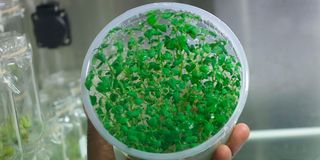
Shangi variety of potato seedlings at Kevian Kenya Limited in Thika, Kiambu County on September 4, 2026.
Photo credit: Evans Habil | Nation Media Group
Mechanisation remains the sector's weak spot, with Kimani estimating it at below 35 per cent nationally, and he argues that Kenya needs simple tools, even basic hand-driven tillers, to make farming attractive to young people and women rather than a grind that eats the whole day for a fraction of the output. Storage is the other missing piece. Without it, farmers dump their harvest fast to avoid losses, flooding the market and crashing prices, unlike cereal growers who can hold stock longer.
In October this year, Kenya is set to host the 13th World Potato Congress in Naivasha, the first time the event has come to sub-Saharan Africa. More than 1,000 delegates from over 60 countries are expected, alongside local farmers, researchers, processors and investors, to discuss everything from seed systems to mechanisation and private investment under the theme "Global Potato Partnership for Enhanced Food Systems, Nutrition Security and Trade".
For Kimani, who chairs the National Potato Council of Kenya, it's a chance to put Kenyan producers in front of the world and pull in the technology, partnerships and markets the industry still lacks.