Time flies with great content! Renew in to keep enjoying all our premium content.
Women farmers’ key role in sustainable farming
When drought arrives or a season fails, adapting means buying better seed, investing in water harvesting, or accessing insurance before the loss becomes unrecoverable.
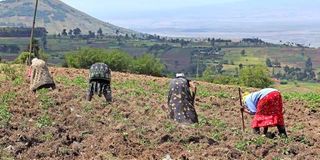
If you walk through almost any market in Kenya on a weekday morning, you will see who is feeding this country. Women arranging dry beans and maize before sunrise, loading sukuma wiki onto handcarts, and haggling over tomato prices with traders. They are not a footnote to Kenya's agricultural economy.
They are, for the most part, the agricultural economy. And they have systematically been underserved by the very systems meant to support them.
Kenya is a signatory to the Comprehensive Africa Agriculture Development Programme, known as CAADP, which is the African Union's framework for agricultural investment and growth. Under the programme, Kenya has committed to achieving six percent annual agricultural growth.
World Bank data shows the sector has averaged three to four percent in most years, reaching six percent only when the rains arrive on time.
That gap is not simply a matter of weather or funding. It points to something more specific: a significant share of Kenya's farming capacity is not producing at the optimal level due to myriad reasons.
The 2022 Kenya Demographic and Health Survey found that 75 percent of women in Kenya own no agricultural land, whether solely or jointly, and only three percent hold an individual title deed. In 2014 the equivalent figure was 61 percent. By 2022 it had risen to 75 percent. That is not progress.
The National Land Commission made women's land rights a centerpiece of its 2024 strategic direction, a signal that the issue has institutional attention at the highest level.
In most instances, land is the collateral that determines whether a bank will talk to you or not. Without it, a farmer makes decisions shaped more by what she cannot afford to lose than by what she might be able to produce, and that difference shows up in her yields, in how much seed she buys, and in whether she plants for the market or just to get through to the next harvest.
Agriculture is not a small part of Kenya's economy. It contributes 21.3 percent of GDP directly, closer to 30 percent when you count the industries that depend on it, and it employs roughly 32 percent of the workforce according to the World Bank and KNBS, 2023.
And yet Kenya spent close to Sh80.2 billion importing food in the first quarter of 2023 alone, nearly matching what it earned from food exports in the same period (KNBS).
The FAO's State of Food and Agriculture 2010–11 put a number to what that something is: if women farmers had equal access to productive resources, yields on their farms could rise by 20 to 30 percent, with total agricultural output across developing countries lifting by 2.5 to four percent.
The question is why that potential has not translated into output, and the answer is not simply a lack of investment. The government committed roughly Sh54.3 billion to the National Fertiliser Subsidy Programme in 2022–23 alone, specifically to get affordable inputs to smallholders.
A 2024 Tegemeo Institute evaluation found that 46 percent of eligible households registered for the programme, but only 19 to 21 percent actually received the input, well below the government's own 40 percent coverage target.
The gap between signing up and collecting was widest among farmers on small untitled plots. This is not an argument against the programme. It is an argument for designing its next phase with that gap in view. The intent was right; the resources were committed; what remains is ensuring that target farmers are reached.
Across credit, extension services and climate adaptation, the farmers least likely to be reached in Kenya are small scale farmers, and women specifically. When drought arrives or a season fails, adapting means buying better seed, investing in water harvesting, or accessing insurance before the loss becomes unrecoverable.
In Kenya, Agricultural Sector Transformation and Growth Strategy sets out clear goals.
The work being done by development organisations, State agencies and farmer groups across is real and it is building something worth building on.
The next step is making sure that momentum reaches farmers who have so far been hardest to reach, not through a separate programme for women, but by treating equitable reach as a design requirement in every investment that touches smallholder agriculture, whether that is a credit facility, a land documentation drive, or an extension service measuring yield change rather than workshop attendance.
The writer is the Regional Communications Coordinator, Heifer International - Africa