Time flies with great content! Renew in to keep enjoying all our premium content.
Beijing summit and future of global diplomacy
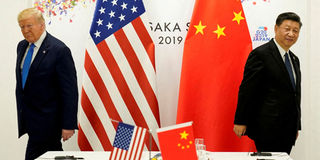
US President Donald Trump (left) attends a bilateral meeting with China's President Xi Jinping during the G20 leaders summit in Osaka, Japan on June 29, 2019.
US President Donald Trump is set to travel to Beijing for a high-stakes meeting with China’s President Xi Jinping on May 14–15, 2026.
The summit, which is officially termed as a bilateral diplomatic engagement is also viewed as something closer to an emergency maintenance check on the global system itself. Not because either side expects a historic breakthrough, but because the modern world has become so economically intertwined.
On May 7, 2026, Chinese Foreign Minister Wang Yi met a bipartisan delegation of US senators led by Steve Daines in Beijing. The first such congressional visit since President Trump returned to office. Wang spoke optimistically about stabilising relations and implementing understandings reached by both leaders.
Diplomatically, this matters. Not because anyone suddenly believes the world’s two largest powers have discovered political soulmates in each other, but because both sides are increasingly aware that permanent instability is expensive.
Even superpowers eventually look at the bill and start asking who ordered all this tension in the first place. In the current geopolitical landscape, optimism has become so rare that when two superpowers merely agree to keep talking, we hold our breathe in anticipation.
Yet beneath the ceremony lies a deeper reality. In this week’s publication of The Economist, in its cover story, the argument is that this summit may expose less a strategic partnership than a “dysfunctional duo”-two powers bound together by economic necessity while simultaneously pulling apart politically.
Meanwhile, The Times has already described the upcoming visit as potentially little more than political theatre: ceremonial handshakes, symbolic soybean deals, flattering communiqués, then everybody boarding separate planes with the assumption that the structural problems stayed behind in the conference room.
This reveals one of the defining features of modern geopolitics.
The world no longer expects permanent solutions from Beijing and Washington. It merely hopes they can manage to meet, compromise and ensure globally we are more prosperous.
The relationship between China and the United States now functions less like a traditional bilateral partnership or rivalry and more like a form of global infrastructure. It quietly underpins trade routes, manufacturing networks, technology standards and capital flows.
For much of the world, particularly across the Global South, the outcome of China-US engagement is not abstract diplomacy. It is fuel prices, debt costs, food inflation, currency stability, infrastructure financing and trade flows. Africa sits at the centre of this transmission system.
The Xi-Trump meeting is therefore not simply about trade disputes, technology restrictions, or geopolitical signaling in isolation. It is a systemic signal event: a moment that reshapes expectations across multiple layers of the global economy.
Three broad outcomes can be expected. If the meeting produces even limited stabilisation, such as clearer communication or a temporary easing of trade tensions, the effects are quickly felt: supply chains become more predictable, commodity markets stabilise, and investment flows into Africa and other developing regions become steadier, manageable. In today’s geopolitical climate, manageability is a rare form of reassurance.
If it produces only partial understanding or symbolic engagement without substantive alignment, the system remains tense but contained. Markets adapt, but uncertainty persists as a baseline condition.
If tensions between China and the US become worse, especially over technology, trade tariffs, or military issues in Asia, the effects spread quickly across the global economy.
Companies begin moving factories and supply chains away from countries or routes seen as politically risky. Investors also become more cautious and avoid putting money into developing economies, including many African countries. This can make it more expensive for these countries to borrow money and can increase inflation, meaning everyday goods become more costly.
One of the fastest ways these tensions affect the world is through oil and energy prices. Historically, when major powers clash politically, oil markets become unstable, especially if there is also conflict in the Middle East. For many African countries that import fuel, higher oil prices immediately raise transport and electricity costs, increase food prices, and put pressure on government budgets.
Also, China’s role in Africa cannot be understood in isolation from its strategic competition with the United States. If China-U.S. relations stabilise, China’s engagement in Africa tends to follow more predictable long-term patterns, particularly in infrastructure, industrial zones, and trade financing.
If tensions escalate, Chinese global capital allocation often becomes more cautious and strategically selective.
U.S. engagement with Africa has become increasingly shaped by its strategic competition with China. Instead of focusing on large infrastructure projects, Washington now focuses on areas such as digital technology, critical minerals, security cooperation, and supply chain protection.
This reflects a more selective and strategic approach, where Africa is often viewed as part of a wider geopolitical contest rather than a priority on its own.
The upcoming President Xi Jinping- President Donald Trump meeting in Beijing is more than a diplomatic photo-op between two powerful leaders shaking hands like relatives trying very hard not to discuss politics at dinner. It is a reflection of a global order increasingly held together by economic interdependence under tension.
For Africa, this is no longer distant geopolitics discussed in conference halls; it is felt in inflation, trade opportunities and the price of everyday life. Yet Africa is also becoming more strategically flexible, engaging multiple powers without fully depending on any single one.
In that sense, the real significance of the Beijing Summit is not simply what Xi and Trump say behind closed doors, but whether the meeting lowers the temperature of the global system enough for everyone else to breathe, trade, invest, and plan without feeling like the world economy is one angry press conference away from another panic attack.
Susan Mukami is a project coordinator, China Media Group Africa