Why soil health is not just about adding more fertiliser or manure

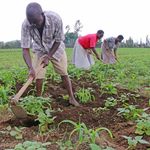
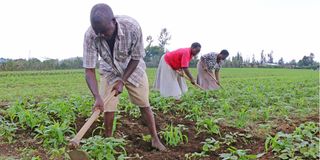
Farmers from Kapkuress in Nakuru County weed their maize and beans crop on April 23, 2024.

Photo credit: File | Nation Media Group

Across rural Africa, conversations on farming often revolve around what needs to be added to the soil. Fertiliser, lime, and manure are inputs seen as the silver bullet to poor yields.

Yet, after seasons of adding more and more, farmers still watch their crops wither. The question we should be asking is not what we can add, but what we are doing to drive life away from the soil in the first place.
Soil is alive. It breathes, breaks down organic matter, stores carbon, retains water, and feeds plants.

A single handful contains millions of organisms, each playing a role in a delicate web. When soil is stripped bare by tillage, compacted by heavy machinery, or saturated with chemicals, that web is destroyed. And no amount of external input can replace the natural resilience of a healthy, living soil.

To restore soil health, we must shift our focus from treating soil like a container to recognising it as a habitat. Just like a home needs shelter, warmth, and cleanliness for people to thrive, soil needs cover, organic matter, and minimal disturbance to sustain life.

Practices such as mulching, cover cropping, crop rotation, and reduced tillage create the right conditions for soil organisms to flourish.

These organisms, in turn, make nutrients available, build structure, and improve water retention.

One of the key responsibilities of government is to ensure food security. This starts not at harvest, but at the level of soil.

Extension services should be retooled to guide farmers toward regenerative practices. Instead of subsidies that promote chemical dependency, resources should be redirected to support soil testing, training on sustainable land use, and access to organic amendments.

The government must also lead by example through public land management and school-based agricultural programmes that teach soil stewardship from a young age. Healthy soil is our silent infrastructure. It holds the key to climate resilience, water security, and sustainable livelihoods. Yet it rarely features in policy priorities, despite being the very foundation of our agricultural economy.

When we protect and nurture soil, we are not just improving yields.

We are investing in ecosystems, in biodiversity, and long-term stability for rural communities. Creating conditions where life wants to stay is not just good for the soil, but it is good for all of us. It is time we stopped asking how to fix the soil and started creating environments where soil can fix itself.

The writer is a climate action enthusiast and a communications specialist at Windward Communications Consultancy.
[email protected]

PAYE Tax Calculator

Note: The results are not exact but very close to the actual.