Malnutrition, what experts call hidden hunger, siphons nearly Sh374 billion from Kenya’s gross domestic product (GDP) each year through lost productivity and healthcare costs. That's more than the nation’s entire 2024/25 roads budget.
The economic stakes are brutal. A new World Bank Investment Framework for Nutrition estimates that every shilling invested in proven nutrition programmes returns Sh23 in future earnings and health-care savings.
Conversely, inaction could cost the State up to Sh5 trillion by 2030.
Studies show that good nutrition is the critical ingredient every one of us needs to survive and to thrive. Without it, the brain cannot develop fully, the body cannot grow properly, the immune system cannot function effectively and individual potential will be stunted.
Kenya has made significant progress in reducing stunting among children under age five, from 26 percent in 2014 to 18 percent in 2022, according to the Kenya Demographic and Health Survey (KDHS, 2022).
However, that still translates to 1.13 million children whose physical and cognitive growth is permanently impaired. In Nakuru, one in four children is stunted, a condition largely driven by chronic deficiencies in zinc and iron, key nutrients essential for growth and immunity.
Zinc deficiency afflicts more than 80 percent of pre-schoolers. Meanwhile, iron-deficiency anaemia afflicts one in five infants by six weeks of age.
Among children under five, stunting still cripples 26 percent, while 36 percent of expectant mothers enter childbirth short on iron, undermining both maternal and neonatal survival.
I’ve seen children dying from malaria, cholera and diarrhea, but perhaps the hardest to watch are those who are nutrient-starved. Their bodies have sores that don’t heal, their hair falls out, and their skin peels. At that point, even nourishing food doesn’t always bring them back.
What is most eerie is that such children don’t cry or protest; they are impassive, with blank faces. This is due to the body's ongoing efforts to maintain the proper functioning of its organs and its refusal to expend energy on protest.
The quiet devastation of malnutrition is not just a failure of food quantity, but of food quality. A Nation investigative report by Angela Oketch on June 24, 2025 exposed how public hospitals serve starch-heavy, micronutrient-poor meals that slow recovery and lengthen hospital stays. The outrage this story triggered is justified.
Addressing this gap calls for solutions that embed nutrition where it matters most: in the very foods we grow.
No single crop constitutes a universal solution, just as no single policy serves as a cure-all. However, Nyota beans show us what is possible when we hard-code nutrition into the seed itself.
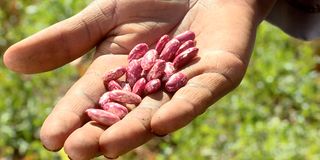
Nyota beans, Kenya’s first iron- and zinc-biofortified variety, contain up to 60 percent more of these essential nutrients than conventional beans, and cook in just 30 minutes. They thrive from the dry Katumani plains to the chilly Rift highlands.
At just Sh298 per kilogramme, they’re an affordable, accessible source of protein, drought-tolerant and naturally replenish the soil with nitrogen.
This one legume illustrates effective nutritional policy: one that is resilient to climate variations, locally acceptable, and rooted in market mechanisms rather than dependency on assistance, providing a model for expanding other biofortified staple foods.
Each school lunch bowl served with Nyota beans meets nearly a quarter of a teenage girl’s daily iron needs, filling a gap most fortification programmes struggle to address in rural communities.
Local leaders are starting to see the potential. In Embu County, Deputy Governor Justus Kinyua announced a Sh 50 million seed budget to support Nyota beans in school feeding programmes. The county also just signed a five-year deal linking 3,500 smallholders to 85 schools for the supply of iron-rich Nyota beans.
Combining scientific research, market development and policy leadership, improve the ability to deliver efficient and effective nutrition programmes across Kenya and the continent.
Nutrition isn’t charity—it’s investment at both the national and county levels. What Kenya needs now is leadership that funds nutrition like the future depends on it. Because it does.
The writer is the lead- programmatic communications at AGRA, and is spearheading food-systems storytelling across the region
Unlock a world of exclusive content today!Unlock a world of exclusive content today!