Why banks must take lead in financing, driving Africa’s green growth

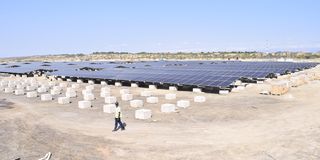
A view of Tata Chemicals’ green energy plant in Magadi, Kajiado County on June 14, 2025.

Photo credit: Stanley Ngotho | Nation Media Group

This week, African leaders and policy makers have converged in Addis Ababa, Ethiopia for the Africa Climate Summit 2.0. This is a gathering that builds on the 2023 forum held in Kenya where among other things, attendees are taking stock on the progress of the proclamations that emanated from the Nairobi Declaration.

At the centre of these discussions will be how to prop up the role of the African Green Industrialisation Initiative (AGII) and the Accelerated Partnership for Renewables in Africa (APRA) now considered as the accelerators of the continent’s industrial transformation, after their endorsement by the African Union early this year.
The initiative brings together financiers across the continent to mobilise resources, de-risk projects, and accelerate investments in renewable energy, sustainable industries, and climate-smart solutions.

At its core, AGII has its premises on multi-sectoral efforts that lean towards designing industries that are competitive in tomorrow’s marketplace.

Basically, prioritising energy-intensive but high-value sectors including green steel, electro-fertilizers, battery and component assembly, agro-processing that can anchor domestic value chains and serve export markets in a climate-conscious world.

However, green industrialisation cannot thrive without reliable, affordable energy. That is where the Accelerated Partnership for Renewables in Africa (APRA) comes in.

With an ambition to double Africa’s renewable energy capacity by 2030, APRA is designed to crowd in investment, lower risks, and unlock large-scale deployment of solar, wind, geothermal, and hydropower projects to position Africa not just as a consumer of clean energy, but as a global leader in renewable supply chains.

Africa’s chance to industrialisation in the 21st century depends less on repeating yesterday’s fossil-fuelled model and more on marrying two things that have long been treated separately.

AGII and APRA are precisely those two halves—complementary, politically backed and, if executed well, transformational. This vision will not be realised by mere talk-shops, it requires massive financial mobilisation estimated at $2 trillion by 2030 for clean energy, infrastructure, and industry.

As a Pan-African banking institution focused on green growth, KCB Group has set the precedent as a critical player in resource mobilisation guided by our ambition to invest 25 percent of the Group loan portfolio in green initiatives by the end of this year.

Additionally, as an accredited entity of the Green Climate Fund (GCF) under category B, this means the Bank can access between $50 million and $250miilion per project.

There are real opportunities at stake. Africa’s young workforce, abundant critical minerals and rapidly growing domestic markets mean that, with green energy and industrial policy working together, the continent can claim its space in the fourth industrial revolution.

However, time is not on our side as global markets are already rewarding low-carbon suppliers and moving investment to regions with secure, cheap green power. Revolutions of such a nature are not won by declarations, they are won by decisive action, bold financing, and relentless execution.

The writer is the KCB Group CEO and Chairman of Kenya Bankers Association (KBA).

PAYE Tax Calculator

Note: The results are not exact but very close to the actual.