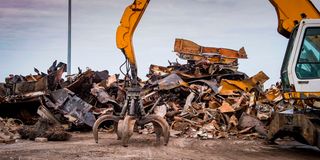
On July 1, the Finance Act, 2026 came into force. On August 21, barely 52 days later, the Scrap Metal Council (SMC), through its chairperson, issued a desperate press release.
The Council noted:" Increase in the number of dealers operating without valid licences... cases of importation and exportation of scrap metal without the requisite permits... increasing cases of illegal exportation and smuggling of lead-acid batteries whose export is currently prohibited."
The council is not complaining about a market glitch. It is documenting the collapse of a regulatory regime. And he is right.
The Finance Act, 2026, by exempting scrap metal from Valued Added Tax (VAT), has not formalised the sector. It has criminalised it. KRA must be told: You cannot use exemption to formalise an informal sector. Exemption does the opposite - it informalises a formal sector.
Two radical amendments were sneaked in under the guise of "expanding the tax base. The first was the VAT Act, Cap 476 - First Schedule, Part I, Section A - Paragraph amended by Finance Act, 2026, Section 31: Scrap metal was inserted as an exempt supply. Effect: 16 percent VAT removed. Supply becomes VAT-exempt.
Secondly, Income Tax Act, Cap 470 - Section 35 and Third Schedule - as amended by Finance Act, 2026, Section 14: Introduction of withholding tax (WHT) at 1.5 percent on the gross amount payable on sale of scrap metal for both residents and non-residents. On paper, this looks like tax relief. In law and economics, it is a disaster.
While defending the changes, the National Treasury argued this would increase revenue but now the opposite is true. The law is now bleeding the exchequer in three ways:1. The Input VAT Trap - VAT Act Sec 17(1) and Sec 17(6):
Section 17(1) of VAT Act is explicit: "input tax... may be deducted... but only to the extent that the supply was acquired to make taxable supplies." Section 17(6) further provides that input tax relating to exempt supplies is not deductible.
Millers now load the expense again onto steel billets, reinforcement bars and wire products. Result: Price has increased by 50 percent and Kenyan steel is now more expensive than Tanzanian or Ugandan steel. KRA lost the 16 percent output VAT and replaced it with a 1.5 percent WHT that it cannot even collect.
The 1.5 percent WHT is uncollectable because 60 percent of collectors have no PIN and thus iTax cannot generate certificate.
The Act assumes every scrap seller has a KRA PIN. The reality is that over 60 percent of collectors are informal - mama karanga collectors, mkokoteni operators, jobless youth. The iTax withholding module cannot generate a certificate without a PIN. So buyers either don't withhold and risk penalties under Tax Procedures Act, 2015, or they withhold and cannot remit.
Revenue is now being lost due to lack of trail. Unlicensed dealers now smuggle scrap and lead-acid batteries (whose export is prohibited under Legal Notice No. 94 of 2022) through porous borders. SMC confirms this. The five percent export WHT + VAT on imported scrap vs 1.5 percent WHT on local exempt scrap creates a loophole for round-tripping. Treasury loses both VAT and customs duty.
The road infrastructure has now come under serious threat courtesy of the legal changes. The government seems to have forgotten why Scrap Metal Act, No. 1 of 2015 was enacted in the first place. It was not a revenue law. It was a security law, enacted after KPLC transformers, Telkom copper, Kenya Railways lines and others were vandalised.
The 2015 Act bars people from dealing in scrap without a licence and a licensee shall not deal in scrap except between 6:30am - 6:30pm. Section 21 of the Act bans disposal, disfiguring or baling of scrap within seven days of acquisition without PS permission. This is meant to allow inspection for stolen property.
VAT was the invisible enforcement mechanism for these sections. To claim VAT, you needed a valid SMC licence, a seller's ID copy, PIN, proof of origin, weighbridge ticket, and you had to keep records for three years.
Exemption has removed that entire audit trail and today, "anybody can sell the commodity to the millers." No invoice needed. No PIN. We have made vandalism more ‘lucrative’.
The legal changes also expose a government that easily forget history. In 2020, former President Uhuru Kenyatta imposed a moratorium on scrap metal dealing after infrastructure vandalism hit crisis levels. The sector was shut for 4 months. Legitimate dealers and steel mills bled billions. It was only reopened after SMC was strengthened and VAT enforcement was tightened.
Sadly, we are now repeating the same mistake, but worse. We are using exemption - a tax tool meant for social goods like medicine and education - to regulate a sensitive security sector.
The National Assembly, National Treasury and KRA should immediately reverse the VAT exemption vide Finance Act, 2026 and return scrap metal to standard rate of 16 percent under VAT Act, or at minimum zero-rate it to allow input VAT recovery under Section 17(1).
The 1.5 percent WHT should be retained but as advance, creditable tax, and enforce at a single point - the miller or exporter - as final purchaser, to avoid cascading. iTax should be linked with SMC Licensing Portal - No WHT certificate or PIN activation for scrap dealing without valid SMC licence.
The Finance Act, 2026 meant well but handed Kenya's critical infrastructure to vandals & economic Bandits on a silver platter. Parliament must act before we need another moratorium. And next time, the moratorium will not save us.
The writers are tax lawyers and Certified Public Accountants (CPAs).