Road to building a fairer future for Kenya’s ride-hailing workers

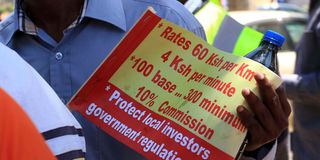
Striking Uber drivers protest over the 25 percent cut by the online taxi hailing app at Uhuru Park on March 2, 2017.

Photo credit: File | Nation Media Group

Ride-hailing platforms have become a daily fixture of urban life in Kenya, transforming both the transport and employment sectors. With just a few taps on a phone, thousands use boda bodas to beat traffic, make deliveries, or commute, expanding mobility for millions.

These platforms offer flexibility and income in a market where formal jobs remain elusive, especially for the youth. Yet behind this convenience and opportunity lies a workforce that remains unprotected, under-supported, and vulnerable to economic shocks.

As part of the Digital Economy Research Impact Initiative, 987 motorcycle drivers working through one of Kenya’s major ride-hailing platforms were surveyed.

We found a full-time, highly active workforce increasingly dependent on platform income, yet lacking the systems for long-term financial security.

The findings presents an opportunity. With coordinated policy action, Kenya can strengthen protections for platform-based workers without undermining flexibility that makes this model attractive.

Based on our findings, we propose three reforms; expanding social protection, improving income transparency, and making asset financing more inclusive.

Expand access to social protection

The average driver in our study worked over 66 hours per week, the equivalent of six or seven days. Most relied on platform income as their primary livelihood.

Yet, only 47 percent were enrolled in the Social Health Insurance Fund (SHIF), and just 45 percent contributed to the National Social Security Fund (NSSF), despite over 95 percent being aware of both schemes.

Drivers want these protections but find them hard to access. Contributions are voluntary and disconnected from how drivers earn. The current systems are not designed to accommodate workers with irregular income.

There is no safety net if a driver falls ill, gets into an accident, or experiences a family emergency. This vulnerability is compounded for those who rent their motorcycles and must make daily payments to keep working. Daily rental fees mean even short disruptions can cause debt spirals and lost income.

This mismatch between how gig work operates and how policy frameworks support workers isn’t unique to Kenya. In India, where we did a comparative study, similar gaps persist despite legislation for gig workers.

Policymakers here must ask: how do we extend social protections to these workers without upending their flexibility? A promising solution is micro-contributions to SHIF and NSSF directly through platform apps.

Drivers could opt in to daily deductions for health insurance or pension savings by selecting from a variety of contribution tiers, with platforms acting as pass-through channels without triggering full employer obligations. This setup would allow drivers to build protection without navigating separate systems.

Make asset financing inclusive

Platform work is only possible if a driver can access the right tools: a motorcycle and a smartphone.

Most drivers cannot afford to purchase these up front. In our survey, 64 percent had rented or financed their bikes, and 40 percent had done the same for phones, typically through costly informal schemes.

Drivers with ongoing financing obligations, whether through rentals or loans, earn less than those who fully own their motorcycles. In our study, renters and loan repayers made only Sh85/hour in net income compared to Sh125/hour for motorcycle owners.

Why? Daily rental and loan repayment fees ate into their take-home pay. These costs also added stress: 72 percent of renting drivers said they’d missed essential expenses at least once due to repayment obligations.

This isn’t just a personal finance issue; it’s a structural one. Most drivers enter the gig economy without savings, credit history, collateral, or with irregular income streams. Without formal employment, they’re considered too risky for traditional banks.

As a result, many turn to informal lenders or high-cost rental schemes.

A promising approach would involve partnerships between government, platforms, and financial institutions to offer safer leasing options or credit guarantees.

Improve pricing transparency

Thirty-three percent of drivers in our study said they didn’t understand how fares were calculated or how discounts worked. For drivers managing tight budgets, often while repaying motorcycle or phone loans, unpredictable pricing systems can make planning impossible.

Platforms set the pricing rules, but drivers bear the brunt of uncertainty. Even as demand fluctuates and costs like fuel rise, drivers have little influence over their earnings and limited visibility into how decisions are made.

Without stable, predictable income, drivers cannot budget or plan ahead.

Addressing this imbalance doesn’t require halting innovation. It calls for greater transparency. Platforms could start by publishing clear fare breakdowns that show base fares, commission rates, per-kilometre and per-minute charges, and how bonuses are applied.

Even simple tools that estimate expected earnings based on hours or routes could help drivers plan more effectively. Platforms should also notify drivers in advance of changes to fares or promotional campaigns.

Additionally, establishing a minimum trip fare could help ensure drivers aren’t operating at a loss during discount periods.

Kenya’s ride-hailing economy is here to stay. The country has an opportunity to lead, not by overregulating the platform economy but by shaping it into something fairer through better protections, clearer earnings systems, and improved access to work tools.

Faith Kemunto is Senior Associate and Dr Martin Atela is Kenya Country Lead, IDinsight

PAYE Tax Calculator

Note: The results are not exact but very close to the actual.